Delta Fitness Authority: What It Actually Is, Why Most People Misunderstand It, and How to Use It
April 24, 2026
0
A few months ago, one of my readers sent me a message that stuck with me. She’d been trying to get consistent with training for about two years,
A few months ago, one of my readers sent me a message that stuck with me. She’d been trying to get consistent with training for about two years, not lazily, either. She’d bought programs, watched YouTube tutorials, tracked her food for three weeks straight. Nothing clicked longer than a month. When she found the term “delta fitness authority,” she said it was the first time she felt like someone was describing her actual problem rather than selling her a solution to a problem she didn’t have.
That told me something. Not about the phrase itself, but about how many people are walking around with a solid work ethic and genuinely no idea why their training keeps falling apart.
So let me be upfront about a few things before we get into this.
“Delta fitness authority” is one of the most misused terms in the current fitness content landscape. Some articles call it a brand. Others treat it as a training philosophy. A few use it as a buzzword to generate traffic without actually explaining anything useful. If you’ve done any searching on this already, you’ve probably noticed that no two articles seem to agree on what it even is. That’s not an accident. It’s what happens when a term gets adopted faster than it gets defined. My job here is to cut through that and give you something you can actually do with this information.
The Real Reason Most Beginner Routines Fall Apart
I want to be direct about something that I think most fitness content dances around.
The problem is rarely effort. In my experience working with beginners, the people who quit weren’t doing it because they were lazy or uncommitted. They quit because their plan gave them nothing to hold onto when motivation dried up, which it always does, usually around week three.
The Flaws of Modern Training Models
Here’s what I mean. Most popular beginner programs are designed around a fixed destination. Lose 20 pounds. Get abs by summer. “Transform in 30 days.” The destination sounds motivating at the start. But destinations are terrible at keeping you moving, because the moment you miss a few workouts or the scale doesn’t move for two weeks, the destination feels unreachable, and suddenly the whole reason for training feels pointless.
What’s missing isn’t motivation. It’s a measurement system.
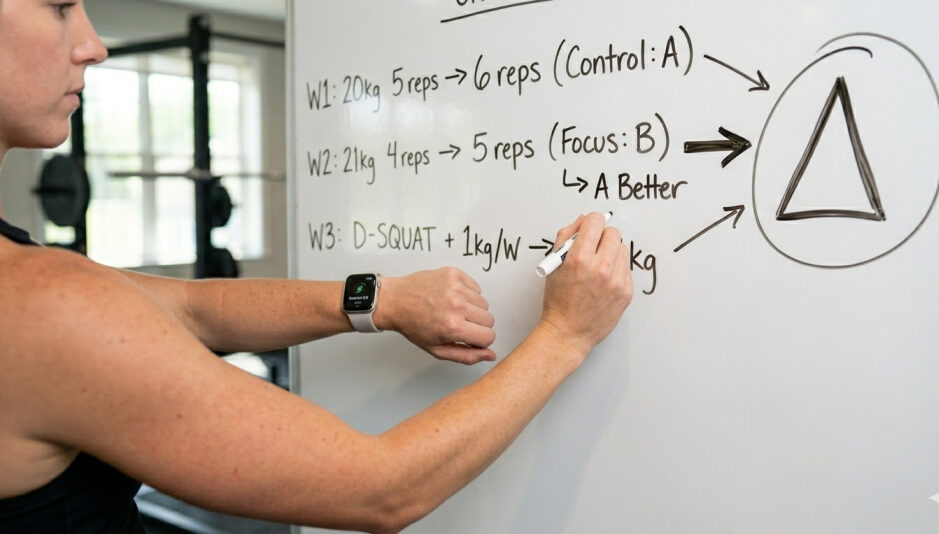
This is the core problem that the delta approach actually solves, and it’s also why I think the concept resonates with people who’ve already failed at the destination-based model. When you shift from “am I at my goal yet?” to “am I different from what I was last week?” the math changes completely. Last week, you did three sets of eight squats at 65 lbs. This week, you hit three sets of nine. That’s a delta. That’s measurable progress. And that’s a reason to keep going, even if you still don’t look the way you want to look yet.
The second structural flaw in most beginner programs is something I’ve come to call the isolation trap. Gym culture, particularly the kind that was mainstream for decades, treated the body as a set of separate parts to be trained in rotation. Chest Monday. Back Tuesday. Shoulders Wednesday. Legs Thursday, which everyone secretly skipped.
That model was built for competitive bodybuilders with very specific aesthetic goals, very specific recovery capabilities (including pharmaceutical assistance most beginners don’t have), and training windows of two or more hours per day. It was not designed for someone trying to get healthier and stronger in four hours a week. Handing that framework to beginners is like giving a learner driver a Formula 1 car and wondering why they keep crashing.
What beginners actually need and what the body actually responds to best in the early stages of training is compound movement. Squatting. Pressing. Pulling. Hinging. Patterns that recruit multiple muscle groups at once, build coordination and strength simultaneously, and give you a lot of physiological return on a modest time investment.
A third problem worth naming is the way most programs treat nutrition as either a punishment (eat less, suffer more) or an afterthought (add a “nutrition section” to the article and call it covered). Nutrition for a beginner doesn’t need to be complicated. But it does need to be consistent. And for most people I’ve worked with, the moment they start treating protein as a non-negotiable rather than a nice-to-have, something shifts. More energy. Better recovery. Less muscle soreness. It’s not magic, it’s just biology. Your muscles are literally built from protein. Making sure you’re eating enough of it isn’t a diet hack; it’s basic maintenance.
What the Delta Fitness Framework Actually Looks Like in Practice
Let me break down how this works as a real training structure, not just a philosophy.
Strength training is the anchor
Three to four sessions per week, built around compound movements. Squats and their variations (goblet squats, front squats, leg press if you’re at a gym). Hip hinges such as Romanian deadlifts, conventional deadlifts, and glute bridges. Horizontal pushing, bench press, dumbbell press, push-ups with proper form. Horizontal pulling, dumbbell rows, cable rows, and inverted rows. These four movement patterns, trained consistently, will develop more functional strength in a beginner than any isolation-focused program you’ll find in a fitness magazine.
Rep ranges between five and twelve work well for most beginners. Lower end (five to seven reps) for heavier compound work where you’re chasing strength. Higher end (eight to twelve) for accessory work where you’re building muscle endurance and metabolic conditioning simultaneously.
Now here’s the delta part: every week, you should be able to point to at least one thing that improved. One extra rep on your last set of squats. Two and a half pounds added to the bar on your bench press. A hip hinge that felt smoother and more controlled than it did seven days ago. If you can’t identify a single delta, that’s important information; something in your recovery, nutrition, or programming needs to be adjusted.
Cardio doesn’t need to be brutal to be effective
Two to three sessions per week, twenty to thirty minutes each. Zone 2 intensity, meaning a pace where you can talk but wouldn’t want to hold a long conversation. Brisk walking, light cycling, and rowing at a moderate pace. This doesn’t look impressive. It doesn’t generate the kind of content that goes viral. But it consistently improves aerobic capacity, supports fat metabolism, and, critically for strength training beginners, it reduces cardiovascular fatigue without taxing the same systems you need for your lifting sessions.
I know twenty minutes of walking doesn’t sound like training. But I’ve watched people dramatically improve their body composition doing nothing more than adding three walks a week alongside a structured strength program. The exercise science here is not controversial.
Recovery is not passive
This might be the thing I push back on hardest with beginners who come to me frustrated that they’re not progressing. They’re training four or five days a week, feeling perpetually sore, sleep is inconsistent, and they can’t figure out why their numbers keep stalling. The answer is almost always the same: you’re not recovering, so your body has nothing to build with.
Muscle tissue isn’t built during your workout. It’s damaged during your workout. The actual growth happens during sleep and rest when your body repairs those microtears with slightly stronger tissue. Consistently getting less than seven hours of sleep doesn’t just make you tired. It measurably impairs muscle protein synthesis, raises cortisol (which competes with testosterone and growth hormone), and slows reaction time in ways that increase injury risk during training. You cannot out-train a chronic sleep deficit.
A deload week every four to six weeks, where you reduce training volume by roughly forty percent, is not optional for anyone training seriously. Your nervous system accumulates fatigue that doesn’t show up in how sore your muscles feel. Deloads allow that systemic fatigue to clear so that when you return to full training, you’re actually able to express the adaptations you’ve built.
Nutrition doesn’t need to be a religion
Well, Nutrition doesn’t need to be a religion, but protein does need to be a priority. Target 0.7 to 1 gram per pound of bodyweight daily. For a 160-pound person, that’s 112 to 160 grams, spread across the day, not crammed into dinner. Beyond that, understand your caloric direction: are you eating below your maintenance (weight loss), at it (maintenance and performance), or above it (muscle gain)? You don’t need to count every calorie. You do need to have a rough sense of which direction you’re heading. Eating randomly and hoping it aligns with your goals is not a nutrition strategy.
Building Your Own System: A Practical Starting Point
Before your first session under this framework, do one thing: establish a baseline.
Spend fifteen minutes writing down where you are right now. How many push-ups can you do with solid form before your hips drop? Can you squat your bodyweight? What does your typical eating day actually look like, not the ideal version, the real one? What’s your resting heart rate first thing in the morning?
This isn’t a fitness test you can pass or fail. It’s a timestamp. It’s the “before” that makes every “after” meaningful. Without it, progress becomes invisible, and invisible progress is the fastest way to convince yourself that nothing is working.
From there, a three-day full-body strength program is the most reliable starting structure for the majority of beginners. Monday, Wednesday, Friday works well for most schedules. Tuesday and Thursday become your light cardio or active recovery days. The weekend is either additional light movement or genuine rest.
Track your workouts. Not obsessively — a simple note on your phone is enough. Exercise, sets, reps, weight. That’s all you need. Review it weekly, look for your deltas, adjust as needed.
Once a month, spend ten minutes asking three honest questions: What got stronger? What stalled? What in my life outside the gym probably affected my training? That last question is where most people find their real answers. A month where you slept badly, worked extra hours, and dealt with personal stress is a month where your training is going to look different — and that’s not a character flaw. It’s just physiology. Knowing that lets you respond with intelligence instead of self-criticism.
The Honest Limitations of This Framework
I don’t think it serves anyone to wrap this up without being straight about what this approach doesn’t do.
It won’t give you a specific program to follow without any thought on your part. If you want someone to hand you a sheet that says “do exactly this on these exact days,” there are better options for that. The delta approach requires you to engage with your own data. It’s more empowering long-term, but it does demand more active participation than passive program-following.
It’s also not a rapid transformation model. Anyone telling you this framework delivers visible body composition changes in two or three weeks is setting you up to quit at week four when reality doesn’t match the promise. Six to eight weeks of consistent training is where most beginners start noticing strength gains that feel significant. Three to five months is when body composition changes become genuinely visible to others. That timeline is not a limitation of the framework. It’s the actual timeline of human physiology. Any approach that claims to shortcut it is either lying or leaving out important context.
And finally, if you have an injury, a chronic health condition, or you’re returning to training after a long period off or after surgery, please work with a physiotherapist or qualified trainer before applying any framework you read about online, including this one. Exercise science is powerful, but it’s not one-size-fits-all in every clinical context.
Where This Leaves You
The phrase “delta fitness authority” is genuinely meaningful once you get past the noise around it. It describes something worth pursuing. A training life built around measurable change, honest self-assessment, and structural consistency rather than motivation spikes, destination obsession, or blindly following someone else’s program.
Whether you found this term through the brand, through a fitness forum, or through a Google search that led you here, the underlying principle is the same. You’re the most important variable in your own training. Your consistency, your tracking, your monthly recalibrations, those are what determine whether your body changes. Not the perfect program. Nor the most aggressive diet. And not the most expensive gym membership.
The question worth sitting with isn’t “is delta fitness authority right for me?” It’s whether you’re currently training with enough structure to actually see — and measure — your own progress. If the honest answer is no, that’s where to start.
If you want a concrete structure to apply this to straight away, the 8-Week Beginner Strength Training Plan here on Fit Routine Lab is built around exactly these principles, progressive overload, compound-first programming, and structured recovery.