Full-Body Gym Routine For Beginners: Simple 3-Day Strength Plan
February 6, 2026
0
Most beginners fail in the gym for one simple reason because they start with routines designed for experienced lifters. Complex splits, excessive volume, and constant variation create confusion
Most beginners fail in the gym for one simple reason because they start with routines designed for experienced lifters. Complex splits, excessive volume, and constant variation create confusion instead of progress. A fitness routine for beginners at gym level must prioritize clarity, repeatability, and measurable control.
This guide introduces a full-body, three-day strength plan built for beginners who want structure without noise. The routine is programmatic, not motivational. Each session has a purpose, each exercise earns its place, and progress follows predictable rules.
Training Philosophy for Beginners
Routine fitness beginners benefit most from consistency rather than intensity. The goal during the first phase of gym training is not exhaustion but skill acquisition.
Learn movement patterns before chasing load
Train the whole body frequently with controlled volume
Use stable exercises that reinforce posture
Progress only when execution stays clean
This philosophy allows beginners to build strength while avoiding unnecessary setbacks caused by poor form or fatigue.
How the 3-Day Full-Body Plan Is Structured
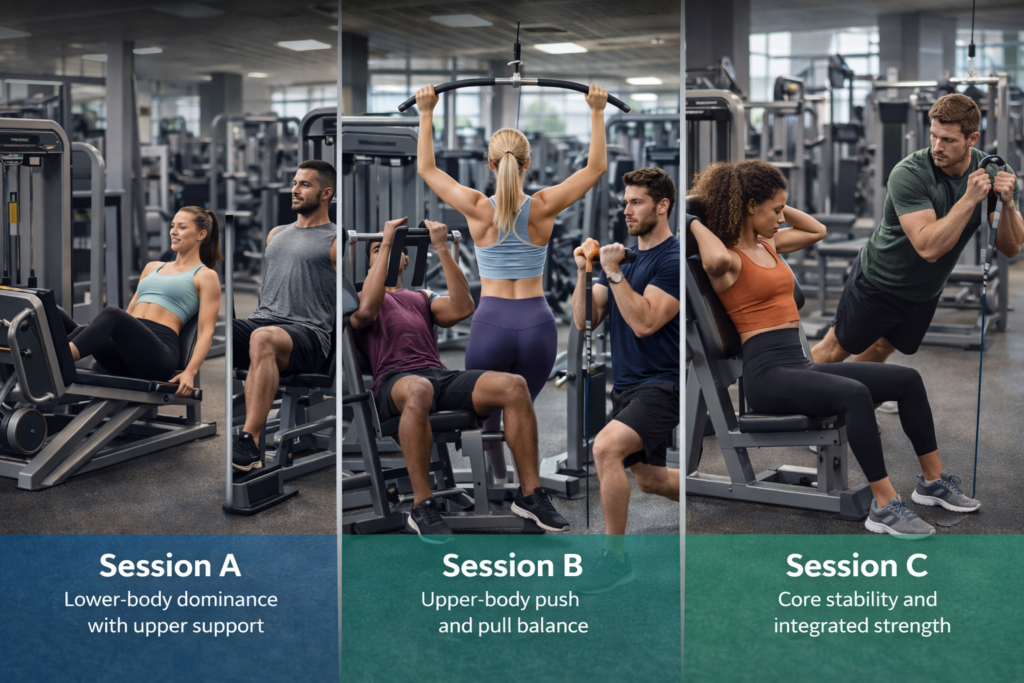
The routine follows three non-consecutive training days. Each session targets the entire body but emphasizes different priorities to prevent overload.
Session A: Lower-body dominance with upper support
Session B: Upper-body push and pull balance
Session C: Core stability and integrated strength
This structure ensures balanced development while keeping workouts predictable and efficient.
Non-Negotiable Warm-Up Protocol
Warm-ups are not optional. Beginners require joint preparation to maintain long-term training capacity.
5 minutes brisk walking or cycling
Shoulder mobility and scapular activation
Hip hinge practice with bodyweight
One light rehearsal set before main lifts
Session A: Lower Body Priority
This session introduces controlled leg strength while supporting upper-body engagement.
Workout
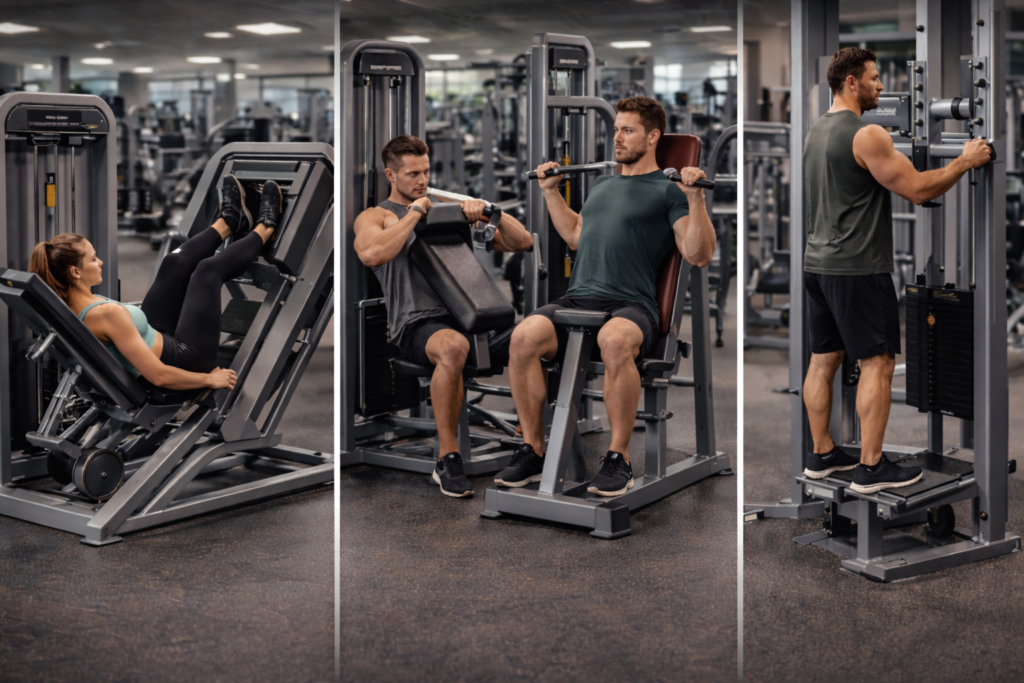
Leg Press Machine — 4 sets × 10–12 reps
Chest-Supported Row — 3 sets × 12 reps
Seated Chest Press — 3 sets × 10 reps
Seated Leg Curl — 3 sets × 12 reps
Standing Calf Raise — 2 sets × 15 reps
Focus on smooth tempo and stable positioning. Lower the weight under control and pause briefly at the end of each repetition.
Session B: Upper Body Strength Control
This session improves coordination between pushing and pulling muscles while reinforcing posture.
Workout
Assisted Pull-Up or Lat Pulldown — 4 sets × 8–10 reps
Incline Chest Press — 3 sets × 10 reps
Seated Shoulder Press — 3 sets × 10 reps
Cable Triceps Pushdown — 2 sets × 12 reps
Cable Biceps Curl — 2 sets × 12 reps
Rest periods should allow breathing to normalize. Avoid rushing between sets, as control matters more than pace.
Session C: Stability and Core Integration
The final session of the week improves balance, spinal support, and controlled movement.
Workout
Goblet Squat — 3 sets × 12 reps
Seated Row Machine — 3 sets × 12 reps
Back Extension Machine — 3 sets × 10 reps
Cable Pallof Press — 2 sets × 12 reps
Ab Crunch Machine — 3 sets × 12 reps
Session C reinforces posture and core engagement, which supports all future strength training.
How Beginners Should Progress
Progression follows simple rules. If all repetitions are completed with control, small increases are allowed.
Increase resistance by the smallest available increment
Never sacrifice posture for weight
Repeat the same routine for at least four weeks
Track workouts to identify consistency
Recovery Expectations
Strength adaptation requires recovery. Beginners should prioritize sleep, hydration, and nutrition over additional training volume.
Muscle soreness is acceptable; joint discomfort is not. Adjust load or volume immediately if discomfort appears.
Beginner Errors That Delay Progress
Changing routines weekly
Copying advanced lifter programs
Ignoring rest days
Training through joint pain
Rushing progression
Final Perspective
A fitness routine for beginners at gym level should feel boring before it feels impressive. That boredom reflects consistency, discipline, and correct execution.
This full-body, three-day plan provides a stable foundation. Strength built through structure lasts longer than strength built through shortcuts.