4 Week Home Workout Plan for Beginners
- October 17, 2026
- 0
A 4-week home workout plan for beginners can start with two full-body strength sessions each week, walking on separate days, and a few familiar exercises repeated with better
A 4-week home workout plan for beginners can start with two full-body strength sessions each week, walking on separate days, and a few familiar exercises repeated with better
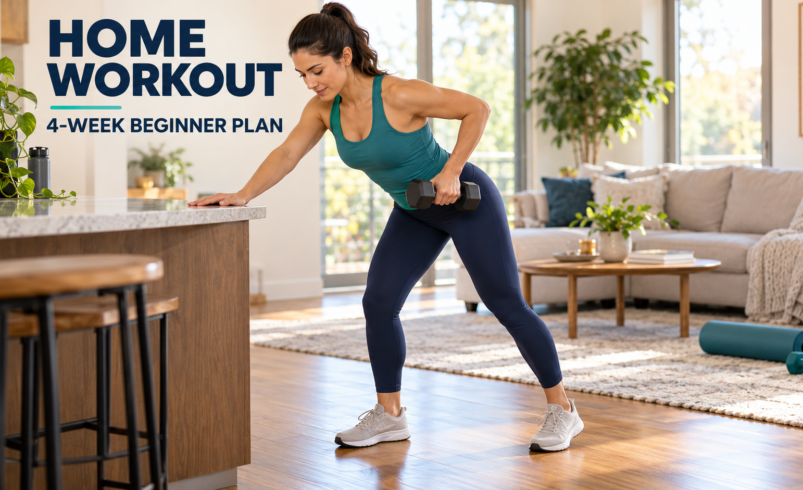
A 4-week home workout plan for beginners can start with two full-body strength sessions each week, walking on separate days, and a few familiar exercises repeated with better control. Keep a rest day between strength workouts and increase the challenge when your current version feels manageable.
You should finish the month knowing what to do when you put your workout clothes on. That means choosing exercises you can perform, recording what happened, and having a sensible next step. There is no need to replace the whole routine every Monday.
This guide turns those decisions into eight strength sessions, with a weekly schedule, movement cues, and examples of how to progress. It is an introductory template for generally healthy adults, rather than a personalized training prescription. If an injury, health condition, pregnancy, or recent surgery affects your exercise choices, get advice about suitable modifications before following it.
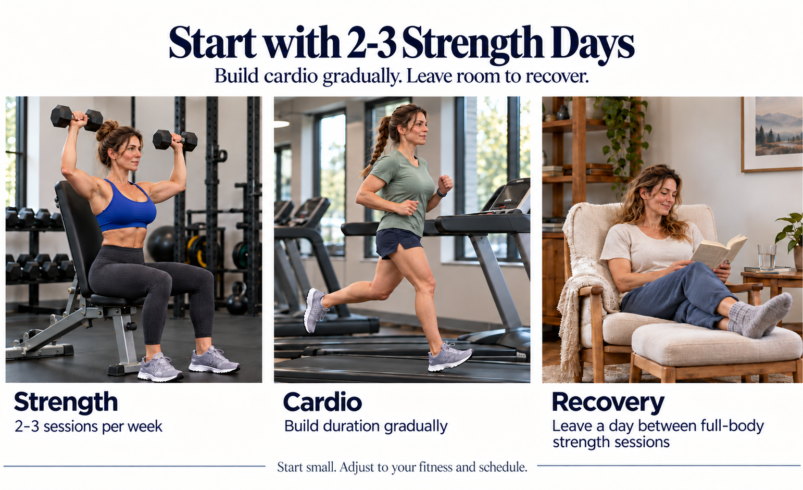
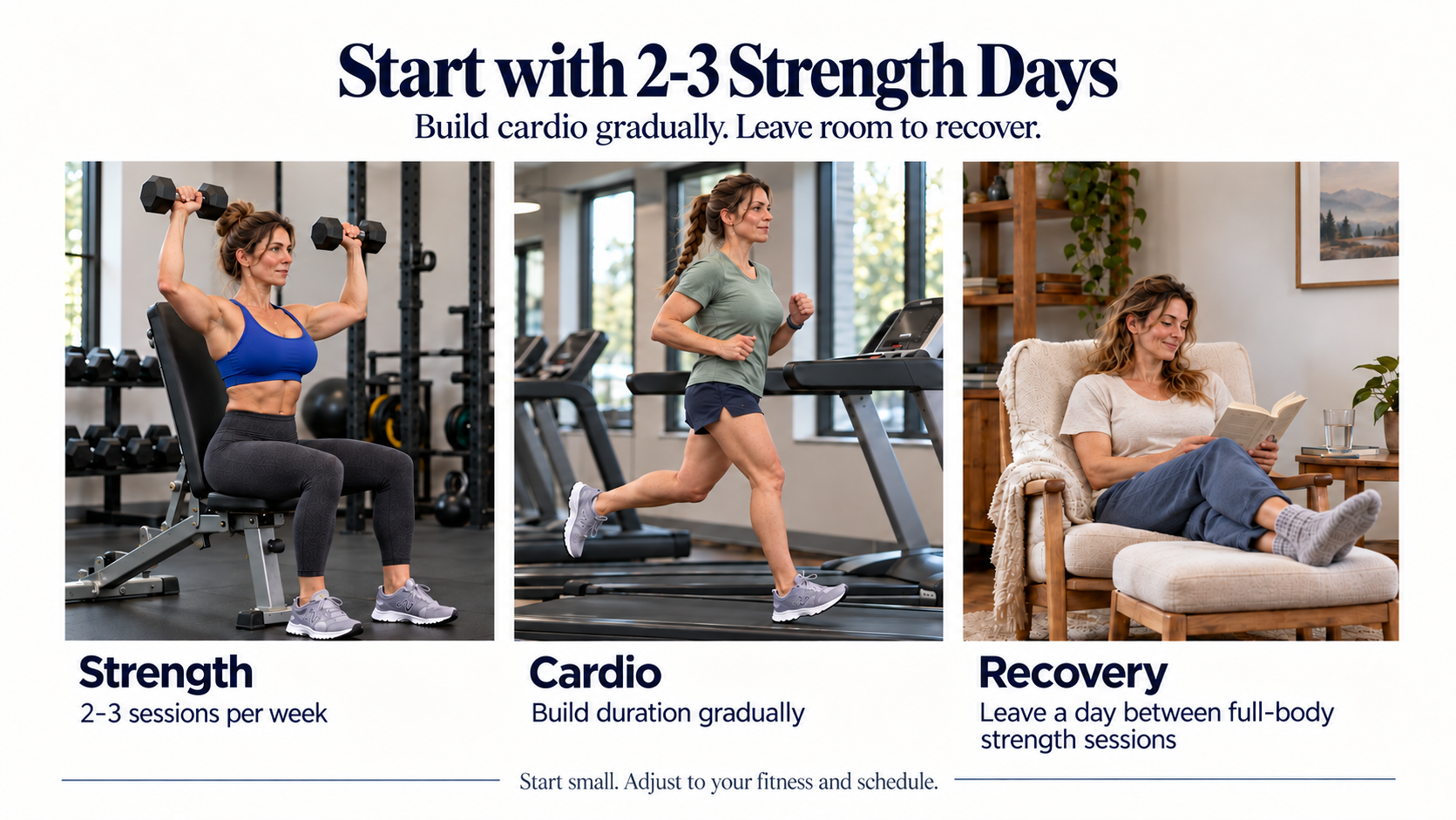
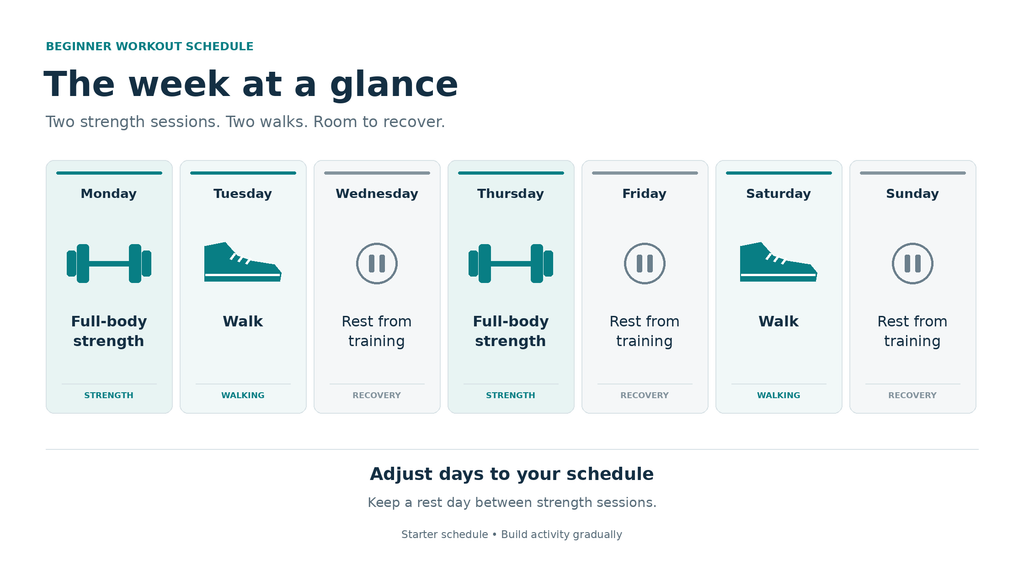
Start with two strength days and two planned walking days. For example, train on Monday and Thursday, then walk on Tuesday and Saturday. You can move these days around while preserving recovery between strength sessions.
The CDC recommends at least 150 minutes of moderate-intensity activity and two days of muscle strengthening each week. Those are ongoing health targets. Someone currently doing very little can start below them and build up gradually; some activity is better than none.
The walking sessions below are a starting point, so they will not meet the full weekly aerobic target on their own. As your capacity grows, add manageable walking time across the week.
| Day | Planned activity | Starting time window |
| Monday | Full-body strength session | About 20–35 minutes including warm-up |
| Tuesday | Walk indoors or outdoors | 10–15 minutes, or shorter if needed |
| Wednesday | Rest from structured training | Ordinary movement as comfortable |
| Thursday | Repeat the full-body strength session | About 20–35 minutes including warm-up |
| Friday | Rest from structured training | Ordinary movement as comfortable |
| Saturday | Walk indoors or outdoors | 10–15 minutes, or shorter if needed |
| Sunday | Rest and plan next week | Choose your next two strength slots |
If you are unsure whether this starting workload suits you, begin with FitRoutineLab’s guide to how to start working out.
You need enough room to extend your arms and take a few clear steps, plus a stable chair without wheels, a wall, and a light dumbbell for rows and carries. Choose a weight you can move without straining. This is a minimal-equipment plan; pulling exercises need something suitable to pull against.
Keep the chair on a nonslip surface. Use a fixed countertop if you need support for a standing row. Avoid folding furniture, glass surfaces, and anything that shifts under pressure. A dining table is not automatically suitable for hanging underneath.
Before each strength session, spend about five to ten minutes walking or marching, then rehearse a few easy versions of the movements ahead. Mayo Clinic’s weight-training guidance recommends warming up before lifting. For a more detailed sequence, see our beginner warm-up guide.
The strength sessions in this 4-week home workout plan for beginners use a squat, hinge, push, pull, and carry. These categories make exercise selection easier to understand, but they are not a complete checklist for every fitness goal. Walking supplies a separate aerobic component, and some people will need additional balance work or other adaptations.
Use the starting amounts below for your first session. A repetition, or rep, is one complete movement. A set is a group of repetitions performed before resting.
| Movement | Exercise | First-session starting amount |
| Squat | Chair sit-to-stand | 1 set of 5–8 reps |
| Hinge | Unloaded hip-hinge practice | 1 set of 6–8 reps |
| Push | Wall push-up | 1 set of 5–8 reps |
| Pull | Supported one-arm dumbbell row | 1 set of 8–12 reps per side |
| Carry | Light suitcase carry | 1 walk of 15–20 seconds per side |
These amounts are suggested starting points, not minimums you must force yourself to reach. Use fewer repetitions or an easier version if needed. Rest around one minute between sets and exercises, taking longer when necessary to regain comfortable breathing and control.
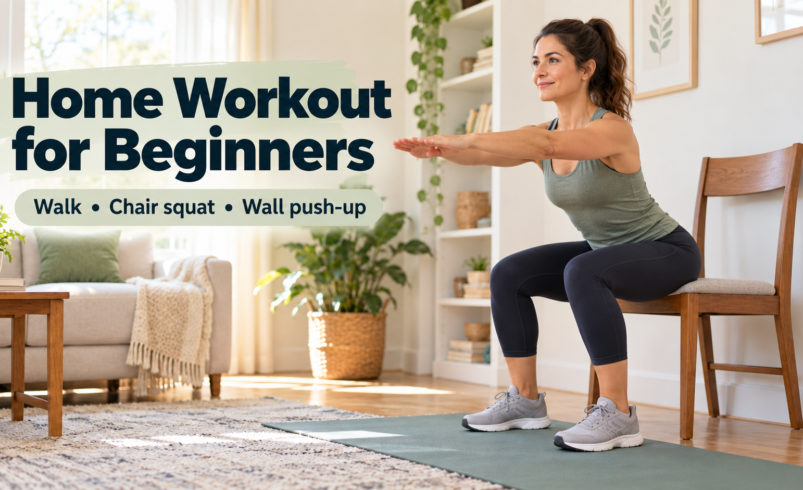
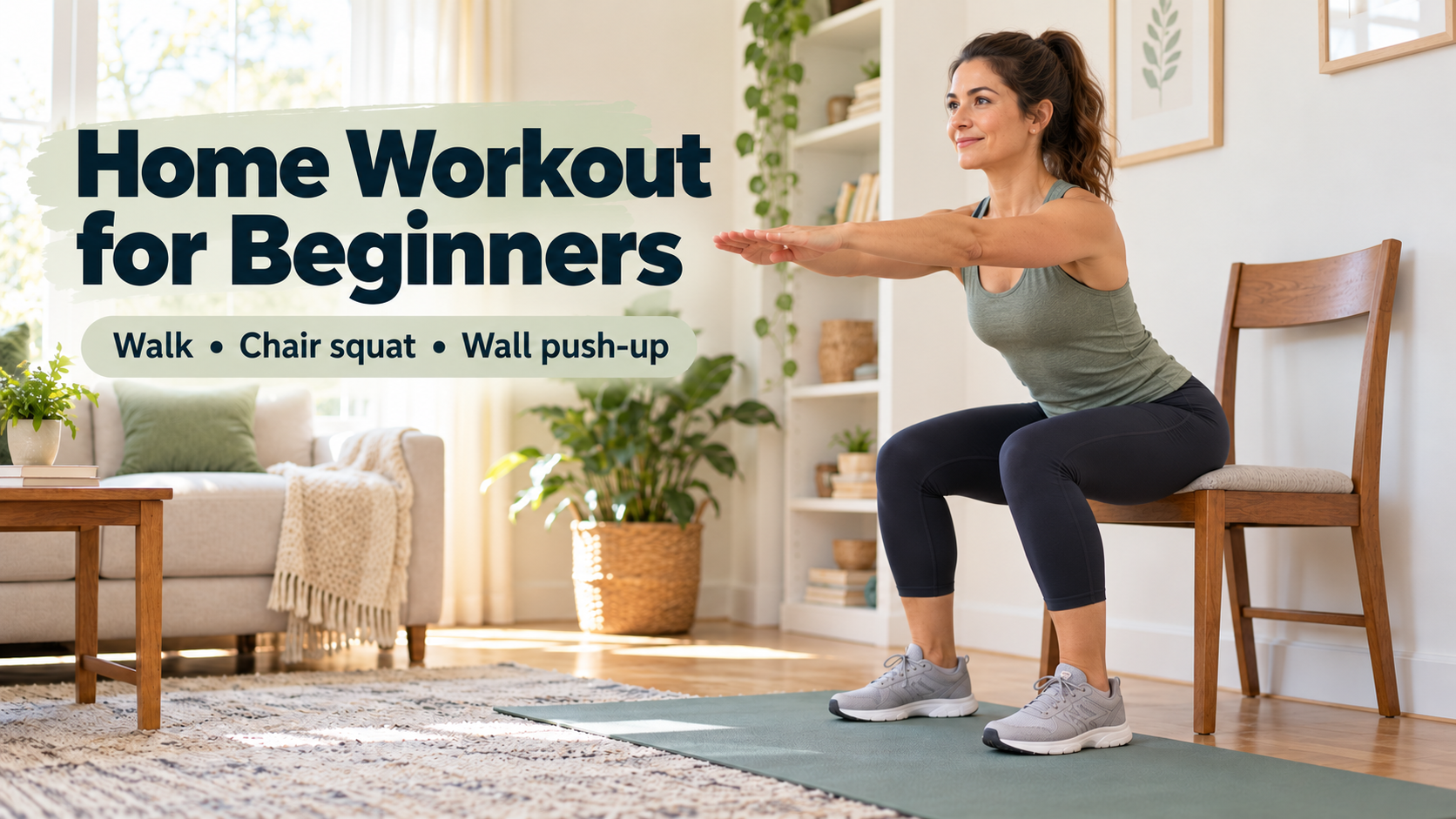
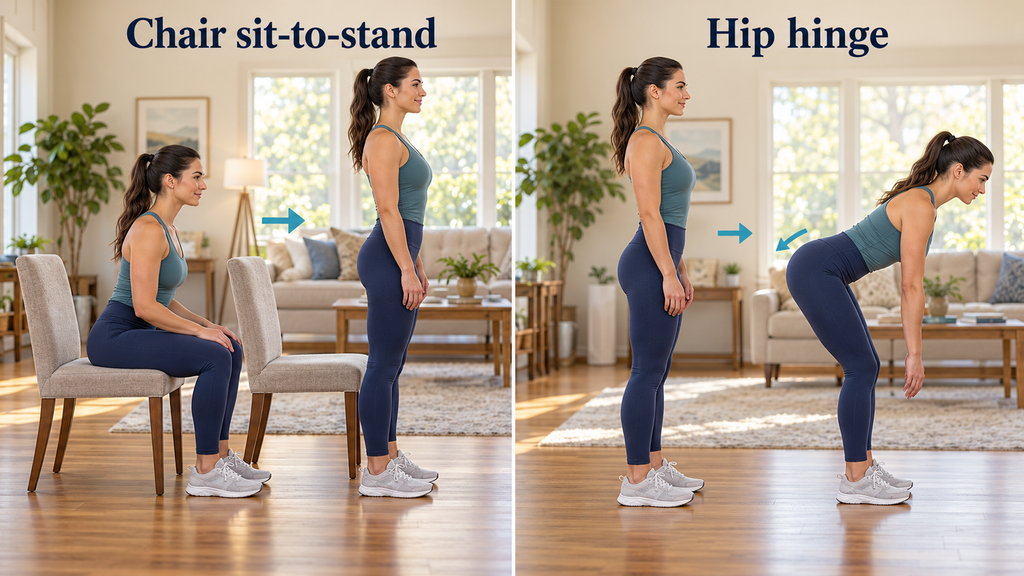
Sit on a stable chair with your feet flat and about hip-width apart. Lean forward slightly, stand up, then lower yourself slowly back to the seat. Avoid dropping into it. Use your hands for assistance if necessary.
The NHS strength exercise guide demonstrates this movement and wall press-ups. Once standing and sitting feel controlled, you can try a bodyweight squat with the chair behind you as a depth reference.
Stand with your knees slightly bent. Push your hips backward while your torso tips forward, keeping your back in a comfortable, steady position. Return to standing without leaning backward at the top.
The distinction from a squat is where most of the movement happens: your hips travel back, with relatively little knee bend. The American Council on Exercise demonstrates the hinge pattern.
In this plan, the unloaded hinge is technique practice. It is not equivalent to a challenging loaded strength exercise. Before adding a dumbbell or attempting a deadlift, make sure you understand the movement; seek coaching if you cannot keep it comfortable and controlled.
Place your palms against a wall at chest height, with your feet a comfortable distance away. Bend your elbows to bring your chest toward the wall, then press away. Keep your body aligned rather than letting your hips sag.
When the wall version becomes easy, a fixed countertop can provide a harder incline. Test its stability first and return to the wall if you cannot control the movement.
Hold a light dumbbell in one hand and place your other hand on a fixed, sturdy support. Keep both feet on the floor, soften your knees, and hinge forward. Draw your elbow back alongside your body, then lower the weight without twisting your torso.
Start very light while learning. The ACE single-arm row demonstration shows the pulling action using a bench-supported setup. Ask a qualified instructor to check your version if the position feels unfamiliar. Do not replace it with an improvised under-table row.
Hold a light dumbbell beside one hip and walk slowly along a clear path. Keep your torso upright instead of leaning sideways, then switch hands. Put the weight down before turning if space is tight.
This adapts the single-arm carry described by Catalyst Athletics. Choose a lighter load if you cannot keep your steps steady. Skip the loaded carry and seek an appropriate alternative if balance or gripping is a problem.
Repeat the same five movements in both weekly strength sessions. Keep a little effort in reserve: stop while you still feel capable of another couple of controlled repetitions. If technique changes or discomfort develops, finish the set earlier.
The ACSM’s 2026 resistance-training guidance emphasizes regular participation, individual adjustments, and training the major muscle groups at least twice weekly. It also notes that reaching muscle failure is not consistently necessary for the average healthy adult. The schedule here is an editorial application of those principles, not a tested four-week protocol.
Use the starting amounts in the exercise table for session one. Write down your repetitions, exercise versions, and anything that felt awkward.
In session two, repeat those amounts. Add a second set only to movements that felt comfortable and controlled, provided you recovered well. You can keep the hinge as a short practice drill. There is no requirement to complete two sets of everything immediately.
Work toward two sets of each exercise if you are ready. Keep the same weight and exercise versions while you learn to repeat the movements consistently.
For sit-to-stands and wall push-ups, gradually work toward 8–12 repetitions per set. For rows, stay within 8–12 per side. Keep hinge practice around 6–10 controlled repetitions and carries around 15–20 seconds per side. Repeat week one if that remains the appropriate challenge.
Choose one exercise that is becoming easier. Add a repetition within the suggested range, or extend a carry by a few seconds, up to about 30 seconds per side. Leave the other exercises unchanged.
On walking days, you might increase a comfortable 10-minute walk to 12 minutes. This is an example, not a required rate of progression. The CDC’s talk test describes moderate aerobic effort as being able to talk but not sing. Build toward that intensity when appropriate for your fitness level.
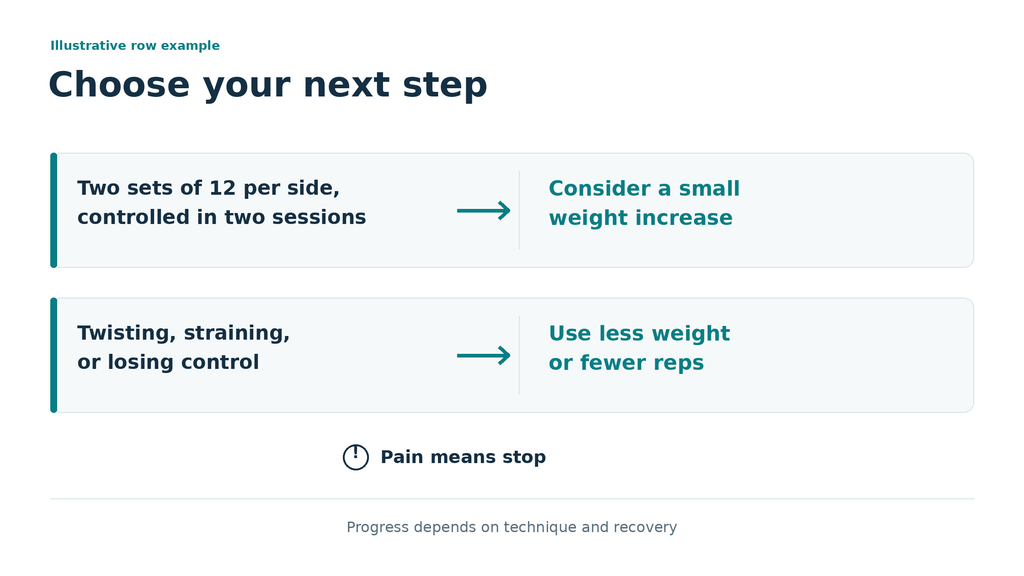
Review your log before changing anything. If the top of a repetition range has felt controlled in two consecutive sessions, consider a small increase in resistance or a harder exercise version. Reduce repetitions initially as needed.
For example, two comfortable sets of 12 rows per side on two separate days may suggest you can try the next small weight increment. If that jump makes you twist or strain, return to the previous load. Two successful sessions are a practical checkpoint, not a guarantee that every increase will suit you.
You can also keep the current difficulty. Finishing this 4-week home workout plan for beginners does not create a deadline for floor push-ups, heavier carries, or single-leg exercises.
After each session, record the date, exercise version, sets, repetitions, and weight where relevant. Add a short note about control and how you felt afterward. Our guide to tracking workout progress as a beginner covers more options.
An illustrative entry might read: “Monday: wall push-ups, 2 × 8; last two reps slower, body stayed aligned. Repeat Thursday.” That gives you a decision you can use. An entry saying only “good workout” leaves you guessing.
If you miss a session, move it to a suitable day while preserving recovery before the next strength workout. Avoid squeezing two sessions together to repair the calendar. When several workouts have been missed, restart with an amount you know you can manage.
movement that causes pain. Persistent pain, swelling, or symptoms that interfere with normal activity deserve professional assessment.
Stop exercising and seek medical advice if you develop dizziness, chest discomfort, or feel unusually unwell. Seek emergency help for chest pain that persists, spreads to an arm or jaw, or comes with breathlessness, sweating, or lightheadedness. The NHS explains these chest-pain warning signs.
No. This plan uses two full-body strength sessions, plus walking on separate days. Four strength days can suit some routines, but they are not a requirement for starting. Choose a schedule you can recover from and repeat.
The chair exercise, hinge drill, and wall push-up need no weights. Rows and loaded carries do. You can start learning the unweighted movements while arranging suitable equipment or asking an instructor for alternatives. Do not assume household furniture is safe exercise equipment.
Repeat the current week or reduce the workload. The calendar organizes practice; your movement quality, symptoms, and recovery determine whether to advance. Four weeks can take longer when you need more time at a particular stage
Choose two strength slots, check your equipment, and save the exercise table before you begin. After the eighth session, compare your notes with the first: which exercises feel more familiar, which need more practice, and which are ready for a small adjustment?
Keep those answers when you plan the following month. A useful 4-week home workout plan for beginners should leave you able to make the next workout decision with more confidence.
Maryam contributed the original beginner-training outline for this article. She also shared a four-week beginner home plan on iLands.