Daily At-Home Fitness Routine For Beginners To Build Muscle
- March 4, 2026
- 0
Building muscle at home without a gym feels counterintuitive to a lot of beginners. The assumption is that you need barbells, cable machines, and a locker room to
Building muscle at home without a gym feels counterintuitive to a lot of beginners. The assumption is that you need barbells, cable machines, and a locker room to
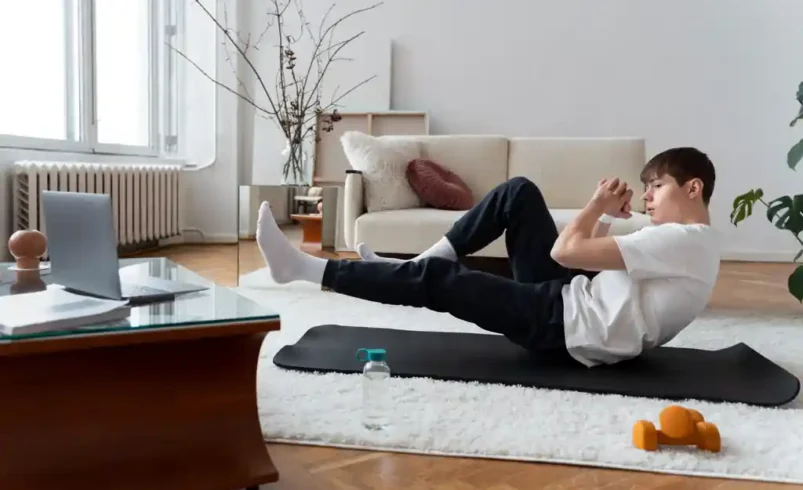
Building muscle at home without a gym feels counterintuitive to a lot of beginners. The assumption is that you need barbells, cable machines, and a locker room to get stronger. That assumption is wrong, but only if you understand why bodyweight training works and how to structure it correctly.
This guide lays out a practical daily fitness routine for beginners to build muscle using nothing but your own bodyweight, a floor, and a wall. You’ll get a clear weekly schedule, a day-by-day exercise plan, and the science behind why this actually works.
No fluff, no filler. Just a training plan you can start today.
| ✘ MYTH You can’t build muscle without lifting weights. | ✔ FACT Muscle grows in response to progressive tension and volume, bodyweight exercises deliver both when programmed correctly. |
| ✘ MYTH You need to train every day to see results. | ✔ FACT Muscle is built during recovery, not during the workout. Strategic rest days are part of the program, not a failure of discipline. |
Keep both of those in mind as you work through this plan. The daily routine below accounts for recovery by rotating intensity — harder days are followed by lighter ones.
Muscle growth — hypertrophy — is triggered when muscle fibers are placed under enough tension to create small amounts of stress, which the body then repairs and reinforces. That stress doesn’t have to come from a barbell. A slow, controlled push-up taken close to failure creates the same kind of muscular demand as a bench press.
The key variables are the same whether you’re using weights or bodyweight:
This fitness workout routine for beginners is built around all four. It won’t turn you into a competitive bodybuilder — that requires more equipment and years of training — but it will produce visible, measurable strength and muscle gains over 6–8 weeks.
This muscle and fitness workout routine for beginners runs 6 days with one full rest day. The intensity alternates so that your muscles get both stimulus and recovery within the same week.
| Day | Focus | Duration |
| Monday | Upper Body Push (chest, shoulders, triceps) | 25–30 min |
| Tuesday | Lower Body Strength (quads, glutes, hamstrings) | 25–30 min |
| Wednesday | Core & Active Recovery | 20 min |
| Thursday | Upper Body Pull (back, biceps) | 25–30 min |
| Friday | Full-Body Compound Circuit | 25–30 min |
| Saturday | Mobility & Light Movement | 15–20 min |
| Sunday | Full Rest | — |
You don’t have to follow this day-by-day. The important thing is the order and the rest pattern: push, pull, legs, compound, recover.
Wall Push-Up / Knee Push-Up / Full Push-Up
Sets & Reps: 3 sets × 10–15 reps
Choose the version that challenges you. Full push-ups if you can manage 8 controlled reps; knee or wall variations if not. Lower to a 3-count, push back deliberately.
⚠ Never rush the descent. The slow lowering phase is where most muscle growth is stimulated.
Pike Push-Up
Sets & Reps: 3 sets × 8–10 reps
Start in a downward-dog position (hips high). Bend your elbows to lower the top of your head toward the floor, then press back up. This targets the shoulders directly.
⚠ Keep your core tight. Don’t let your hips drop as you fatigue.
Tricep Dip (using a chair)
Sets & Reps: 3 sets × 10–12 reps
Sit on the edge of a sturdy chair, hands gripping the seat. Slide forward and bend your elbows to lower yourself, then press back up.
⚠ Use a stable, non-wheeled chair. Keep your back close to the edge of the seat throughout.
Bodyweight Squat
Sets & Reps: 4 sets × 12 reps
Feet shoulder-width apart, lower to at least parallel (thighs level with floor). Drive through heels on the way up.
⚠ If parallel feels too deep, lower only as far as comfortable and build range over time.
Reverse Lunge
Sets & Reps: 3 sets × 10 reps per leg
Step one foot back, lower the back knee close to the floor, return to standing. Work each leg independently.
⚠ Front shin should stay vertical. Pushing the front knee too far forward increases joint stress.
Glute Bridge
Sets & Reps: 3 sets × 12 reps + 2-sec hold at top
Lying on your back, knees bent. Press through heels, raise hips to a straight line, hold, lower slowly.
⚠ Single-leg variation: extend one leg as you bridge for added difficulty.
Dead Bug
Sets & Reps: 3 sets × 8 reps per side
Lie on your back, arms up, knees at 90°. Lower opposite arm and leg simultaneously while keeping your lower back flat. Return and alternate.
⚠ This is about control, not speed. Slow it down to maximize core engagement.
Plank
Sets & Reps: 3 holds × 20–40 seconds
Forearms on the floor, body in a straight line. Hold without letting your hips rise or sag.
⚠ Add a 5-second increase each week to build toward a 60-second hold.
Pulling movements are harder to replicate without equipment. These two options work well at home:
Doorframe Row (towel row)
Sets & Reps: 3 sets × 10–12 reps
Loop a towel around a doorknob, hold both ends, lean back with arms extended. Pull yourself toward the door, squeezing your shoulder blades together.
⚠ The more horizontal your body angle, the harder this gets. Start more upright.
Superman Hold
Sets & Reps: 3 sets × 10 reps + 2-sec hold
Lie face down, arms extended overhead. Lift your arms, chest, and legs off the floor simultaneously, hold, then lower.
⚠ This targets your lower back and rear shoulder muscles — often neglected in home routines.
Perform each exercise for 40 seconds, rest 15 seconds, move to the next. Complete 3 rounds with 60 seconds between rounds.
15–20 minutes of gentle stretching, yoga, or a slow walk. No muscle-building work today. This is active recovery, not a day off from discipline.
Bodyweight training stalls when you stop challenging it. After 2–3 weeks, if the sets feel manageable, make one of these adjustments:
For a complete no-equipment progression framework, the Beginner Bodyweight Fitness Routine: Full-Body No-Equipment Workout walks through how to scale each movement safely as your strength develops.
Training alone won’t build much muscle if your diet is working against it. You don’t need a complicated meal plan, but you do need adequate protein — most fitness guidelines suggest around 0.7–1 gram per pound of bodyweight daily for people aiming to build muscle.
Practically speaking, that means including a meaningful protein source — eggs, chicken, fish, legumes, Greek yoghurt — in most meals. Total calorie intake also matters: consistently eating below your maintenance level makes muscle gain significantly harder.
For straightforward guidance on pairing food with training, the Nutrition Plan With Workout Routine For Beginners covers practical, budget-conscious meal strategies designed specifically around beginner training schedules.
This daily fitness routine for beginners to build muscle works best for people who:
If you’re eventually planning to train with weights, this home routine builds the movement foundations you’ll need. The push, pull, and lower-body patterns practiced here translate directly into barbell and dumbbell training. The Beginner Muscle Building Routine For Men and the Beginner Muscle Building Routine For Women both build directly on these foundations when you’re ready to progress.
You don’t need a gym, a trainer, or any equipment to start building muscle today. What you need is a structured plan, the willingness to challenge your muscles progressively, and enough patience to let the process work.
This 6-day home routine gives you all of that. Start with Monday’s push session. Do it properly, track how you feel, and show up again on Tuesday. That’s how muscle — and habits — are built.
Already comfortable with short daily sessions? The Home Fitness Routine For Beginners: Start Getting Active in 20 Minutes a Day is a strong companion read for fitting movement into a genuinely busy schedule.