What Is Active Recovery? (And Why Rest Days Should Not Mean Lying Still)
June 12, 2026
0
There is a quiet assumption baked into most beginner fitness advice: rest days mean doing nothing. You trained hard yesterday, so today you sit still, let the soreness
There is a quiet assumption baked into most beginner fitness advice: rest days mean doing nothing. You trained hard yesterday, so today you sit still, let the soreness run its course, and wait for tomorrow. That approach is not wrong exactly, but it is leaving a meaningful amount of recovery quality on the table.
Active recovery is a specific, research-supported approach to non-training days that accelerates muscle repair, reduces soreness duration, and improves how you feel going into your next session, without adding any meaningful training stress to your body. For beginners especially, understanding the difference between productive rest and passive inactivity can reshape how quickly you adapt to a new exercise routine.
What Active Recovery Actually Means
Active recovery refers to low-intensity physical movement performed on rest days or after training sessions. The intensity is deliberately kept far below the threshold of training stress. The goal is not to build fitness or burn calories in any meaningful way. The goal is to promote blood flow, clear metabolic byproducts from fatigued tissue, and support the physiological processes that happen between workouts.
The defining characteristic of a genuine active recovery session is how you feel when it ends. You should feel looser, more mobile, and less stiff than you did before you started. If you finish a so-called recovery session feeling fatigued or more sore, you have crossed into additional training load, which defeats the purpose entirely.
Active recovery sits on a spectrum between complete rest, where you do no intentional physical activity, and formal training, where you are deliberately stressing the body to drive adaptation. It occupies the middle ground: movement with a purpose, but without the intensity that triggers another round of muscle breakdown.
Why Active Recovery Works: The Physiology
Blood Flow and Metabolic Clearance
After a hard workout, your muscles contain elevated levels of metabolic byproducts including lactate, hydrogen ions, and damaged cellular debris from the micro-tears that training produces. Repair processes require adequate blood flow to deliver nutrients, oxygen, and immune cells to the site of damage, and to remove waste products that would otherwise slow the process.
Complete rest allows blood flow to remain at baseline levels. Low-intensity movement increases circulation without generating additional damage, accelerating the delivery and clearance process. Studies published in the Journal of Sports Sciences have shown that active recovery performed at approximately 30 to 40 percent of maximum heart rate produces measurably faster lactate clearance than passive rest in the hours following exercise.
For beginners whose muscles are adapting to training stress for the first time, this difference in clearance speed translates into noticeably reduced soreness by the following day compared to doing nothing at all.
Nervous System Recovery
Training does not only stress your muscles. It stresses your central nervous system as well, particularly during compound movements like squats, deadlifts, and overhead presses that require significant motor unit recruitment. CNS fatigue manifests as reduced force production, slower reaction times, and a general feeling of heaviness during subsequent workouts.
Low-intensity movement on rest days supports nervous system recovery by maintaining gentle neural activation without the high-demand recruitment patterns of training. Walking, easy cycling, and light stretching all accomplish this. They keep the system active and regulated without asking it to perform at a level that would deepen fatigue.
Psychological Benefits
This aspect gets overlooked in most technical discussions of recovery, but it is real and relevant for beginners. Complete inactivity on rest days can create a mental disconnection from your routine, particularly in the early weeks when habits are still forming. Gentle movement maintains a physical connection to your program without requiring the effort of a full session.
Research in behavioral psychology consistently shows that partial engagement with a habit on non-primary days strengthens long-term adherence. A 20-minute walk on a rest day keeps you in the routine. It reinforces the identity of someone who moves regularly, which matters more in the early months than most people realize.
Active Recovery vs. Passive Rest: When to Use Each
Both have their place, and neither should be used exclusively. The choice depends on how your body feels and what kind of training you did most recently.
When Active Recovery Is the Better Choice
You have mild to moderate soreness that limits your movement but not your ability to walk comfortably
You trained two or more consecutive days and want to keep momentum without adding more training stress
Your previous session was moderately intense but not maximal effort
You slept well and feel functional but not ready for another structured workout
When Complete Rest Is the Better Choice
Soreness is severe and limits basic movement patterns
You are experiencing fatigue that feels systemic rather than localized to specific muscles
Sleep quality has been poor and your body signals genuine depletion
You are coming off your highest-effort session of the week and the following day is a scheduled training day
Most beginners benefit from one or two active recovery days per week and one complete rest day, rather than filling all non-training days with either extreme. A three-day training schedule, for example, naturally creates four non-training days. Using two of those for active recovery and two for complete rest is a balanced and practical approach.
For more on how to structure your full week around training and rest, including how many rest days beginners actually need based on their training frequency, the article on how many rest days per week beginners need covers the scheduling logic in practical detail.
What Counts as an Active Recovery Workout?
The activity you choose matters less than the intensity at which you perform it. Almost any form of movement can serve as active recovery if kept at the right effort level. That said, some activities are more naturally suited to the recovery intensity range than others.
Walking
Walking is the single most underused recovery tool available to beginners. A 20 to 30 minute walk at a comfortable pace increases circulation, gently mobilizes sore muscle groups, supports digestion and sleep quality, and requires no equipment, scheduling, or preparation. It is the most accessible form of active recovery and one of the most effective.
The pace should be conversational, meaning you could carry on a normal conversation without effort. If you find yourself breathing hard or your heart rate climbing significantly, you are walking too fast for recovery purposes.
Light Stretching and Mobility Work
A 15 to 20 minute stretching session targeting the muscle groups that trained most recently is an excellent active recovery choice. Focus on static holds of 30 to 45 seconds per position rather than dynamic or ballistic stretching, which can add more stress than intended to fatigued tissue. Hip flexors, hamstrings, thoracic spine, and chest are common targets after lower and upper body training respectively.
Mobility work that takes joints through their full range of motion without loading, such as hip circles, shoulder rolls, and gentle spinal rotation, complements stretching well and is particularly beneficial for beginners who are still developing flexibility alongside strength.
Gentle Yoga
Beginner or restorative yoga classes, whether in person or via video, are well-suited to recovery days because they combine stretching, breathing, and body awareness at a low physiological cost. Sessions labeled as restorative or yin yoga are specifically designed to be held at recovery-appropriate intensity. Avoid classes labeled as power, hot, or flow if your goal is genuine recovery rather than additional training.
Easy Swimming
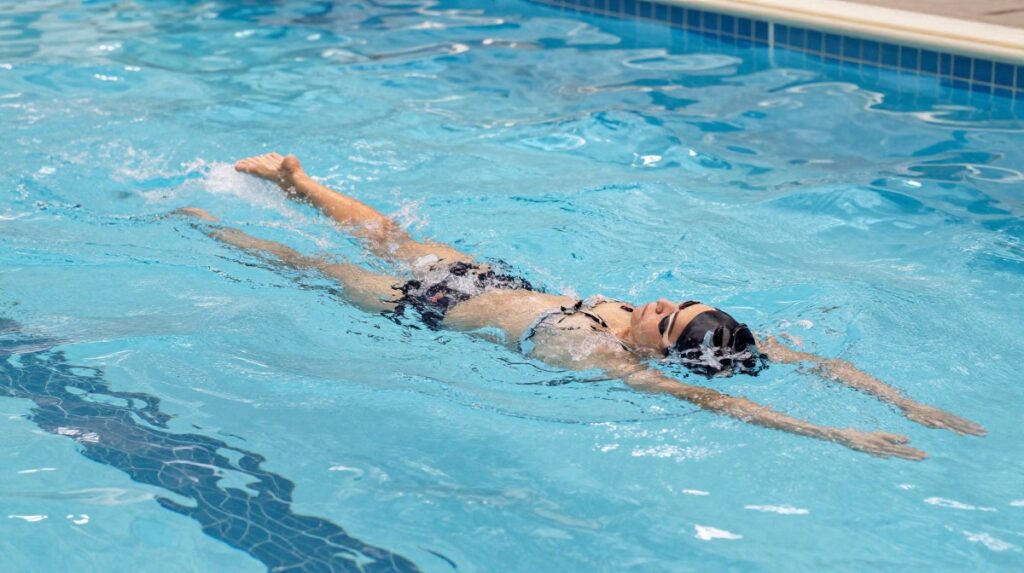
Swimming at a slow, comfortable pace provides an excellent active recovery stimulus because the water supports body weight, reducing compressive load on joints that may be sore from weight-bearing exercise. The gentle resistance of water promotes circulation through the full body without mechanical loading. Even 20 minutes of easy laps or treading water provides meaningful recovery benefit.
Low-Resistance Cycling
Cycling at low resistance on a stationary bike or outdoors at flat terrain promotes lower body blood flow without the impact stress of running. Keep the effort level at a pace where breathing remains easy and the legs feel like they are turning over without any meaningful muscular challenge. Twenty to thirty minutes is sufficient.
What Active Recovery Is Not
This distinction matters because many beginners accidentally turn rest days into training days without realizing it, then wonder why they feel perpetually fatigued.
A HIIT session at reduced effort is not active recovery. A long run at what feels like a moderate pace is not active recovery. A heavy stretching class that leaves your muscles burning is not active recovery. A recreational sport played competitively is not active recovery.
The test is simple: does the activity add meaningful training stress to your system? If you finish the session feeling tired in a way that will require recovery, it was training, not recovery. The threshold for most beginners sits around 50 percent of maximum effort or below. If the activity requires genuine focus or sustained exertion, it is likely above the active recovery threshold.
Active Recovery and Soreness: What to Expect
One of the most common experiences beginners report is that gentle movement on a rest day reduces soreness faster than doing nothing. This is not placebo. It reflects the physiological mechanism described earlier: increased blood flow accelerates the delivery of repair resources and the clearance of inflammatory byproducts from sore tissue.
The effect is most noticeable in the first 24 to 48 hours after a training session, which is also when DOMS is intensifying. A 20-minute walk the morning after a leg day will typically produce a meaningful reduction in stiffness within the walk itself, as circulation increases and the nervous system modulates the pain sensitivity in sore areas.
This connects directly to the question many beginners have about whether it is appropriate to keep training when muscles are already sore. For a full breakdown of when training through soreness is safe and when rest is the right call, the FitRoutineLab guide on working out with sore muscles addresses each scenario with clear, practical guidance.
Building Active Recovery Into Your Weekly Schedule
The simplest approach is to treat active recovery as a scheduled element of your training week rather than something you do only when you feel like it. When it is on the calendar, it happens consistently. When it is optional, it tends to get skipped.
Sample Weekly Structure for a 3-Day Beginner Program
Monday: Training session
Tuesday: Active recovery (20-30 min walk or light stretching)
Wednesday: Training session
Thursday: Active recovery (easy cycling or gentle yoga)
Friday: Training session
Saturday: Complete rest
Sunday: Complete rest or light walk
Sample Weekly Structure for a 4-Day Beginner Program
Monday: Training session
Tuesday: Training session
Wednesday: Active recovery (walk, swim, or stretching)
Thursday: Training session
Friday: Training session
Saturday: Active recovery (easy cycling or gentle yoga)
Sunday: Complete rest
Notice that in both structures, active recovery days are placed between training days or after training blocks rather than grouped at the end of the week. This placement maximizes the clearance benefit during the window when soreness and fatigue are most likely to be present.
Active Recovery and Sleep: The Combination That Accelerates Adaptation
Active recovery and sleep work through different but complementary mechanisms. Plus, active recovery improves blood flow and accelerates metabolic clearance. Sleep is when growth hormone release drives the actual structural repair of muscle tissue. Neither replaces the other, and both are necessary for a beginner making consistent progress.
Gentle movement on rest days can also improve sleep quality by reducing the physiological arousal that sometimes makes it harder to fall asleep on rest days compared to training days. A 20-minute evening walk has been shown in several studies to reduce the time it takes to fall asleep and improve subjective sleep quality in adults who exercise regularly.
A complete beginner recovery approach that addresses sleep, post-workout stretching, hydration, and rest day movement is covered in the full recovery routine guide for beginners. Reading it alongside this article gives you a comprehensive picture of everything that happens between your training sessions and why each element matters.
Nutrition on Active Recovery Days
A common beginner question is whether to eat differently on rest and active recovery days compared to training days. The short answer is: not dramatically. Your body continues repairing muscle tissue on rest days, which means protein needs remain essentially the same as on training days.
Total calorie intake can be modestly lower on rest days since energy expenditure from formal exercise is reduced, but this adjustment should be minor rather than a significant reduction. Eating far too little on rest days compromises the repair process that rest days are supposed to support, which defeats the purpose of taking them.
Protein targets of approximately 1.6 to 2.2 grams per kilogram of body weight remain relevant on active recovery days. For context on how calorie intake relates to your training goals and why energy availability matters throughout the full week rather than just on workout days, the calorie deficit and weight loss guide explains the fundamentals in a straightforward, beginner-friendly way.
How Long Before Active Recovery Starts to Show Results?
Beginners who add structured active recovery to their routine typically notice the difference within one to two weeks. The most common early reports are reduced soreness 24 to 48 hours after training, feeling more ready to train at the start of each new session, and a general decrease in the stiffness and heaviness that often accumulates across training days.
Over four to eight weeks, consistent active recovery contributes to faster adaptation curves. Because muscles are arriving at each training session in better condition, training quality improves. Better training quality means a stronger stimulus. A stronger stimulus drives faster strength and fitness gains. The compounding effect is meaningful across a full training cycle even though no individual active recovery session looks particularly impressive.
Frequently Asked Questions
What is an active recovery workout?
An active recovery workout is any low-intensity physical activity performed on non-training days with the goal of promoting blood flow, reducing muscle soreness, and supporting the body’s repair processes without adding meaningful training stress. Common examples include walking, light stretching, easy swimming, gentle yoga, and low-resistance cycling.
How hard should an active recovery session be?
Active recovery should be performed at approximately 30 to 50 percent of your maximum effort level. A useful practical test is the talk test: if you can carry on a normal conversation without difficulty throughout the activity, your intensity is appropriate for recovery. If you are breathing too hard to speak comfortably, you have exceeded the recovery threshold.
Is active recovery better than complete rest?
For most beginners on most rest days, active recovery produces better outcomes than complete inactivity because it accelerates metabolic clearance and blood flow to sore tissue. However, complete rest is appropriate after particularly demanding training sessions, during periods of illness or significant fatigue, and whenever the body is signaling genuine depletion rather than ordinary soreness.
How long should an active recovery session last?
Twenty to thirty minutes is sufficient for most active recovery activities. Longer sessions are fine if the intensity remains genuinely low, but there is no significant additional benefit beyond 45 minutes at recovery-appropriate effort. The duration matters less than the intensity. A 20-minute walk at an easy pace accomplishes more recovery benefit than a 45-minute session at moderate intensity.
Can beginners do active recovery every day?
Low-intensity walking and gentle stretching can be performed daily without concern about adding training stress. More structured active recovery activities like swimming or cycling should be limited to two to three times per week to ensure that at least one or two days per week include complete rest for full nervous system and psychological recovery.
Closing Thoughts
Rest days do not have to be inactive days. Active recovery gives you a concrete, evidence-based way to use your non-training time productively, supporting the repair processes that your workouts depend on while keeping you connected to the routine you are building.
Start simple. Add a 20 to 30 minute walk on the day after your next workout. Notice how your soreness responds. Notice how you feel walking into the following training session. That single change tends to be enough to make the value of active recovery immediately clear, and from there it becomes a natural part of how you approach rest days rather than something that requires motivation to do. The best training programs account for what happens between sessions, not just during them. Active recovery is one of the most accessible and underutilized tools for making that in-between time work in your favor.