Is It Okay to Work Out With Sore Muscles? A Clear Answer for Beginners
- June 10, 2026
- 0
Soreness after a workout feels like proof of effort, and for many beginners, it raises an immediate question. Do you push through and train anyway, or do you
Soreness after a workout feels like proof of effort, and for many beginners, it raises an immediate question. Do you push through and train anyway, or do you

Soreness after a workout feels like proof of effort, and for many beginners, it raises an immediate question. Do you push through and train anyway, or do you wait until the soreness fades before going back? The answer depends on a set of specific factors that most beginner-focused content glosses over completely.
This is not a simple yes-or-no question, and the wrong decision in either direction has real consequences. Training through severe soreness can compromise your form, reduce workout quality, and risk injury. But waiting until soreness disappears entirely before training again can create a cycle of extended gaps that interrupts your progress and momentum. The distinction between the two choices lives in the details, and this article works through them clearly.

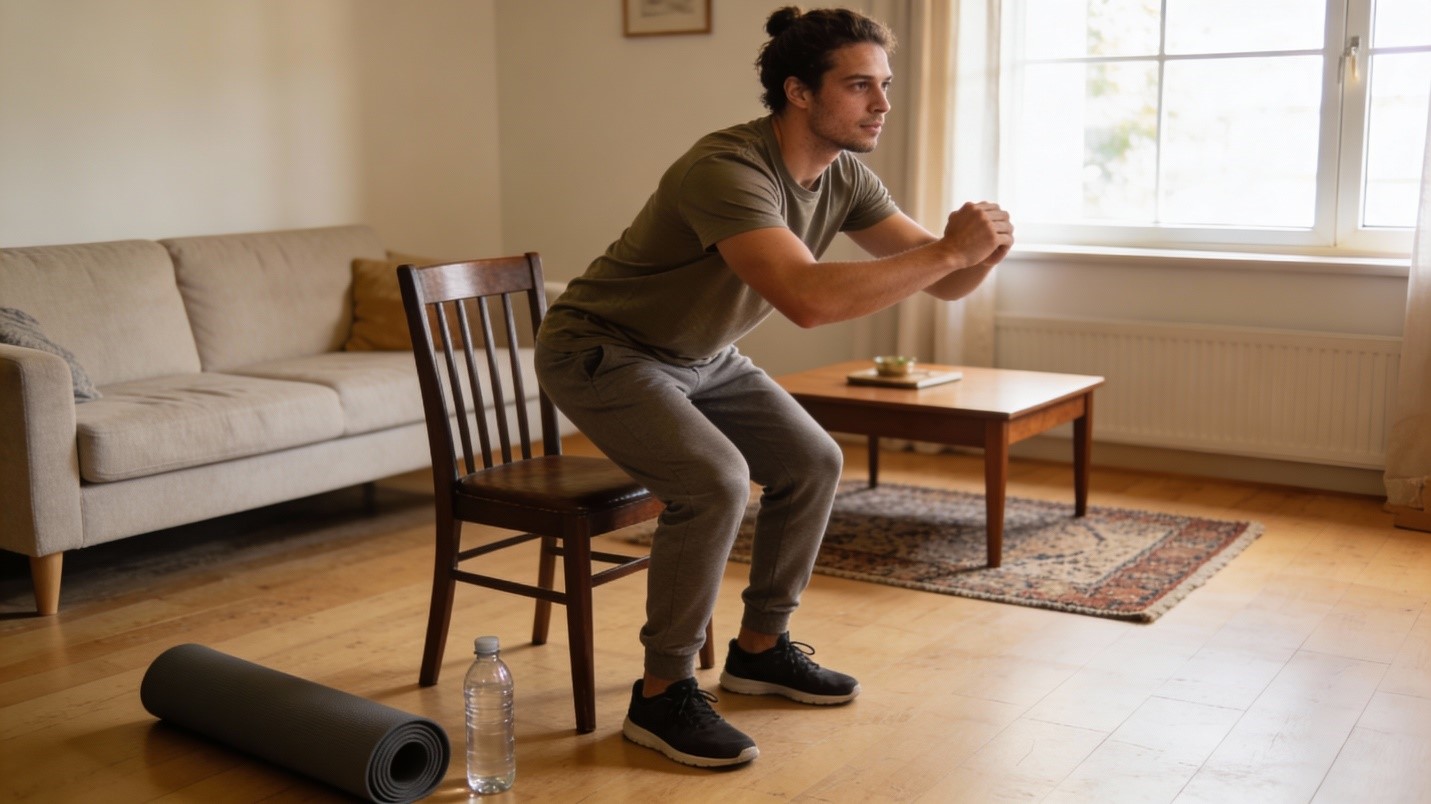
The delayed ache you feel 12 to 48 hours after a hard session is called Delayed Onset Muscle Soreness, or DOMS. It results from microscopic structural disruption to muscle fibers during exercise, particularly during the eccentric phase of movement, the lowering portion of a squat or the controlled descent in a push-up, when the muscle is lengthening under tension.
This disruption triggers a localized inflammatory response. Blood flow increases, fluid accumulates around the tissue, and chemical signals sensitize nearby nerve endings, producing the characteristic stiffness and tenderness. DOMS typically peaks between 24 and 72 hours post-exercise and resolves on its own within three to five days in most cases.
The important thing to understand is that DOMS is a normal physiological response to novel or intensified training stress, not an injury. It is particularly common in the first four to eight weeks of a new program when the body is adapting to movement patterns and loads it has never encountered before.

The most straightforward situation is when you want to train a muscle group that is not currently sore. If your legs are sore from Monday’s squat session but your upper body feels fine, training your chest, back, or shoulders on Tuesday is completely appropriate. The soreness in your legs is not a reason to avoid training altogether. It is simply a reason to avoid loading those specific muscles before they have had adequate recovery time.
This is one reason why training splits, where you organize workouts by muscle group, are practical for beginners who want to train more than three days per week. Alternating between lower body and upper body focus allows one set of muscles to recover while another is being trained.
If the soreness is mild, meaning the muscle is slightly tender to the touch and a little stiff but not painful during movement, training that muscle group is generally acceptable. Research has not demonstrated that training through mild DOMS causes additional damage or impairs recovery. In fact, gentle movement and warm-up activity often reduce the perceived soreness within the first few minutes of a session through increased circulation and nervous system modulation.
The practical test is whether you can move through your intended range of motion without compromising form. If you can squat to full depth, press without compensatory shoulder shrugging, or hinge without rounding your lower back, your muscles are functional enough to train, even with mild soreness present.
Consistency is one of the most important variables in long-term fitness progress. If waiting for complete soreness resolution means training only once every seven to ten days, the disruption to your adaptation curve outweighs the benefit of the extra rest. Training with mild soreness, at the same or slightly reduced intensity, is a better choice than extended gaps between sessions.

There is a meaningful difference between ordinary DOMS and soreness that is significantly limiting your movement, causing pain at rest, or producing sharp sensations during basic activities. Severe soreness that makes it painful to walk down stairs or lift your arm above shoulder height is your body communicating that recovery is incomplete and the tissue needs more time.
Training through severe soreness raises the risk of compensatory movement patterns. When a primary muscle is significantly compromised, the body recruits surrounding muscles to take over the load. This mechanical compensation changes the stress distribution across your joints and soft tissue, which is a well-documented precursor to overuse injuries.
Standard DOMS should be improving or fully resolved by 72 hours. If your soreness is still present and has not meaningfully diminished three days after your last session, that is a signal to investigate your recovery quality before adding more training stress.
Persistent soreness beyond 72 hours often points to inadequate sleep, insufficient protein intake, poor hydration, or simply too much training volume relative to your recovery capacity. A thorough post- workout recovery routine that addresses stretching, sleep, and nutrition can resolve most cases of prolonged DOMS within one to two weeks of consistent application.
Muscle soreness has a diffuse, bilateral quality. It affects both legs equally after squats, both arms after pressing, and it has a dull, aching character. Pain that is sharp, appears at a specific point on a joint or tendon, or is noticeably asymmetrical (one knee but not the other, one shoulder but not the other) is not DOMS. It is a potential injury signal.
Training through injury-type pain without assessment significantly worsens most musculoskeletal problems. If you suspect an injury rather than ordinary DOMS, rest is appropriate and a medical or physiotherapy assessment is the correct next step.
One of the most counterintuitive findings in exercise science is that gentle movement on rest days actually accelerates recovery from DOMS rather than prolonging it. Low-intensity activity increases blood flow to sore tissue, which clears metabolic waste products and delivers the nutrients and oxygen needed for repair.
Active recovery is specifically distinct from training. It involves activity at an intensity where you can carry on a conversation without difficulty and finish the session feeling more mobile, not tired. A 20 to 30 minute walk, a light stretching session, easy swimming, or gentle cycling all qualify.
If you are uncertain what active recovery should look like in practice, our detailed guide on what active recovery actually means and how to use it on rest days covers the specific approaches that work best for beginners, including how to distinguish recovery-promoting movement from movement that adds more training stress.
This is a question worth addressing directly because it trips up many beginners. Training through mild to moderate DOMS does not appear to meaningfully impair muscle growth when workout quality is maintained. The research suggests that the primary drivers of muscle growth, particularly mechanical tension and sufficient training volume, can still be achieved when soreness is present at a mild level.
What does impair muscle growth is training with significantly compromised form due to soreness, which reduces the quality of the stimulus. And what impairs muscle growth more broadly is insufficient recovery between sessions, regardless of whether soreness is the symptom. The relationship is not between soreness and growth directly. It is between recovery quality and the body’s ability to adapt.
This is a point explored in depth in the FitRoutineLab article on whether soreness actually means muscle growth, which separates the popular myth from what the research actually shows about DOMS and hypertrophy.
Rather than guessing each time, use this straightforward decision process to determine whether to train or rest on a given day.
If the soreness is in a muscle group you are not planning to train that day, proceed with your session normally. The soreness in an uninvolved area is not a training barrier.
Mild soreness, meaning stiffness and tenderness that does not limit your range of motion or produce pain during movement, is workable. Moderate soreness requires caution and possibly a volume reduction. Severe soreness or sharp pain is a clear signal to rest.
Begin your session with 5 to 10 minutes of light warm-up targeting the sore area. Many cases of moderate DOMS diminish noticeably during a proper warm-up as blood flow increases. If you complete the warm-up and the soreness has reduced, proceed with your session. If it has intensified, choose active recovery instead.
Training with soreness present does not require you to match your previous session exactly. Reducing total sets by 20 to 30 percent or dropping intensity slightly while maintaining movement quality is a reasonable compromise that keeps your training frequency consistent without overloading recovering tissue.
Soreness is a normal and expected part of beginning a fitness routine, particularly in the first four to eight weeks. It is not something to avoid entirely, nor is it something to push through recklessly. The goal is a program structure that allows training frequency to remain consistent while giving individual muscle groups adequate recovery time between sessions.
A well-designed beginner program incorporates rest days specifically to manage this. If you are building your training schedule from scratch, our 4-week beginner fitness plan structures workout days and rest days in a way that naturally accounts for beginner-level DOMS and recovery needs.
As your body adapts over the first two to three months of consistent training, you will notice that the intensity of DOMS decreases even as your workouts remain challenging. This is a sign of positive adaptation, not a sign that your training has stopped working. Your muscles are becoming more efficient at handling training stress and recovering from it.
Workout decisions and rest days are only part of the picture. The speed at which your muscles recover from DOMS depends significantly on what you eat and how well you sleep.
Protein is the most critical nutritional variable. Research from the Journal of the International Society of Sports Nutrition supports a daily protein intake of approximately 1.6 to 2.2 grams per kilogram of body weight for individuals engaging in resistance training. Adequate protein gives your body the amino acid building blocks required to repair damaged fibers after training. Beginners consistently eating below their protein needs will experience slower DOMS resolution and slower overall adaptation.
Carbohydrates replenish muscle glycogen depleted during training, which supports performance in subsequent sessions. Hydration affects the cellular environment in which repair occurs. And sleep, particularly deep slow-wave sleep, is the window during which growth hormone release drives the actual repair and strengthening of muscle tissue.
None of these factors is complicated to address. Eating enough protein, drinking enough water, and sleeping seven to nine hours per night covers the nutritional and recovery fundamentals that dramatically influence how sore you get and how quickly you recover.
It depends on the severity. Mild to moderate soreness in a muscle group is generally not a barrier to training, particularly if you can maintain proper form throughout the session. Severe soreness, sharp pain, or soreness that has persisted beyond 72 hours without improvement are reasons to rest or choose active recovery instead.
Light to moderate training through mild DOMS can actually reduce the perceived soreness within the session as blood flow increases and the nervous system adapts. Training at high intensity through severe soreness can prolong recovery and increase injury risk. The session intensity and training volume matter more than the presence of soreness itself.
DOMS is diffuse, bilateral, dull, and aching. It affects both sides of the body similarly after symmetric exercises and peaks 24 to 72 hours after training. Injury pain is typically sharp, localized to a specific point, asymmetric, and may be present at rest or during unrelated daily activities. If pain is sharp, joint-located, or does not follow the expected DOMS pattern, treat it as a potential injury and avoid loading the area until assessed.
Beginners should train through mild soreness rather than waiting for complete resolution, particularly when using a structured program with scheduled training days. Waiting for soreness to fully resolve often results in extended gaps between sessions that disrupt the adaptation process. Active recovery on rest days between training sessions helps soreness resolve faster than complete inactivity.
Not necessarily. Soreness reflects unfamiliar mechanical stress on muscle fibers. A well-adapted muscle can receive a highly effective training stimulus with minimal subsequent soreness. Over time, experienced trainees experience less DOMS even as their workouts remain productive. The absence of soreness does not indicate the absence of a growth stimulus.
Working out with sore muscles is acceptable when the soreness is mild to moderate, when you can maintain proper form throughout the session, and when you are targeting a muscle group that has had at least 48 hours since its last significant training stress. It is not appropriate when soreness is severe, when movement quality is compromised, or when the sensations resemble injury rather than ordinary DOMS.
Use active recovery on rest days, prioritize protein and sleep, and build your training schedule around adequate recovery time between sessions targeting the same muscle groups. That combination of consistent training and consistent recovery is what produces the best results for beginners over the first months and years of training.