What Is Overtraining Syndrome? Signs, Symptoms, and How to Recover
June 19, 2026
0
Most fitness advice tells beginners to push harder. Train more, go heavier, never miss a session. The message is so consistent that many new trainees internalize it as
Most fitness advice tells beginners to push harder. Train more, go heavier, never miss a session. The message is so consistent that many new trainees internalize it as truth. Yet there is a physiological ceiling to how much stress the body can absorb and adapt to before the opposite occurs: training stops producing improvement and begins undoing it.
Overtraining syndrome is real, it is medically recognized, and it is not just something that happens to elite athletes. Beginners are actually at elevated risk because their bodies are adapting to training stress for the first time, their tissues are not yet conditioned to repeated loading, and the motivational push to do more is highest at the stage when the capacity for recovery is lowest.
Understanding what overtraining syndrome is, how to recognize it before it becomes serious, and how to recover from it gives you a significant advantage over beginners who are training by feel alone.
What Is Overtraining Syndrome?
Overtraining syndrome (OTS) is a clinical condition that occurs when the cumulative training load applied to the body consistently exceeds its capacity to recover over an extended period. It is not the same as being tired after a hard workout, nor is it simply being sore. OTS represents a systemic breakdown in the body’s ability to adapt, characterized by prolonged performance decline, mood disturbances, hormonal disruption, and physical symptoms that do not resolve with normal rest.
The clinical definition, established by the European College of Sport Science and the American College of Sports Medicine in a joint consensus statement, distinguishes between functional overreaching (short-term, reversible), non-functional overreaching (longer-term, takes weeks to months to reverse), and overtraining syndrome itself (the most severe state, requiring months of recovery). You can read the full clinical framework in the British Journal of Sports Medicine. Most cases in beginners fall into the overreaching category rather than full OTS, but the difference matters primarily in severity and recovery time, not in approach.
How Overtraining Syndrome Develops in Beginners
The progression toward OTS follows a predictable pattern. A beginner starts training and experiences rapid improvement. Encouraged by progress, they train more frequently, add more volume, take fewer rest days, and push intensity higher. Each addition feels like it is contributing to results. For a while, it is.
But adaptation has a rate limit. The body can only synthesize new muscle protein, repair connective tissue, and restore hormonal balance at a fixed pace determined by biology, nutrition, and sleep. When the training stimulus accumulates faster than recovery can process it, adaptation stalls. Performance begins to plateau, then decline. The body is receiving more training stress than it can absorb.
This is precisely why rest days are not optional for beginners. Scheduled recovery is what allows the adaptation from training to complete. Removing rest days does not make training more effective. It removes the window during which training actually produces results.
Early Warning Signs of Overtraining
Overtraining syndrome does not arrive suddenly. It develops gradually through a series of warning signals that beginners often misinterpret as normal training fatigue. Recognizing these early is the difference between a minor adjustment and weeks or months of enforced rest.
Persistent Fatigue That Does Not Improve With Rest
Normal training fatigue resolves with 24 to 48 hours of rest. Fatigue associated with overreaching persists through rest days and carries into the next training session. If you arrive at Monday’s workout feeling as tired as you did when you finished Friday’s session, the recovery process has not completed. This is one of the earliest and most reliable warning signals.
Declining Performance Over Several Consecutive Sessions
Beginners expect to improve week over week. When performance drops across multiple consecutive sessions on exercises you have been performing consistently, it indicates that recovery is not keeping pace with training demand. A single bad session is normal. Three or four in a row is a pattern that warrants attention.
Elevated Resting Heart Rate
A resting heart rate that is consistently five to ten beats per minute above your personal baseline is a physiological marker of incomplete recovery and elevated sympathetic nervous system activity. If you track your resting heart rate in the morning and notice a sustained elevation over several days, reduce training volume immediately.
Sleep Disruption Despite Physical Exhaustion
This is one of the more counterintuitive signs. Overtrained individuals frequently report difficulty falling or staying asleep even when physically exhausted. This occurs because overtraining disrupts the hypothalamic-pituitary-adrenal axis and elevates cortisol, which interferes with the hormonal signals that initiate sleep. The combination of physical fatigue and poor sleep quality is a strong indicator of non-functional overreaching.
Mood Changes, Irritability, and Low Motivation
Research consistently documents mood disturbances in overtrained individuals, including increased irritability, anxiety, and reduced motivation to train. The exercise that previously felt energizing begins to feel like an obligation, then a burden. This psychological component is driven by neuroendocrine changes, specifically suppressed dopamine activity and elevated cortisol, rather than laziness or lack of discipline.
Increased Susceptibility to Illness
Overtraining suppresses immune function. The immune system is metabolically expensive and is among the first systems to receive reduced resources when the body is under chronic stress. Beginners who notice they are getting sick more frequently than usual, or that minor illness is taking longer than normal to resolve, should consider recovery inadequacy as a contributing factor. A review in the International Journal of Sports Physiology and Performance documented the relationship between training load, immune suppression, and upper respiratory tract infections in detail.
Joint Pain and Persistent Muscle Soreness
Delayed onset muscle soreness that resolves within 72 hours is normal. Soreness that persists for five or more days, or joint aches and tendon sensitivity that worsen across multiple training sessions, indicates that tissue is not recovering between bouts of loading. Tendons and ligaments adapt more slowly than muscle and are particularly vulnerable to overuse injury when recovery is inadequate.
Overtraining vs. Normal Fatigue: How to Tell the Difference
Not every period of feeling tired is overtraining. Distinguishing between normal post-exercise fatigue and the early stages of overreaching is important so beginners do not rest unnecessarily or, conversely, push through genuine warning signals.
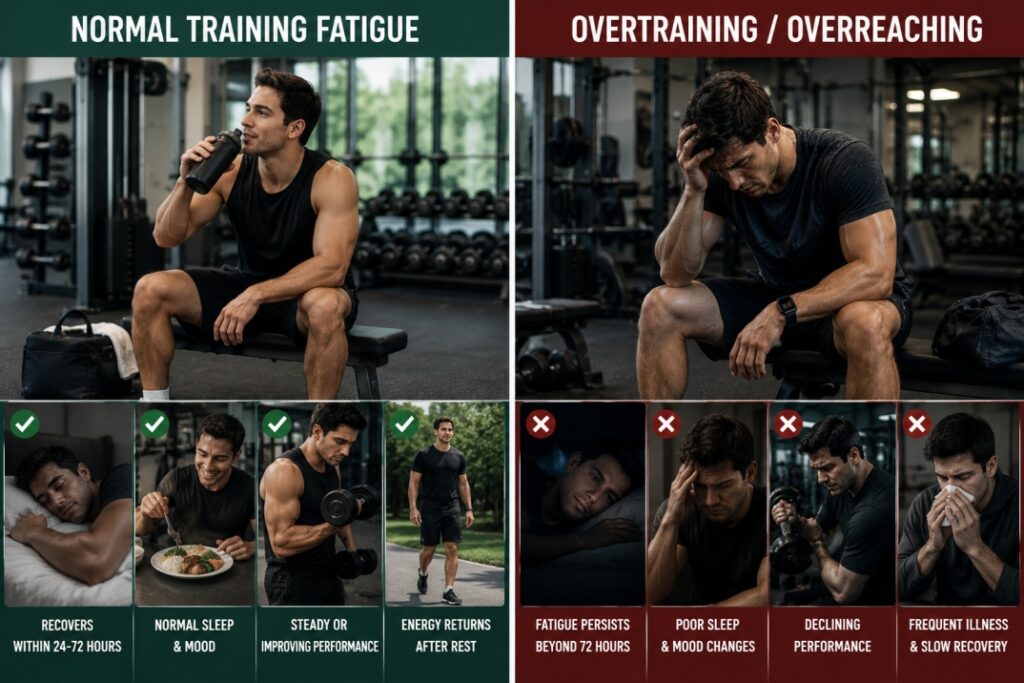
Normal training fatigue is localized, resolves within 24 to 72 hours, does not significantly affect mood or sleep, and does not cause performance decline across consecutive sessions. You may feel sore, stiff, or tired the day after a hard training session. That is expected and appropriate.
Overreaching involves systemic fatigue rather than localized soreness, persists through rest days, affects sleep quality and mood, and is associated with declining performance rather than stable or improving performance. If three or more of the warning signs listed above are present simultaneously, overreaching is the more likely explanation.
How to Recover from Overtraining Syndrome
Recovery from OTS or non-functional overreaching requires a systematic reduction in training stress combined with active support of the body’s repair systems. The approach depends on severity.
Step 1: Reduce Training Volume Immediately
The first and most important step is to reduce total training volume by 40 to 60 percent. This means fewer sets, fewer sessions per week, or both. You do not need to stop training entirely in most cases, but you do need to create a significant recovery window. For beginners experiencing mild overreaching, one to two weeks of reduced volume is often sufficient to restore performance.
Step 2: Prioritize Sleep Above Everything Else
Sleep is the most powerful recovery mechanism available. During slow-wave sleep, the body releases growth hormone, restores neurotransmitter levels, and completes the tissue repair that training initiated. Targeting eight to nine hours per night and maintaining a consistent sleep schedule are the highest-return recovery interventions available. A structured recovery routine that incorporates sleep as a non-negotiable component addresses the most significant driver of recovery at a systemic level.
Step 3: Increase Dietary Protein and Total Calorie Intake
If you have been training in a calorie deficit, the combination of reduced energy availability and high training stress significantly worsens overreaching. Increasing caloric intake toward or slightly above maintenance during the recovery period removes the energy constraint and accelerates tissue repair. Protein intake should remain at or above 1.6 grams per kilogram of body weight throughout recovery.
Step 4: Use Active Recovery on Non-Training Days
Gentle movement on non-training days promotes blood flow to recovering tissue, reduces stiffness, and supports the lymphatic clearance of metabolic waste products without adding meaningful training stress. A 20 to 30 minute walk, light yoga, or easy swimming qualifies as active recovery. The goal is to feel better after the activity than you did before it. Understanding the difference between training through soreness and smart active recovery gives you the framework to make this distinction accurately.
Step 5: Monitor Objective Recovery Markers
Track resting heart rate, sleep quality, and subjective mood ratings during the recovery period. These markers provide more reliable feedback than subjective feelings of readiness alone. When resting heart rate returns to baseline, sleep quality normalizes, and mood improves, the recovery process is progressing. Resuming full training volume before these markers stabilize risks cycling back into overreaching.
How Beginners Can Prevent Overtraining Syndrome
Prevention is straightforward in principle but requires consistent application of a few foundational habits.
Follow a Structured Program With Built-In Rest
Programs designed by qualified coaches include rest days and deload periods precisely because the designers understand recovery physiology. Following a structured beginner program rather than improvising daily training decisions removes the guesswork and builds appropriate recovery into the schedule automatically.
Apply Progressive Overload Gradually
The most common path to overreaching is increasing training intensity, volume, and frequency simultaneously. Progressive overload should be applied to one variable at a time. Add weight to an exercise, or add a set, or add a training day. Do not do all three in the same week.
Track Performance Across Sessions
Keeping a simple training log allows you to detect performance decline early. If your squat weight or rep count is dropping across consecutive sessions on the same program, that is actionable information. It does not necessarily indicate overtraining, but it does indicate that something in the balance between stress and recovery needs attention.
Take Nutrition and Sleep as Seriously as Training
Training without adequate sleep and protein does not produce adaptation. It produces accumulated stress with diminished repair. Every training session is a withdrawal from a recovery account. Sleep and nutrition are the deposits. Beginners who treat these as secondary to the workouts themselves consistently underperform relative to those who address all three with equal discipline.
Frequently Asked Questions
What is overtraining syndrome in beginners?
Overtraining syndrome is a clinical condition that occurs when training stress accumulates faster than the body can recover over an extended period. In beginners, it most commonly appears as non-functional overreaching, characterized by persistent fatigue, declining performance, mood disturbances, and increased injury susceptibility. It results from training too frequently or intensely without adequate rest and nutrition.
How long does it take to recover from overtraining?
Mild overreaching in beginners typically resolves within one to three weeks of reduced training volume and improved sleep and nutrition. More severe cases of non-functional overreaching can take several weeks to months. Full overtraining syndrome, the most serious form, may require months of significantly reduced or eliminated training to resolve completely.
Can you overtrain as a beginner?
Yes, and beginners are at elevated risk. The musculoskeletal system of an untrained individual has not yet adapted to regular training stress, which means recovery needs are proportionally higher than those of experienced athletes. The enthusiasm that drives many beginners to train every day is also the behavior most likely to cause overreaching in the early stages of training.
What does overtraining feel like?
Overtraining feels like persistent tiredness that does not resolve with rest, workouts that feel harder than they should at familiar weights, difficulty sleeping despite physical exhaustion, mood changes including irritability and low motivation, and a general sense of physical and mental heaviness that carries from session to session. These feelings persist for days or weeks rather than resolving after a single rest day.
Should I keep training if I think I am overtrained?
No. If three or more warning signs of overreaching are present simultaneously, the appropriate response is to reduce training volume significantly, prioritize sleep and nutrition, and monitor recovery markers before resuming full training. Continuing to push through genuine overreaching symptoms delays recovery and increases injury risk.
Final Say
Overtraining syndrome is not a myth. It is a documented physiological condition with measurable markers, predictable warning signs, and a clear recovery pathway. For beginners who are motivated and disciplined, it represents a real and underappreciated risk.
The solution is not to train less in general. It is to train with an awareness of the relationship between stress and recovery, to schedule rest as deliberately as you schedule workouts, to eat enough protein and sleep enough hours, and to treat declining performance and persistent fatigue as data rather than challenges to push through.
More training is not always better training. The beginner who trains intelligently, recovers consistently, and adjusts based on real feedback from their body will outperform the beginner who trains daily on pure enthusiasm every single time. Build the foundation correctly, and everything else follows.