What Is Muscle Memory? (And Why Returning to the Gym Is Easier Than You Think)
June 27, 2026
0
Skeletal muscle retains structural and neurological information from previous training long after the visible results of that training have faded. This is not a metaphor or a motivational
Skeletal muscle retains structural and neurological information from previous training long after the visible results of that training have faded. This is not a metaphor or a motivational claim. It is a documented biological phenomenon with mechanisms rooted in both neuroscience and cellular physiology, and understanding it changes how you should think about taking breaks from training.
When muscle memory is discussed in fitness circles, the conversation rarely goes deep enough. You hear that ‘the body remembers. But the mechanisms behind that memory explain far more than just why coming back feels easier. They also tell you what to prioritize, how quickly to expect recovery. And why the discouragement of starting over is largely unfounded. This article explains what is muscle memory explained at a scientific level, and what that science means for your training practice.
What Is Muscle Memory, Exactly?
Muscle memory is an umbrella term covering two distinct but related phenomena: neurological adaptation memory and myonuclei retention. Both contribute to faster strength and size regain after a training break, but they operate through entirely different mechanisms and on different timescales.
The term also sometimes refers to motor skill memory, which is the brain-body coordination that allows trained movements like a squat or a deadlift to feel automatic after sufficient repetition. This third type is real and relevant, but the more remarkable story is what happens at the cellular level inside the muscle fiber itself.
Neurological Muscle Memory
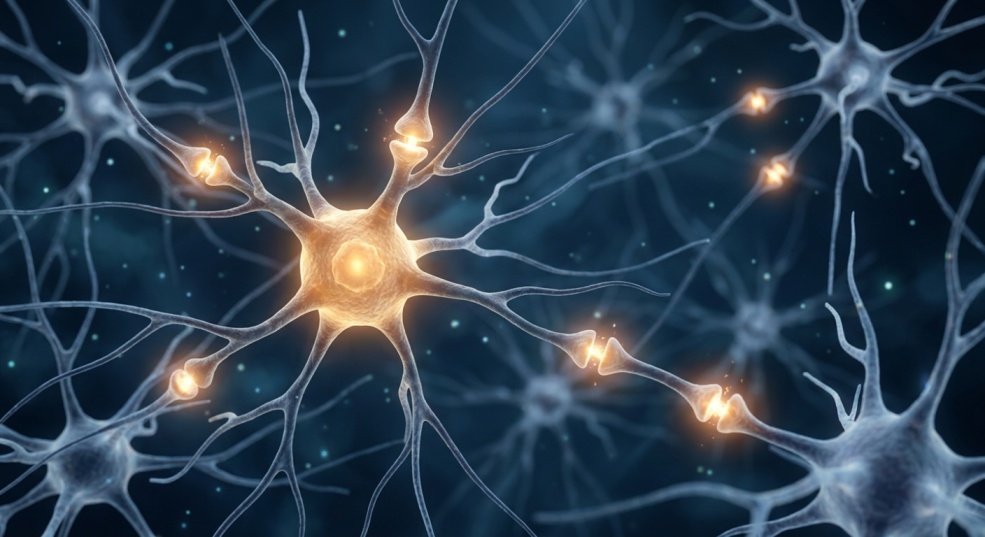
The nervous system is the faster and more immediately noticeable side of muscle memory. When you first learn a resistance exercise, your brain has to establish and reinforce the motor patterns needed to execute that movement efficiently. It recruits motor units, sequences activation across muscle groups, and calibrates the timing of contraction and relaxation across joint actions. This process takes weeks of repetition.
After a period of detraining, the motor patterns do not reset. Neural pathways, once established and myelinated through repeated use, remain intact far longer than the muscular fitness they were built to serve. Research published in the
Research in neuroscience has confirmed that the Journal of Physiology demonstrates that motor learning consolidates into long-term memory stores that are highly resistant to decay. When you return to the gym after weeks or months away, your brain already knows the movement. The recruitment patterns are still encoded. You just need to reactivate what was already built, not start from zero.
Myonuclei Retention: The Cellular Foundation
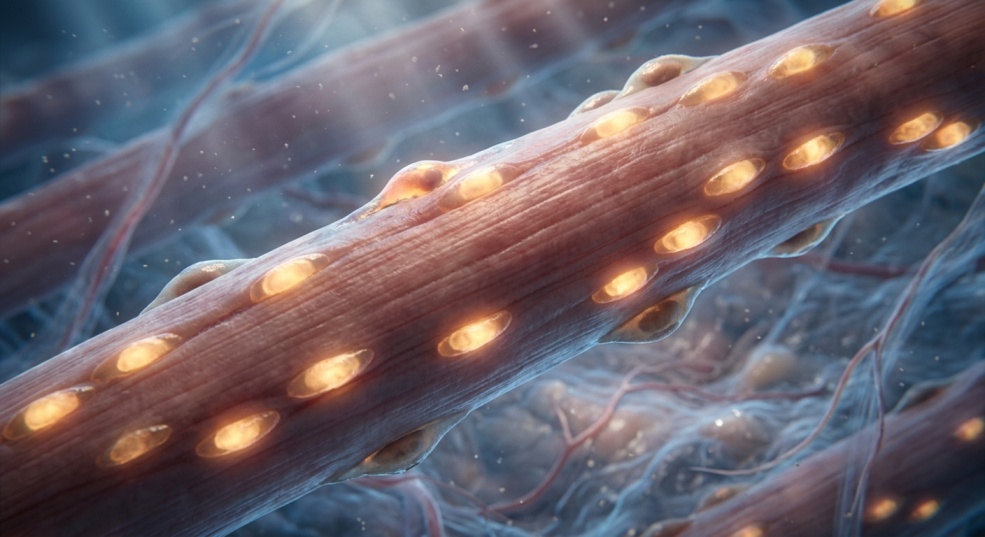
The more profound side of muscle memory lives inside the muscle fiber itself. To understand it, you need a quick piece of muscle biology. Unlike most cells in the body, mature muscle fibers are extraordinarily large and contain multiple nuclei, called myonuclei. These nuclei house the genetic machinery that directs the production of new muscle proteins, including the contractile proteins actin and myosin that give muscle its force-generating capacity.
When you train consistently, the muscle fiber grows larger through a process called hypertrophy. To support that growth, satellite cells, which are muscle stem cells that reside adjacent to muscle fibers, are recruited and donate their nuclei to the growing fiber. The myonuclei count in the fiber increases.
Here is where muscle memory becomes genuinely surprising. When you stop training and the muscle atrophies back toward its pre-training size, those myonuclei do not disappear. A landmark study published in the Proceedings of the National Academy of Sciences found that myonuclei acquired through training are retained in muscle fibers for months, and potentially years, after training ceases. The muscle fiber shrinks, but it keeps its expanded nuclear domain.
When you return to training, those retained myonuclei can immediately begin directing protein synthesis without waiting for new satellite cell recruitment. The fiber can grow back toward its previous trained size far more rapidly than it could the first time, when it had to build its nuclear infrastructure from scratch.
What Is Muscle Memory Explained Through Research?
The science of myonuclei retention has been most thoroughly studied in animal models, but human evidence is accumulating and consistent with the mechanism. What the research shows is both clear in principle and practically significant.
In one frequently cited study involving rodent muscle fibers, researchers observed that fibers with elevated myonuclei counts from prior training grew back approximately twice as fast as fibers that had never been trained, when an equivalent training stimulus was reapplied. The nuclear advantage translated directly into a speed advantage in regaining muscle mass.
Human studies using magnetic resonance imaging and muscle biopsy analysis have produced consistent findings. A 2013 paper in the Journal of Applied Physiology tracked previously trained individuals through a period of detraining followed by retraining and found that the retraining phase produced faster strength and mass regain than the initial training phase had, even when the subjects had returned to untrained baseline levels of muscle size.
The implication is significant. Even when the visible results of training are entirely gone, the cellular machinery that made those results possible remains dormant inside the muscle fiber, waiting for the stimulus to reactivate it.
How Quickly Does Muscle Come Back?
The timeline for regaining lost muscle and strength is highly individual, but it is consistently faster than initial development. Several variables determine the pace of regain.
The duration of the training break matters, though perhaps less than most people assume. Short breaks of two to four weeks produce little meaningful muscle loss in trained individuals, largely because neurological function remains intact and the small amount of fiber atrophy that does occur reverses quickly. Longer breaks of three to six months produce more significant atrophy but leave the myonuclei infrastructure intact, allowing faster rebuild than the original build.
Training age matters considerably. Someone who trained for several years before taking a break has a larger myonuclei pool than someone who trained for only a few months. The longer and more seriously you trained before the break, the more pronounced the muscle memory advantage when you return.
Individual genetics, hormonal environment, sleep quality, and protein intake all influence the speed of regain, just as they influenced the original development. Ensuring adequate protein intake, typically in the range of 1.6 to 2.2 grams per kilogram of body weight daily, maximizes the rate at which retained myonuclei can direct protein synthesis back toward previous levels.
Muscle Memory and Training Consistency: What This Means for Beginners
Understanding muscle memory reframes one of the most common sources of discouragement for beginners: the fear that taking time off means starting from scratch. It does not.
There is a reason that building a consistent training habit is often more valuable than any specific program or training approach. The neurological and cellular adaptations that accumulate through consistent training become the foundation that makes every future training period easier and more productive. Each block of consistent training adds to a biological record that your body does not quickly erase.
This is also why beginners who train consistently for even eight to twelve weeks, then stop for a period, come back faster than pure beginners. The foundation was laid. The myonuclei were recruited. The motor pathways were encoded. Returning is reactivation, not reconstruction.
That said, muscle memory does not make recovery from long breaks effortless or immediate. Tendons and connective tissue do not retain adaptation the same way muscle fibers do. Cardiovascular fitness declines faster than muscular strength and does not benefit from the myonuclei mechanism. And movement skill, while well-retained, still requires a few sessions to feel sharp again. The return still requires patience and appropriate progression.
Common Misconceptions About Muscle Memory
Misconception: Muscle Memory Only Applies to Skilled Movements
This is the most widespread misunderstanding. When people hear ‘muscle memory’ in casual conversation, they usually mean motor skill automaticity, the way a practiced movement feels effortless. This type of memory is real, but it represents only part of the story. The myonuclei retention mechanism is a separate and arguably more important phenomenon for anyone focused on building and maintaining strength and muscle mass.
Misconception: A Long Break Erases Your Progress
The cellular record of training is far more durable than the visible results. Progress does not erase. It becomes dormant. Myonuclei persist through months of detraining. Neural pathways remain encoded. The fitness built over years of training does not vanish during a few months away from the gym. It waits.
Misconception: Detraining Is the Same for Everyone
The rate of muscular detraining is significantly slower in more experienced trainees. A beginner may notice meaningful strength declines after two to three weeks of complete inactivity. A trained individual may retain the majority of their strength for four to six weeks without training. Understanding what happens in the first 30 days of working out helps clarify how quickly adaptations build, which in turn gives context for how they are retained when training stops.
Practical Application: Returning to the Gym After a Break
Knowing that muscle memory exists does not mean you should ignore progression logic on your return. The smart way to come back is with appropriate volume management, patience with connective tissue adaptation, and realistic timelines.
In the first one to two weeks back, aim to perform familiar exercises at reduced volume and moderate intensity. Your muscles can handle more stimulus than connective tissue can initially tolerate, because muscle adapts faster than tendon and ligament. Jumping immediately back to peak training loads dramatically increases injury risk, even when strength returns quickly.
By weeks three to four, most returning trainees find that their strength has returned significantly faster than expected. Former training maxima that took months to build the first time often reappear within four to eight weeks of consistent retraining. This is the muscle memory advantage in practice.
If you are returning to training after an injury or extended break, combining your return with appropriate recovery practices is important. The site’s guide on what is active recovery and why rest days matter is worth reading alongside your return-to-training plan.
Frequently Asked Questions
Is muscle memory real or just motivational talk?
Muscle memory is a documented biological phenomenon with two distinct mechanisms: retained neural motor pathways and myonuclei persistence inside muscle fibers. Both are supported by peer-reviewed research, not motivational messaging.
How long do myonuclei last after you stop training?
Animal studies have found myonuclei persisting for over three months after training cessation. Human evidence suggests the retention window may be substantially longer, potentially years in individuals with significant prior training histories.
Can beginners benefit from muscle memory?
Yes. Even a few months of consistent training creates a neurological and cellular foundation that makes any future training period more productive. The muscle memory advantage grows with training experience, but it begins accumulating from the first consistent training block.
Does muscle memory work the same way for strength and size?
Both strength and size regain are accelerated by muscle memory, but through slightly different mechanisms. Strength regain benefits heavily from the neurological side of muscle memory, while size regain is driven primarily by myonuclei retention and their ability to immediately direct protein synthesis.
How should I train when coming back after a long break?
Start at roughly 50 to 60 percent of your previous training volume and allow at least two weeks for connective tissue to readapt before progressively increasing load. Your muscle strength will return faster than your joints and tendons, so manage the gap carefully.
Wrap Up
Muscle memory is one of the most underappreciated concepts in fitness education, largely because it is talked about without being properly explained. The science behind it, from the durability of motor pathways to the persistence of myonuclei inside muscle fibers, tells a story that is both scientifically fascinating and immediately practical.
What is muscle memory explained in plain terms? It is your body’s biological record of previous training, encoded in your nervous system and stored inside your muscle cells, waiting to be reactivated when you return to the gym. The work you did before a break is not lost. It is banked.
Coming back to training after a period away is not starting over. It is returning to a foundation that still exists, even when the visible results above it have faded. For anyone who has ever walked back into a gym after months away and felt defeated before a single set, that is not just encouragement. That is the biology.