Foam Rolling for Beginners: Does the Science Actually Support It?
- June 30, 2026
- 0
Walk into almost any commercial gym and you will find a foam roller sitting in the corner, usually being either ignored completely or used in ways that bear
Walk into almost any commercial gym and you will find a foam roller sitting in the corner, usually being either ignored completely or used in ways that bear
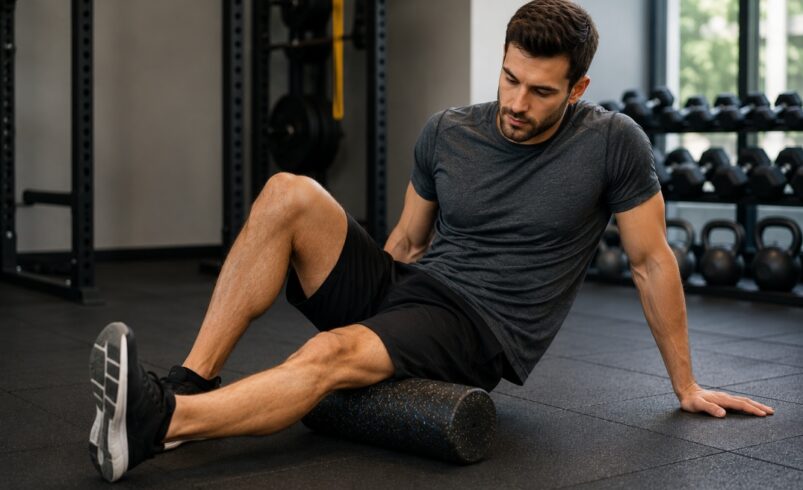
Walk into almost any commercial gym and you will find a foam roller sitting in the corner, usually being either ignored completely or used in ways that bear no resemblance to what the research actually suggests. Foam rolling has accumulated a reputation built partly on legitimate evidence and partly on extrapolated claims that the science does not cleanly support.
The honest answer to whether foam rolling benefits for beginners explained by the research is ‘yes, but not for the reasons most people think, and not in the way most people do it.’ Understanding what foam rolling actually does, what it cannot do, and how to use it effectively is considerably more useful than the vague advice to ‘roll your muscles for recovery’ that most beginners receive.
Foam rolling is a form of self-applied soft tissue pressure, technically called self-myofascial release or SMR. By rolling your body over a cylindrical foam device, you apply sustained and moving compressive force to muscle tissue, fascia, and the connective structures surrounding them.
The practice originated in physical therapy and sports rehabilitation before migrating into mainstream fitness. Equipment ranges from basic low-density foam cylinders to high-density textured rollers and vibrating devices. For beginners, a standard medium-density foam roller is adequate to get the benefits the research supports.
Foam rolling is not massage in the clinical sense. No external force is being applied by a practitioner with training in soft tissue manipulation. Instead, you are using your own body weight to create pressure, and you control both the location and the duration of that pressure. This makes the technique accessible, low-cost, and safe for most people to use independently.
The most consistently replicated finding in foam rolling research is a short-term improvement in range of motion. A meta-analysis published in the Journal of Athletic Training analyzed multiple controlled trials and found that foam rolling produced significant acute increases in flexibility in the joints surrounding the rolled muscle groups. These improvements were statistically meaningful and appeared within a single session.
The catch is the word ‘acute.’ The flexibility gains from a foam rolling session last roughly ten to twenty minutes in most studies. This does not mean the practice is useless, but it does mean the gains are time-sensitive. Rolling before a training session or stretching routine takes advantage of this window. Rolling in the morning and training in the evening likely captures none of it.
For beginners whose mobility often limits their ability to perform key compound movements with proper form, even a temporary range of motion improvement at the right time can meaningfully improve training quality and reduce injury risk.
Several randomized controlled trials have found that foam rolling after exercise reduces the severity and duration of delayed onset muscle soreness (DOMS). A study published in the Journal of Athletic Training assigned subjects to foam rolling or passive rest following an intense squat protocol. The foam rolling group reported significantly lower soreness scores at 24, 48, and 72 hours post-exercise, and also performed better on force production tests during the soreness period.
The proposed mechanism involves several factors. Compression may temporarily alter the pain signaling from sensitized nociceptors in sore tissue. The movement component of rolling may accelerate local blood flow, speeding the delivery of repair nutrients and the clearance of inflammatory byproducts, similar to the mechanism behind active recovery.
This connects logically to the broader recovery picture that active recovery practices support. Foam rolling occupies a similar space: it is not a passive intervention. It involves gentle mechanical input to tissue that promotes circulation without adding meaningful training stress.
One of the more practically relevant findings is that foam rolling before training, unlike traditional static stretching, does not appear to reduce force production in the muscles being treated. This matters because the evidence on static pre-exercise stretching consistently shows that long-duration holds reduce peak strength and power output by small but measurable amounts.
Pre-training foam rolling produces range of motion benefits comparable to static stretching while preserving force production. For strength training sessions where peak performance matters, this distinction is relevant. Rolling before a session can open up range of motion for deeper squats or fuller deadlift positioning without the force decrement associated with a prolonged static stretch.
The research is also clear about what foam rolling cannot accomplish, and several popular claims about the practice are not well supported.
One of the most repeated claims is that foam rolling ‘breaks up’ adhesions, knots, or scar tissue. This is anatomically implausible. The force generated by body-weight self-applied pressure is nowhere near sufficient to physically disrupt organized scar tissue or collagen adhesions. These structures require levels of force and specificity available only through surgical or clinical intervention.
The ‘knots’ you feel while rolling are not structural adhesions. They are likely hypercontracted motor units, localized areas of increased fascial tension, or trigger points, which are themselves a topic of ongoing debate in the research literature. Rolling may reduce the sensitivity and perceived tension in these areas, but not through any mechanical breaking or disruption.
Foam rolling produces temporary range of motion improvements, but the adaptations that create lasting flexibility come from consistent static and dynamic stretching over time. Rolling is a useful adjunct to a mobility practice, not a replacement for it. Beginners who roll regularly but never stretch will not build meaningful long-term flexibility.
Foam rolling has no direct effect on hypertrophy. It does not increase muscle protein synthesis or alter the anabolic signaling pathways that govern muscle growth. The contribution it makes to muscle building, if any, is indirect: by reducing soreness and improving mobility, it may allow beginners to train more consistently and with better technique, both of which support long-term muscle development.
The practical protocol matters as much as the decision to roll in the first place. Most beginners roll incorrectly in ways that reduce the effectiveness of the practice and occasionally increase discomfort unnecessarily.
Research protocols that produced positive outcomes typically used rolling durations of 30 to 90 seconds per muscle group. Spending five seconds on a muscle and moving on is insufficient to produce the neurological response associated with tension reduction. Spending five minutes on one area is similarly unproductive. One to two minutes per major muscle group is a practical and evidence-aligned target.
The goal is moderate, sustainable pressure, not pain. Many beginners assume that more discomfort means more benefit, which is not what the research supports. Extreme pressure that produces sharp or stabbing pain is more likely to trigger a protective muscle contraction, which actively counteracts the relaxation response you are trying to elicit. Position your body to allow roughly 50 to 70 percent of your body weight to load the roller, using your hands or elbows to offset some of the pressure as needed.
Pre-training rolling is best used to address specific areas of tightness that limit movement quality in your session. Keep sessions short, five to ten minutes targeting the joints and muscles most relevant to that day’s training. Post-training rolling is appropriate for targeting sore areas with the goal of reducing next-day DOMS. A 10 to 15 minute post-session roll across the trained muscle groups is a reasonable and evidence-supported habit.
For anyone dealing with soreness between sessions, foam rolling fits naturally into a recovery strategy. If you are unsure whether your soreness is normal training adaptation or something to be concerned about, the FitRoutineLab guide on working out with sore muscles gives clear guidance on when movement is appropriate and when rest is the better call.
The muscle groups that tend to produce the most meaningful benefit from foam rolling are those chronically tight in sedentary individuals: hip flexors, quadriceps, hamstrings, thoracic spine, calves, and the muscles surrounding the IT band. Beginners coming from desk-based lifestyles often have significant tightness in these areas that limits their ability to perform squats, lunges, and hip hinge patterns safely and effectively.
The IT band itself deserves specific mention. Rolling directly on the iliotibial band is extremely common but not especially effective. The IT band is a thick, dense connective structure with very limited capacity to change shape under the pressure of a foam roller. Rolling the structures adjacent to it, particularly the TFL muscle at the hip and the lateral quad, produces more useful results.
The short answer is yes, with appropriate expectations. Foam rolling produces real, research-supported benefits in acute flexibility, DOMS reduction, and pre-training range of motion. The benefits are meaningful for beginners who are managing soreness from initial training adaptations and developing the mobility needed for safe execution of fundamental exercises. The site’s discussion of overtraining syndrome and its signs is relevant here: when a beginner is accumulating fatigue and soreness across training days, foam rolling is one of several practical tools for managing recovery load without interrupting training continuity.
The time investment is modest. A five to fifteen minute rolling session produces real outcomes. The equipment cost is low. The technique is simple enough to learn from a single good demonstration. The risk of harm from correct usage is minimal.
The practice is genuinely worth adding to a beginner’s routine, not as the cornerstone of a recovery strategy, but as a practical tool that complements the more fundamentally important elements: adequate sleep, sufficient protein intake, appropriate training volume, and scheduled rest days. Roll with accurate expectations and you will find it earns its place in the routine.
Yes, within specific parameters. Peer-reviewed research supports foam rolling as a method for reducing delayed onset muscle soreness and temporarily improving range of motion. The benefits are real but time-limited, making timing an important variable in how effectively the technique is applied.
Spend 30 to 90 seconds per muscle group, targeting the areas most relevant to that day’s training or the areas carrying the most soreness. A total session of five to fifteen minutes is appropriate for most beginners.
Both have merit and serve different purposes. Pre-training rolling addresses tightness that limits movement quality in the session. Post-training rolling targets soreness management and is most effective when done within an hour of finishing training.
Moderate discomfort is normal, particularly over tight or sore areas. Sharp or stabbing pain is not appropriate and signals either too much pressure or that the area is not suitable for rolling. Use enough pressure to feel the tissue responding, not enough to trigger a pain response or breath-holding.
Yes. Unlike training, foam rolling does not create meaningful mechanical damage to tissue and does not require rest for recovery from the practice itself. Daily rolling at appropriate pressure is safe and beneficial for most beginners.
Not independently. Foam rolling produces acute flexibility improvements that fade within twenty minutes. Long-term mobility improvements require consistent stretching practice performed regularly over time. Rolling is best used alongside a stretching routine, not as a substitute for one.
Foam rolling is not the revolutionary recovery tool that its most enthusiastic advocates claim, and it is not the useless gimmick that its most skeptical critics suggest. The research places it somewhere more useful than either extreme: a low-cost, low-risk, modest-benefit practice with specific and well-defined applications.
Foam rolling benefits for beginners explained through the science include acute range of motion improvements, meaningful DOMS reduction following challenging sessions, and pre-training mobility work that does not compromise force output. These benefits are real, practically accessible, and worth integrating into a broader recovery approach.
Use a foam roller as one component of a recovery practice that prioritizes sleep, protein intake, appropriate training volume, and scheduled rest. Do not expect it to compensate for inadequate sleep or excessive training load. Within those honest expectations, it earns a consistent place in a beginner’s routine.