Why Beginners Hit a Plateau in Weight Training (And the Real Reason It Happens)
- July 4, 2026
- 1
Most of the strength a new lifter gains in the first two months has almost nothing to do with muscle size. It comes from the nervous system learning
Most of the strength a new lifter gains in the first two months has almost nothing to do with muscle size. It comes from the nervous system learning

Most of the strength a new lifter gains in the first two months has almost nothing to do with muscle size. It comes from the nervous system learning to recruit existing fibres more efficiently, a process that runs its course quickly and then stops delivering results. That single fact explains why a beginner can add weight to the bar nearly every session for weeks, and then, seemingly overnight, stall completely.
The stall feels personal. It isn’t. It’s a predictable biological transition, and once you understand what’s actually happening inside the muscle, the fix becomes obvious rather than mysterious.
If you’re currently working through a structured programme such as the full-body muscle-building routine for beginners, this article explains the science behind why that progress can stall, and exactly what to adjust when it does.
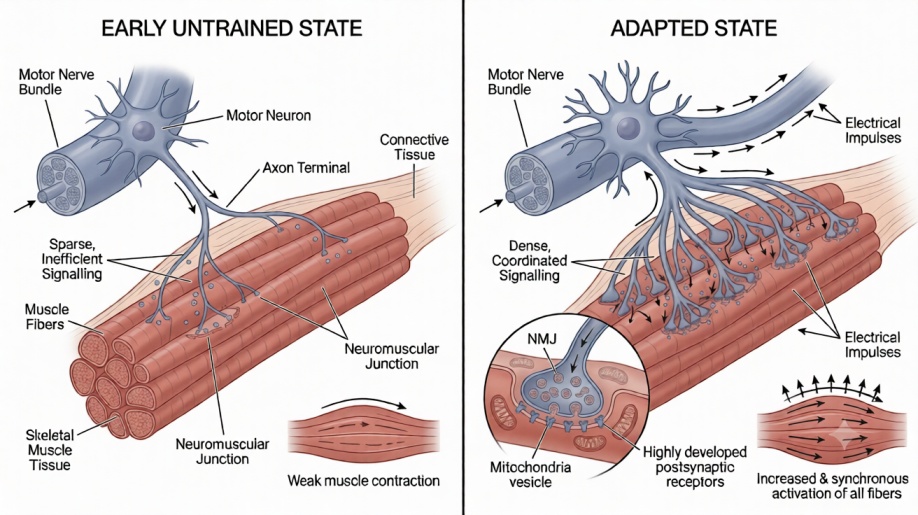
The rapid early gains that almost every new lifter experiences have a specific name in exercise science: neural adaptation. When resistance training begins, the nervous system has to learn how to recruit muscle fibres efficiently and coordinate movement patterns it has never practised. In the first four to eight weeks, most strength increases are not new muscle tissue at all. They come from the brain getting better at signalling the muscle that’s already there.
This is why a complete beginner can add noticeable strength within days of starting a programme, well before any meaningful hypertrophy has had time to occur. The neuromuscular system adapts at a pace that simply cannot continue once those adaptations are complete.
Research summarised by the National Strength and Conditioning Association (NSCA) confirms that neural adaptations account for the majority of strength gains during the first eight to twelve weeks of resistance training, particularly in previously untrained individuals. So it isn’t unusual or a bad sign to hit a wall around week four to six. For most beginners, this is exactly the point where the nervous system’s adaptations have largely run their course and the body has to switch to the slower, more demanding work of actual muscle growth.
Muscle doesn’t grow in response to effort on its own. It grows in response to a stimulus that exceeds what it’s already capable of handling. In the first weeks of training, almost any load qualifies as a novel stress, so the muscle adapts, repairs, and rebuilds slightly larger and stronger to prepare for it next time.
The problem is that once a muscle has adapted to a given load, that same load no longer counts as a sufficient stimulus. It has effectively been memorised. Repeating the same weight for the same number of repetitions delivers a demand the body has already met, so there’s nothing new to adapt to. This single mechanism explains the majority of beginner plateaus, and it is almost entirely preventable through consistent progressive overload.
Progressive overload is the principle that training has to become progressively more demanding over time to keep driving adaptation. When beginners stop increasing the challenge, whether by accident or because a routine feels comfortable, growth stops with it. The body settles into balance with the current stimulus and simply maintains rather than develops further.
Reintroducing that challenge can mean adding weight, adding reps, adjusting rest periods, or increasing total training volume, and the specific mechanics of how to do each one safely are broken down in Progressive Overload for beginners. At least one of these variables needs to change on a rolling basis. A common beginner mistake is treating a programme as a fixed routine to repeat indefinitely rather than a framework built to be added to over time. Without that progression, a plateau isn’t a possibility; it’s a guarantee.
Muscle doesn’t grow during the workout. It grows during the recovery period that follows it. A training session creates small amounts of mechanical damage in the muscle fibres, and the body repairs that damage and reinforces the tissue slightly stronger than before. That repair process depends entirely on adequate sleep, nutrition, and rest between sessions.
Many beginners plateau not because they aren’t working hard enough, but because they’re working hard without giving the body enough room to recover. Training creates the signal for growth. Recovery is where the growth actually happens. Chronic sleep deprivation directly interferes with this. A study published in PMC examining glucocorticoid response to exercisefound that chronically elevated cortisol, which rises with insufficient sleep and high psychological stress, suppresses the anabolic hormonal environment needed for muscle protein synthesis. When recovery is consistently poor, the biological conditions for growth simply aren’t being met, regardless of how hard a session was.
The instinctive reaction to a plateau is to push harder: add sets, add gym days, push through more fatigue. It’s understandable, and it often makes the problem worse.
When a plateau is caused by insufficient progressive overload, adding more of the same training changes nothing, because it isn’t a new stimulus, just more volume of a stimulus the body has already adapted to. When the cause is poor recovery, adding more training actively worsens the situation. The body falls further behind on repair, fatigue accumulates, and performance drops instead of improving. In its mild form this is called overreaching; left unaddressed, it can progress into overtraining syndrome.
The fix for a plateau is almost never simply doing more of what you’ve already been doing. It requires a targeted change: a smarter adjustment to a training variable, a genuine recovery improvement, or both together.
Most beginner plateaus resolve by adjusting one or two variables within an existing programme rather than replacing it entirely. Work through the following steps in order before concluding the programme itself is the problem.
Look at your training log from the past three to four weeks and ask directly: has anything actually changed? Weight, reps, working sets, rest periods? If the honest answer is no across the board, that’s both your cause and your fix. Pick one variable and make it slightly harder. The two-rep rule is a useful guideline: when you can perform two extra reps above your target range on your final set for two consecutive sessions, it’s time to add weight.
Volume, meaning total working sets per muscle group per week, is one of the biggest drivers of hypertrophy. A systematic review and meta-analysis published in the Journal of Sports Sciences found a graded, dose-response relationship between weekly set volume and muscle growth, generally supporting a range of ten to twenty working sets per muscle group per week for continued gains. If your set count hasn’t changed since you started, you may have simply outgrown what that volume can stimulate. The 8-week bodyweight-to-weight training plan shows how volume should be structured to increase progressively across a programme, which is a useful reference point for where your current routine may have stalled.
If overload is genuinely in order and progress has still stopped, recovery is the next variable to examine. Seven to nine hours of quality sleep isn’t optional for meaningful growth; it’s the window when growth hormone secretion and muscle protein synthesis both run at their highest. A PubMed study on cortisol and age-related muscle strength reinforces why this matters: elevated cortisol, which climbs with poor sleep, was directly associated with reduced muscle mass and strength outcomes. Practical adjustments include consistent sleep and wake times, reduced screen exposure before bed, deliberate stress management, and at least one to two full rest days per week.
Muscle can’t be built from nothing. Protein supplies the raw material for new tissue, and total calorie intake determines whether the body has the energy available to run repair processes efficiently. The evidence-based target for muscle building is roughly 1.6 to 2.2 grams of protein per kilogram of body weight per day. Harvard Health’s guidance on protein timing notes the body makes best use of protein in doses of roughly 20 to 40 grams at a time, which is why spreading intake across three to five meals tends to outperform loading it into one or two sittings, a structure laid out in more detail in the daily at-home fitness and nutrition routine. Protein alone won’t fix a plateau if progressive overload is missing, since nothing is triggering the repair process in the first place, but consistently under-fuelling training will stall growth even when everything else is right.
A deload is a planned, short-term reduction in training volume or intensity that allows accumulated fatigue to clear. Many coaches build one in every four to eight weeks regardless of whether a plateau is present. For beginners who have trained consistently for eight or more weeks without a break, a deload often restores performance on its own.
| Training Variable | Normal Working Week | Deload Week |
| Working sets per exercise | 3–4 sets | 1.5–2 sets (about 50% reduction) |
| Load used | 100% of working weight | 60–70% of working weight |
| Rep range | Target range as programmed | Same movement pattern, lighter effort |
| Primary goal | Drive adaptation | Dissipate fatigue, maintain skill |
Exercise variation can also play a role here, but it works best as a deliberate tool rather than a reflex. Swapping movements can reintroduce a novel stimulus when the nervous system has fully adapted to a specific pattern, which is genuinely useful. Rotating exercises too frequently, however, prevents the skill development and consistent loading that long-term strength and size actually depend on. Use variation strategically, not as an escape from a programme that has simply gotten harder.
A plateau isn’t only a physiological event. It’s also a significant moment in the psychology of training. The rapid early gains of the beginner phase create an expectation of continuous, visible progress. When that progress decelerates, many beginners read it as proof the approach isn’t working, or that they lack the genetics to improve further.
Neither is accurate. The slowdown is a predictable response to adaptation, and it simply marks the end of the easy neural-gains phase. Continued progress from here requires more deliberate attention to the variables involved, not a different genetic starting point. That’s not a failure. It’s the natural handoff from beginner to intermediate training, and with the right adjustments, most beginners see renewed progress within two to three weeks.
The lifters who push through this stage, rather than abandoning the programme or switching routines impulsively, are consistently the ones who make the most reliable long-term progress. Staying the course while making targeted, evidence-based adjustments beats starting over almost every time.
A beginner plateau in weight training isn’t a sign that progress is finished. It’s a biological checkpoint marking the end of the easy adaptation phase and the start of more deliberate training. Understanding that muscle responds to progressive challenge, not to repetition of a stimulus it has already mastered, is the single most useful shift a beginner can make.
Check your progressive overload first. Assess your recovery and sleep second. Review your nutrition third. In most cases, the answer is sitting in one of those three places, and the fix is a targeted adjustment rather than a new programme altogether.






1 Comment
[…] across several weeks in a row, rather than a single session, that is when it is worth looking into why progress has stalled and adjusting volume, intensity, recovery, or nutrition accordingly. How long results actually take […]