How to Warm Up Before a Workout (The Beginner 5-Minute Protocol)
- August 19, 2026
- 3
Picture the last time you walked straight from the car to the squat rack. Cold hips, stiff shoulders, and a first set that felt heavier than it had
Picture the last time you walked straight from the car to the squat rack. Cold hips, stiff shoulders, and a first set that felt heavier than it had

Picture the last time you walked straight from the car to the squat rack. Cold hips, stiff shoulders, and a first set that felt heavier than it had any right to. That’s not bad luck. That’s what happens when the body hasn’t been given a few minutes to catch up before the real work starts.
A proper warm-up before a workout raises muscle temperature, opens up the joints through the ranges the session is about to ask for, and gets the nervous system firing before the working sets begin. Done right, it takes about five minutes. Here’s a practical warm-up beginners can actually use, why each piece of it matters, and how to shift it depending on what the workout looks like.
Raising muscle temperature is the main task. Warmer tissue contracts more efficiently and moves through a joint’s range with less resistance, which is a big part of why a rushed cold set feels stiffer than the second or third set of the same lift.
A 2024 study using infrared thermography found that both static and dynamic warm-ups measurably raised knee temperature before a change-of-direction drill, with the dynamic protocol producing a faster rise in the muscles doing the most work (Trovato et al., Frontiers in Physiology). That temperature shift shows up again and again across warm-up research, and it’s the physiological reason a warm-up needs actual movement, not a few seconds of standing around rolling the shoulders.

The second job is neuromuscular. Light, progressively loaded movement wakes up the motor units that will need to fire during the working sets, so the first real rep doesn’t feel like the body is starting from a dead stop.
For most beginner sessions, five minutes covers it, as long as that time goes toward movement that raises heart rate and takes the joints through a full range, not passive stretching.
Heavier strength days or high-intensity cardio can justify a longer warm-up, but a beginner running a full-body routine a few times a week doesn’t need to spend ten or fifteen minutes getting ready. By the end, you want to feel noticeably warmer and slightly out of breath, not tired before the first working set has even started.
A good warm-up moves from general to specific. It opens with movement that gets blood flowing through the whole body, then narrows toward whatever joints and muscles the workout is about to load.
General movement comes first. Marching in place, a light jog on the spot, or a few rounds of jumping jacks gets things moving without draining energy.
Dynamic mobility comes next. Leg swings, arm circles, hip openers, and torso rotations take the joints through the ranges they’ll need, without holding any position long enough to count as a stretch.
Static stretching, where a muscle is held in a lengthened position for 20 to 30 seconds, works better after the workout than before it. Research reviewed by the National Strength and Conditioning Association has repeatedly linked pre-exercise static stretching to short-term drops in strength, power, and speed, especially once a stretch is held past 45 to 60 seconds (NSCA). A more recent meta-analysis found the same pattern, reporting consistent acute strength and power reductions following pre-exercise static stretching (Warneke et al., 2024). None of this makes static stretching bad. It just fits better at the end of a session, or as its own thing, than right before a set of squats.

This sequence works as a default before most beginner strength or cardio sessions. Each block runs for roughly one minute.
| Time | Movement | How to Do It | What It Prepares |
| 0-1 min | March or jog in place | Lift knees to hip height, swing arms naturally | Raises heart rate and core temperature |
| 1-2 min | Arm circles and shoulder rolls | Small circles building to large ones, both directions | Shoulders and upper back for pressing or pulling |
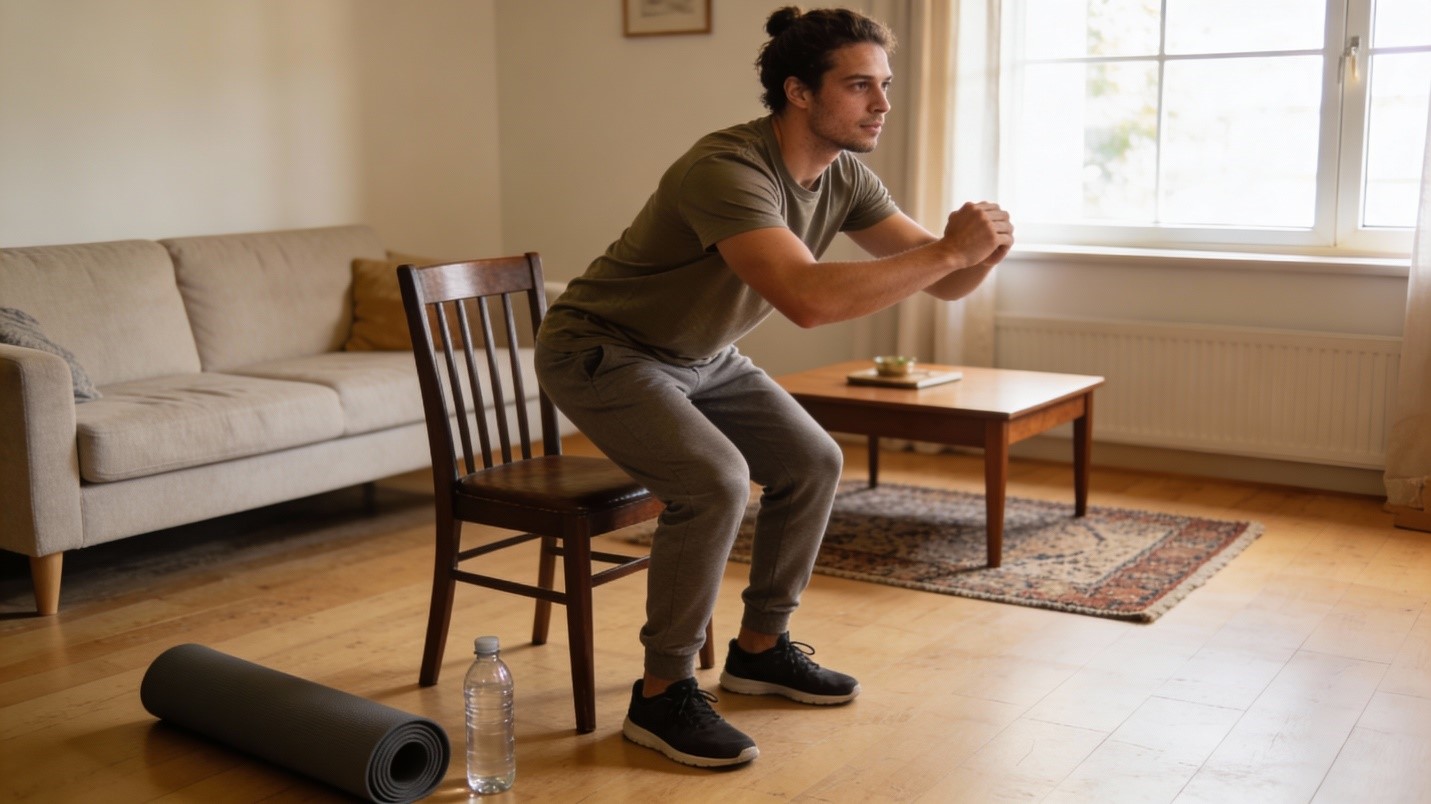
| 2-3 min | Bodyweight squats | Slow, controlled reps through a full comfortable range | Hips, knees, and ankles for lower-body work |
| 3-4 min | Walking lunges with a twist | Step forward, rotate torso toward the front leg | Hips, core, and balance |
| 4-5 min | Inchworms or hip circles | Hinge at the hips, walk hands out, walk back in | Hamstrings, lower back, and hip mobility |
By the fifth minute, breathing should be a little elevated and the muscles should feel looser than when you started. That’s the cue the body is ready for the working sets.
The five-minute sequence above is a starting framework, not a fixed script. A few small swaps make it more specific to whatever’s on the schedule.

Before a strength workout, tack on a light warm-up set or two of the first exercise itself, using an empty bar or lighter dumbbells, before loading up for real. This bridges the gap between the general warm-up and the actual working weight, and it pairs naturally with figuring out how many sets and reps a beginner should actually do once the working sets begin.
Before cardio, stretch the first minute of light jogging or cycling out to two, building pace gradually instead of jumping straight to target intensity.
And before a lower-body workout, spend a little extra time on the squat and lunge portions, since the hips, knees, and ankles are carrying most of the load.
Before an upper-body workout, add band pull-aparts or a few push-up-to-downward-dog reps to open the shoulders and warm the chest and upper back.
Before a full-body workout, the sequence as written already covers what’s needed, since it touches the shoulders, hips, and lower body in order.
Skipping the warm-up entirely is the obvious one, but a few smaller habits quietly undercut it just as much.
Jumping straight to static stretching is common. Holding a hamstring or quad stretch for thirty seconds feels productive, but as covered above, it can leave the muscle temporarily weaker right when the working sets need it to perform.
Rushing through the movements is another. A warm-up crammed into ninety seconds at full speed doesn’t give the body time to actually raise its temperature, which defeats the point of doing it at all.
Copying someone else’s warm-up without adjusting it is a third. A routine built for a powerlifter loading up a heavy deadlift doesn’t map cleanly onto a beginner running a bodyweight circuit, and the reverse is just as true. It’s the same trap covered in common workout form mistakes beginners make, where borrowing advice without context tends to backfire.
Some beginners lean on a foam roller as their entire warm-up. It can be a useful addition, but on its own it doesn’t raise heart rate or take joints through dynamic ranges the way the movements above do. For where it actually fits, foam rolling for beginners breaks down what the research supports.

The move from warm-up to working sets should feel gradual, not sudden. After the five-minute sequence, the first exercise of the actual workout should start a notch below target weight or pace, then build over a set or two.
For strength training, that usually means one light set at roughly half the working weight before loading up fully. For cardio, it means starting the first couple of minutes at a pace that feels easy before settling into the target zone.
That ramp-up matters as much as the five minutes before it. A warm-up that ends with the body still cold going into a heavy first set hasn’t actually done its job, no matter how thorough it looked on paper.
Building this into every session stops taking any real thought after a week or two. Pairing it with a structured beginner routine, like the one in the 4-week starter plan for absolute beginners, makes it far more likely to stick than treating it as an optional extra tacked onto the front of a workout.



3 Comments
[…] warming up, try the following illustrative starting session. Do fewer repetitions if […]
[…] Before each strength session, spend about five to ten minutes walking or marching, then rehearse a few easy versions of the movements ahead. Mayo Clinic’s weight-training guidance recommends warming up before lifting. For a more detailed sequence, see our beginner warm-up guide. […]
[…] our beginner five-minute warm-up for a practical starting sequence. Some sessions need longer preparation, especially as resistance […]