What Happens to Your Body in the First 30 Days of Working Out
- May 19, 2026
- 0
Nearly all people expect their first month of training to produce dramatic visible results. When that does not happen, they assume they are doing something wrong, or that
Nearly all people expect their first month of training to produce dramatic visible results. When that does not happen, they assume they are doing something wrong, or that

Nearly all people expect their first month of training to produce dramatic visible results. When that does not happen, they assume they are doing something wrong, or that the process is simply not working for them.
What they do not realize is that the first 30 days of consistent exercise trigger some of the most rapid and significant adaptations your body will ever experience. These changes are happening in your nervous system, your cardiovascular system, your hormonal environment, your sleep quality, and your muscle tissue. You just cannot see most of them in the mirror yet.
This week-by-week breakdown explains exactly what is happening inside your body during the first month of training, why so much of it goes unnoticed, and why this phase is actually the most important foundation for every visible result that comes later.
When you have been training consistently for months or years, your body has already adapted to the basic demands of structured exercise. Progress becomes more gradual because the systems being challenged are already well-developed.

At the very beginning, none of those adaptations exist yet. Your nervous system has never been asked to coordinate these specific movement patterns efficiently. Nor has your cardiovascular system ever had to sustain this level of repeated demand. Your muscles have never received this type of progressive mechanical tension on a regular basis.
This means your body has more room to respond, and it responds faster in the first 30 days than at almost any other period in your training. The changes are real and measurable. They just do not always show up on the outside right away.
The first thing that changes when you start exercising is not your muscles. It is the communication between your brain and your muscles.

This process is called neuromuscular adaptation. When you perform a squat, a push-up, or any resistance movement for the first time, your brain is figuring out which motor units to recruit, in what order, and at what intensity to produce an efficient and coordinated movement. The exercise feels awkward and tiring in week one not primarily because your muscles are too weak, but because the neural pathway for that movement pattern has not been established yet at the level needed.
Within the first week of consistent training, your brain begins rapidly reinforcing those pathways. You start to activate more muscle fibers with each contraction. You become more coordinated in each movement pattern. Plus, you use less energy per rep because your body is learning to move more efficiently.
This is the scientific explanation for why complete beginners often see their strength numbers improve dramatically in the first two to three weeks without gaining any measurable muscle size. The muscle has not grown yet. The nervous system has learned to use what was already there more effectively. This neural strength gain is a real and significant change, even if it is invisible.
Nearly everyone who starts a new training program experiences Delayed Onset Muscle Soreness, or DOMS, in the first week. This soreness typically appears 12 to 48 hours after a session and peaks around 24 to 72 hours post-exercise.

DOMS is caused by microscopic structural disruption to muscle fibers and the surrounding connective tissue, combined with a localized inflammatory response. That inflammation brings increased blood flow, minor swelling, and chemical signals that sensitize nearby nerve endings. The result is the characteristic stiffness and tenderness you feel when walking downstairs the day after leg day.
This is normal. It is not an injury. Moderate soreness in week one is expected and reflects the fact that your muscles are encountering a stimulus they have not previously adapted to. However, soreness so severe that normal daily movement is impaired is a sign that you took on too much volume too soon.
One important clarification: soreness is not a reliable indicator of muscle growth or training quality. For a clear explanation of this distinction, the FitRoutineLab article on does soreness mean muscle growth is worth reading before you start optimizing for post-workout pain.
By the transition between week one and week two, the cardiovascular system begins responding to the repeated demands placed on it. Your heart becomes slightly more efficient at pumping blood with each beat, a measurement called stroke volume. Your blood vessels improve in their ability to deliver oxygen-rich blood to working muscle tissue. Also, your body becomes more capable of utilizing oxygen efficiently during aerobic effort.

You will notice this as a modest but real improvement in how long you can sustain activity before feeling significantly out of breath. Exercises that had you gasping in week one start to feel slightly less demanding. This is not imagined. It is a measurable physiological shift in cardiovascular function.
After being exposed to a specific training stimulus once, your muscles adapt their inflammatory response to handle it more efficiently the next time. This phenomenon is called the Repeated Bout Effect, and it explains why the same workout that left you unable to sit down comfortably in week one produces noticeably less soreness in week two.
Your connective tissue, including tendons and ligaments, also starts adapting to the mechanical demands of training, becoming more resilient to the loads being applied. This structural adaptation reduces injury risk and allows you to train more consistently as the weeks progress.
The reduced soreness in week two is not evidence that the workouts have become ineffective. It is evidence that your body is adapting, which is exactly the goal.
Regular exercise triggers meaningful changes to your hormonal environment, and these shifts begin to accumulate by week three.
Cortisol, the primary stress hormone, tends to regulate more efficiently with consistent physical training. Testosterone, a hormone involved in muscle repair and maintenance in both men and women, responds positively to resistance exercise. Growth hormone, which is critical for tissue repair and fat metabolism, is released in higher amounts during and after resistance training sessions.
Insulin sensitivity also improves with regular exercise. This means your muscle cells become more responsive to insulin and better at absorbing glucose from the bloodstream to be used as fuel. The practical result is better energy regulation, fewer energy crashes, and a reduced tendency for excess carbohydrate intake to be stored as body fat.
Exercise has a well-established and consistent positive effect on sleep. By week three, many people report falling asleep faster, sleeping more deeply, and waking up feeling more genuinely rested than they did before starting training.

Research published by the American Academy of Sleep Medicine has found that regular moderate-intensity exercise significantly improves both sleep onset and sleep quality, particularly in people who previously experienced poor or disrupted sleep patterns.
This matters enormously for training results. Growth hormone is released primarily during the deep sleep stages. Muscle protein synthesis, the biological process of building and repairing muscle tissue, is most active during rest. Better sleep accelerates every adaptation happening during training.
The mood benefits of regular exercise are not simply psychological encouragement. They are rooted in documented neurobiological changes.

Physical activity increases the production of brain-derived neurotrophic factor, or BDNF, a protein that supports the growth, maintenance, and repair of brain cells. It also produces changes in serotonin and dopamine activity. These neurotransmitters directly regulate mood, motivation, and stress response. Regular exercise has been shown to reduce anxiety and depressive symptoms in multiple large-scale studies, with effects comparable to medication in some populations.
By week three, most people report feeling meaningfully less stressed during the day, more focused and productive, and more motivated to continue training. This mental and emotional shift often matters as much for long-term adherence as any physical change.
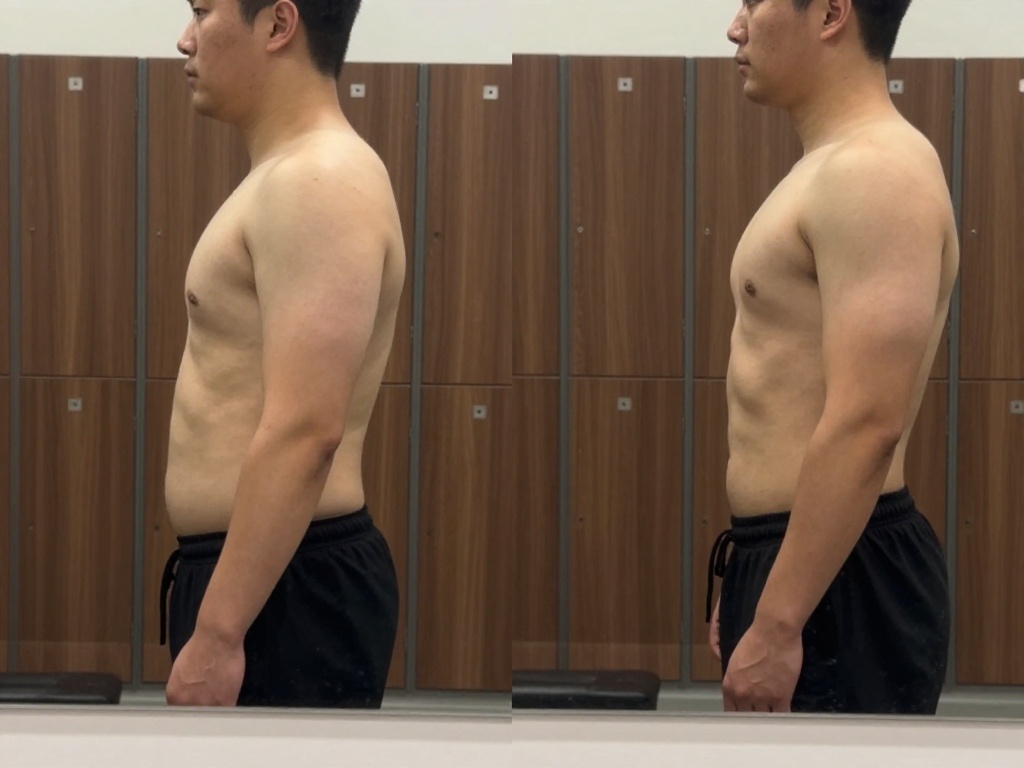
By week four, muscle fibers that were previously underactivated or poorly recruited have now been consistently stimulated for three to four weeks. The muscle does not look dramatically different in most cases, but its density and baseline tension change. Many people describe this as feeling more toned even before visible size increase.
This is not imaginary. The consistent mechanical stimulus of resistance training increases baseline muscle tone, a term that refers to the degree of resting tension maintained in muscle tissue.
Actual hypertrophy, meaning an increase in the physical size of individual muscle fibers, begins to accelerate after approximately four weeks of consistent resistance training. The structural changes occurring in weeks one through three, including improved neuromuscular coordination, increased satellite cell activation, and elevated muscle protein synthesis rates, all lay the groundwork for the visible growth that typically begins to appear between weeks six and twelve.
For beginners who want a structured home-based program that supports these early adaptations from day one, this article on daily at home fitness routine for beginners to build muscle is built around exactly the type of progressive bodyweight training that drives these early phase changes effectively.
Visible changes at the 30-day mark vary significantly depending on starting body fat percentage, training intensity, nutrition, and individual genetics. Most people do not see dramatic mirror changes. What they do typically notice:

The non-visible changes at day 30 are actually more significant than the visible ones. These include measurable strength gains, improved cardiovascular capacity, better sleep, more consistent energy levels throughout the day, and a more efficient nervous system. None of these show up in a photo, but all of them are driving the visible changes that will appear in weeks six through twelve.
Setting accurate expectations protects motivation more than any motivational advice can. Here is what is not realistic to expect in 30 days of training.
You will probably not see dramatic fat loss. Fat loss is a slower process driven by a sustained calorie deficit over weeks and months. Understanding exactly how this works, including the role of your metabolism and food intake, is clearly explained on what a calorie deficit actually is.
You will not have significantly larger muscles. Measurable muscle hypertrophy in most people requires six to twelve weeks of consistent resistance training combined with adequate protein intake. Four weeks builds the foundation. The growth accelerates after that foundation is established.
You will not have peak cardiovascular fitness. Cardiovascular fitness takes months of consistent effort to develop to a high level. Thirty days creates the first tier of adaptation.
What you will have is a body that already moves more efficiently, recovers faster from physical stress, uses energy better, sleeps more deeply, and handles daily mental stress with greater resilience than it did on day one. The visible results come later. The changes that make those results possible are already well underway.

Show up consistently. Two to three sessions per week maintained consistently is more valuable than six sessions per week for two weeks and then nothing. Adaptation requires regularity.
Prioritize protein intake. Muscle repair begins immediately after your first training session. Aim for at least 0.7 to 1 gram of protein per pound of bodyweight per day to support this process.
Do not start at maximum volume. Taking on too much in week one often results in severe soreness that disrupts your training schedule for several days. Starting at a manageable volume and building gradually protects consistency.
Track your training performance from week one. Write down the exercises, weights, sets, and reps from every session. Watching these numbers improve week over week is the most concrete and motivating record of progress available during a phase when visible changes are minimal. For clear guidance on how much volume to start with, the guide on how many sets and reps a beginner should actually do gives direct, evidence-based starting points.
Treat sleep as part of training. Recovery is where adaptation happens. Sleep as much as your schedule allows, and treat it as a non-negotiable component of the program rather than a separate lifestyle issue.
Some people see modest weight loss in the first 30 days, particularly when training is combined with a calorie deficit and adequate protein intake. However, the scale weight can actually increase slightly in the first two to three weeks due to increased water retention in muscles responding to a new training stimulus. This temporary increase is not fat gain. Body composition, the ratio of fat to muscle, is a more meaningful measure than scale weight during this phase.
Increased fatigue in the first one to two weeks is common and normal. Your body is adjusting to higher energy demands and the inflammatory response from an unfamiliar training stimulus. This typically resolves by the end of week two as recovery systems improve and the body becomes more efficient at handling training-related stress. Ensuring adequate sleep and protein intake speeds this resolution.
Most people notice clear cardiovascular improvements by the end of week two. Resistance training starts to feel significantly more manageable around weeks three to four as neuromuscular coordination improves and the trained movements become more familiar.
Yes, and it is a common source of confusion. Muscle tissue retains water during the repair process, which can add one to three pounds of scale weight temporarily. This does not represent fat gain. Provided total calorie intake has not increased significantly, genuine fat gain from starting a training program is not physiologically likely.
Resting metabolic rate increases modestly as muscle tissue is activated more consistently and cardiovascular efficiency improves. Insulin sensitivity improves, meaning your body processes carbohydrates more effectively and is less likely to store excess glucose as fat. These metabolic shifts are small at 30 days but compound meaningfully over months of consistent training.
For most beginners with no prior training history, meaningful hypertrophy begins accelerating around weeks four to six. In the first 30 days, measurable muscle size increases are minimal because the primary adaptations are neurological rather than structural. Strength gains in this period are real and significant, but muscle size increases are modest and largely non-visible at the 30-day mark.

At the end of your first month of consistent training, you will not have the body you are working toward. But you will have something that matters far more at this stage: a nervous system that has learned new movement patterns, a cardiovascular system that handles demand more efficiently, muscle tissue that is primed to grow, and a habitual structure around training that is beginning to feel normal.
None of that shows up in a before-and-after photo. All of it determines whether you ever reach the point where the photos actually look different.
The first 30 days are not about visible results. They are about building the physiological and behavioral foundation that visible results grow from. Stick with the process. The changes are happening. You just have to give them enough time to become visible.