How Long Until You Actually See Results From Working Out?
- May 15, 2026
- 1
Starting a new workout routine and seeing no change in the mirror for several weeks is one of the most discouraging experiences in fitness. You are putting in
Starting a new workout routine and seeing no change in the mirror for several weeks is one of the most discouraging experiences in fitness. You are putting in

Starting a new workout routine and seeing no change in the mirror for several weeks is one of the most discouraging experiences in fitness. You are putting in the effort, following a plan, and the reflection looks exactly the same. That gap between effort and visible outcome is the reason most people quit before the process ever has a proper chance to work.
One important thing beginner fitness guides rarely explain is that your body starts changing from day one. The problem is that most of those changes are happening in places you cannot see yet. Once you understand the difference between the progress you can measure and the progress you can see, the whole experience becomes far less frustrating.
This is a science-based, realistic breakdown of when different types of results actually appear, what factors speed up or slow down your timeline, and why you are probably making more progress than you realize.
Before looking at timelines, it helps to understand that results come in two separate forms. Most people are only watching for one of them, and that is why they feel like nothing is happening.
This is the type of progress you can track with numbers before anything is visible in the mirror. Measurable progress shows up in your performance. You run farther before getting winded. The weight you lifted last week feels lighter this week. You recover faster between sets. Your resting heart rate is lower. You sleep better.
These are real, documented physiological adaptations. They happen quickly. Ignoring them because they are not visible is one of the most common mistakes beginners make when judging their own progress.
This is the change you can see in the mirror or notice when your clothes fit differently. Fat loss becomes visible once enough body fat has been reduced in a given area. Muscle definition becomes visible once muscle size has increased enough, and body fat is low enough, for the muscle shape to show clearly through the skin.
Visible progress takes longer and depends on far more variables than measurable progress does. Treating your visible results as the only measure of success will always make your progress feel slower than it actually is.
Both types are real. Both matter. Tracking only one gives you an incomplete and discouraging picture.

In the first two weeks, almost all of your strength improvements come from your nervous system, not from any actual change in muscle size. This is called neuromuscular adaptation.
When you perform a new movement like a squat, a push-up, or a deadlift for the first time, your brain is figuring out which motor units to recruit, in what sequence, and at what intensity. The pattern feels awkward and inefficient because those neural pathways are not yet well-established for that specific movement.
Within the first week of consistent training, your brain begins reinforcing those pathways rapidly. You start activating more muscle fibers more efficiently with each rep. This is why complete beginners can sometimes double the load they are moving within the first few weeks without gaining any visible muscle mass at all. The muscle itself has not grown. The nervous system has simply learned to use what is already there.
During these first two weeks, you will also experience delayed onset muscle soreness, or DOMS. This is the stiffness and aching that peaks around 24 to 72 hours after a session and is caused by microscopic structural disruption to muscle fibers and the localized inflammatory response that follows. It is a normal part of the early adaptation process and not a sign of injury.
Energy levels during this phase may actually feel slightly worse before they improve. Your body is adjusting to a new energy demand, and some beginners feel more fatigued than usual in the first week or two.

By weeks three and four, the cardiovascular system starts catching up with the demands being placed on it. Your heart becomes slightly more efficient at pumping blood per beat, a measure called stroke volume. Your muscles become better at extracting and using oxygen. Activities that left you breathless in week one start to feel manageable.
Soreness also begins to fade during this phase. This does not mean your workouts have stopped working. It means your muscles have structurally adapted to the type of stimulus you are applying, which is called the Repeated Bout Effect. Your training can still be producing excellent results without producing significant soreness. Understanding this distinction is important, and the FitRoutineLab article on does soreness mean muscle growth breaks down exactly why the absence of soreness is not a warning sign.
Energy throughout the day usually improves noticeably by the end of week four. Better circulation, improved sleep quality, and the hormonal benefits of regular exercise all contribute to feeling more alert and less fatigued during normal daily activities.

Between weeks four and six, the neuromuscular improvements from the first phase solidify, and your muscles are now receiving a consistent mechanical signal to grow. You will notice that you can lift more weight, complete more reps at the same weight, or finish the same workout with significantly less effort than the first time.
This is the phase where the principle of progressive overload matters most. If you keep performing the same workout with the same weights week after week, your body has no continuing reason to adapt further. Understanding how to keep increasing the training stimulus is essential at this point. The guide on what progressive overload means for beginners is the most important concept to understand for keeping progress moving forward.
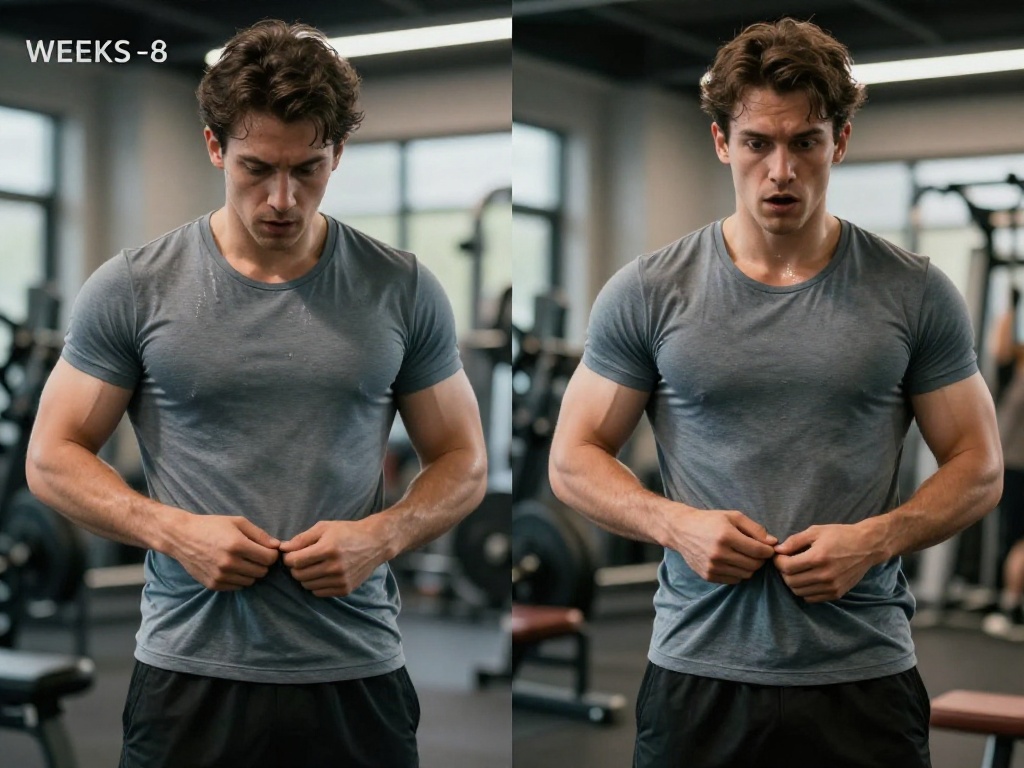
For people who started with a lower body fat percentage, visible muscle definition may begin to appear between weeks six and eight. Shoulders start to look slightly more defined. Arms show a bit more shape. The waist narrows slightly.
For people who started with a higher body fat percentage, the strength and performance changes are well underway at this point, but the visible fat reduction takes longer to show clearly because there is more tissue to reduce before the underlying muscle definition becomes visible through it.
Clothes fitting differently is often the first physical sign most people notice. The scale may not have moved dramatically, but a shirt that fits more loosely in the midsection or trousers that feel looser around the waist reflects real body composition changes that are already underway.

At the end of three months of consistent training and nutrition that supports your goal, most people see clearly visible changes in body composition. Body fat has reduced. Muscle mass has increased to a measurable degree. Strength improvements have compounded significantly compared to where you started.
Research published in the Journal of Strength and Conditioning Research consistently shows that untrained individuals who follow a structured resistance training program for 8 to 12 weeks produce significant gains in both strength and lean body mass. These outcomes are not reserved for people with exceptional genetics. They are what happens when consistent training meets consistent effort over a meaningful time period.
Two people can follow the exact same program and see noticeably different results over the same period. This is normal, and there are specific reasons for it.
Resistance training builds visible muscle and improves body composition more efficiently than cardio alone. People who combine strength training with cardiovascular work see better overall body composition results than those who focus on only one type. For beginners who are not sure how to structure a training week that addresses both cardio and strength, the weight loss workout routine for beginners provides a practical weekly framework that balances cardio and strength effectively.
Training is the signal. Food provides the raw materials. Without enough protein to support muscle repair and growth, the training stimulus you are applying does not fully translate into adaptation. Without a sustained calorie deficit for those focused on fat loss, the fat covering developing muscle never reduces enough to become visible in the mirror.
Growth hormone is released primarily during deep sleep. Muscle protein synthesis, the process of building new muscle tissue, continues for up to 48 hours after a training session and requires adequate rest to proceed fully. People who consistently sleep poorly see slower results than those who treat recovery as a non-negotiable part of their program. The recovery routine for beginners covers the practical habits that make rest productive rather than passive.
Genetic factors influence where you tend to store fat, how quickly your muscles respond to a training stimulus, your natural hormone profile, and your muscle fiber composition. This is not an excuse for slow results, but it is an honest explanation for why comparing your six-week progress to someone else’s is not a useful or accurate exercise. Your timeline is your own.
Inconsistency is the biggest one. Three workouts per week held consistently for 12 weeks will outperform six workouts per week for three weeks followed by a two-week break. The compounding nature of adaptation requires regularity.
Ignoring nutrition. You cannot train your way past a diet that works against your goal. Protein intake and total calorie balance directly determine how quickly body composition changes become visible.
Not tracking performance. If your workouts are not written down, you have no reliable way to know whether you are progressing or just repeating the same effort week after week. Track the weights, reps, and sets. Progress in those numbers means progress in your body.
Chasing soreness as a signal. Soreness does not equal progress. A training session that produces minimal soreness can still generate an excellent muscle-building stimulus if the load and volume were appropriate. Optimizing for soreness often leads to ineffective training choices.
Expecting visible change too soon. Expecting to look different after two weeks leads to disappointment and quitting. Understanding the actual timeline prevents this.
Daily mirror checks are unreliable. Lighting, hydration, posture, and even the time of day affect what you see. These are more useful indicators to track:
Tracking these creates a full and honest record of your progress. Progress tracked this way is far more motivating than relying on a mirror that changes very little week to week.
How long does it take to see results from working out as a complete beginner?
Most beginners notice measurable performance improvements, better endurance, and strength gains within two to three weeks. Visible physical changes typically begin to appear between weeks six and eight with consistent training and proper nutrition support.
Can I see real results in 30 days?
You can see measurable results in 30 days, including meaningful strength gains, improved cardiovascular endurance, better energy levels, and improved sleep. Visible body composition changes in 30 days are possible but depend significantly on starting body fat percentage, nutrition quality, and training intensity.
I have been training for four weeks and see no change. What is wrong?
Four weeks is usually not enough time for clearly visible body composition changes, especially if reducing body fat is the main goal. Check whether your nutrition aligns with your goal, whether you are applying progressive overload in your workouts, and whether sleep and recovery are adequate. Measurable performance progress, such as lifting heavier weights or running farther, is very likely already happening even if visual changes have not appeared yet.
Do genetics affect how fast you see workout results?
Yes. Genetic factors influence fat distribution patterns, muscle fiber composition, and hormonal responses to training. However, consistent training and proper nutrition will produce real results for virtually everyone. The timeline varies between individuals, but the direction does not.
Does the type of workout change how fast you see results?
Yes, significantly. Resistance training combined with adequate protein intake produces visible body composition changes faster than cardio alone. Cardio improves endurance and cardiovascular health relatively quickly, but visible fat loss and muscle definition are most efficiently produced by combining strength training with a supportive diet.
Your body starts adapting from session one. The nervous system improves first. Endurance follows. Strength numbers climb next. Then, visible body composition begins to shift. The people who see real, lasting results are not usually the ones with the best genetics. They are the ones who show up consistently, eat to support their training goal, sleep enough to recover, and track their performance over time instead of staring at the mirror every morning.
The timeline is real. The process works. You just have to give it enough time to unfold.






1 Comment
[…] immediate physical changes. Early progress may mean completing your planned walks or performing an exercise more confidently. Avoid using […]