Can You Build Muscle at Home Without Weights? The Science-Backed Answer
- May 20, 2026
- 0
Here is something the majority of people get wrong right from the start that muscle does not respond to weight. It responds to tension, effort, and stimulus. The
Here is something the majority of people get wrong right from the start that muscle does not respond to weight. It responds to tension, effort, and stimulus. The

Here is something the majority of people get wrong right from the start that muscle does not respond to weight. It responds to tension, effort, and stimulus. The load on your muscles does not care whether it comes from a barbell in a gym or from the force you generate pushing your own body off the floor. What triggers muscle growth is mechanical stress placed on the muscle fibers, and bodyweight exercises can absolutely create that stress.
This is not a motivational claim. It is basic exercise physiology. And yet, a large number of beginners still believe that going to a gym and picking up weights is the only real path to building muscle. This article is going to break down exactly what the science says, what the actual limits of home training are, and how you can make real, measurable progress without a single piece of equipment.
To understand whether you can build muscle without weights, you first need to understand what causes a muscle to grow in the first place.
When you put enough mechanical tension on a muscle, small amounts of damage occur at the fiber level. Your body responds to this by repairing and reinforcing those fibers, making them slightly thicker and stronger over time. This process is called muscle hypertrophy, and it requires three key things to happen consistently: enough mechanical tension on the muscle, adequate protein intake to support repair, and sufficient rest between training sessions.
Notice that none of those three requirements say anything about barbells, dumbbells, or gym machines. What they require is load and stimulus, and your own bodyweight is a perfectly valid source of both.
Research published in the Journal of Human Kinetics confirms that bodyweight resistance training can produce comparable improvements in muscle strength and size when performed with sufficient intensity and volume, especially in beginners and intermediate trainees (Calatayud et al., 2015).
The honest answer is that, quite a lot, especially in the beginning.
Push-ups, for example, are not just a “warm-up” exercise. When performed with proper form, full range of motion, and enough volume, they generate real tension across the chest, shoulders, and triceps. Pull-ups and bodyweight rows challenge the back and biceps in ways that gym beginners often do not reach for months. Squats, lunges, and glute bridges load the lower body through a meaningful range of motion.
What matters most is not the type of resistance but whether your muscles are being challenged close to their current capacity. If an exercise feels genuinely difficult in the 8 to 20 rep range and you are recovering well between sessions, your muscles are receiving the stimulus they need to grow.
For beginners especially, bodyweight training is not a compromise. It is a legitimate and well-supported training method that builds real muscle when done right.
This is the most important concept in any muscle-building program, whether you train at home or in a gym. If you want to understand this principle in depth, our guide on how progressive overload works for beginners covers it thoroughly.
Progressive overload simply means giving your muscles a little more stimulus over time than they are used to. Without this, your body has no reason to continue adapting. You hit a plateau and stop making progress.
The good news is that with bodyweight training, you have several practical ways to apply progressive overload without adding a single weight:
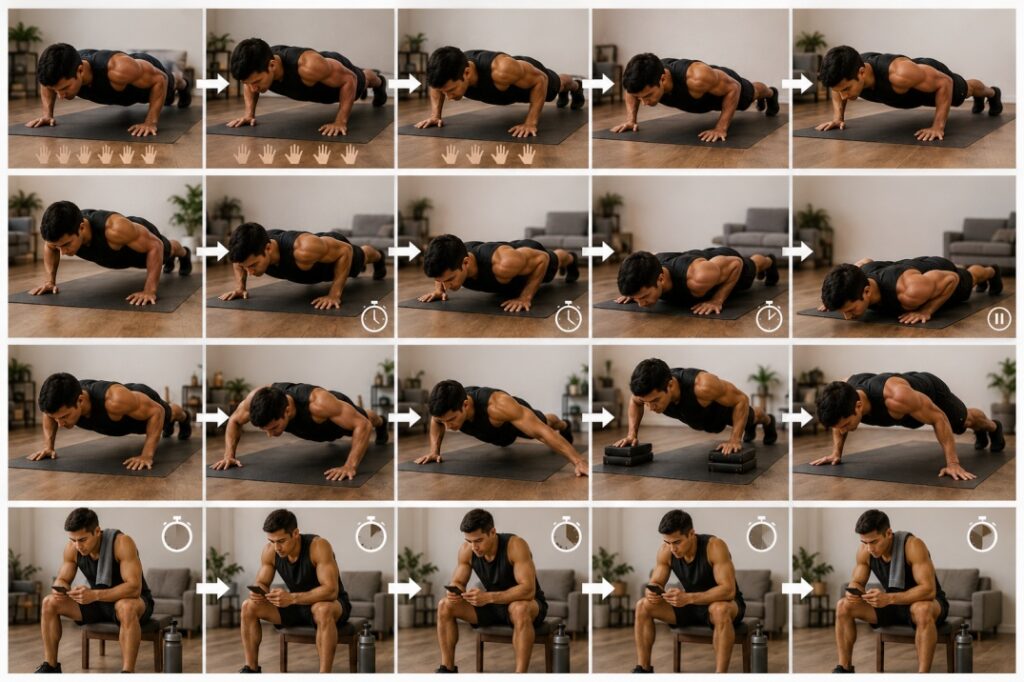
Increase reps and sets. If you do 3 sets of 10 push-ups today, working toward 4 sets of 15 over the coming weeks gives your muscles more total volume to adapt to.
Slow down the movement. Performing a push-up with a 3-second lowering phase (the eccentric portion) significantly increases time under tension and makes the same exercise much harder without adding any load.
Progress to harder exercise variations. This is perhaps the most powerful tool available to home trainers. You can move from a regular push-up to an archer push-up, then a pseudo planche push-up. Bodyweight squats can progress to Bulgarian split squats and eventually to pistol squats. Each variation loads the target muscle more intensely than the previous one.
Reduce rest time. Shortening the rest period between sets increases metabolic stress on the muscle, which contributes to the growth stimulus.
These methods of applying progressive overload are just as scientifically valid as adding weight to a barbell. They just require a bit more creativity and tracking.
Not all bodyweight exercises are built the same when it comes to building muscle. The ones that produce the most hypertrophy are compound movements that challenge a large amount of muscle mass through a full range of motion.
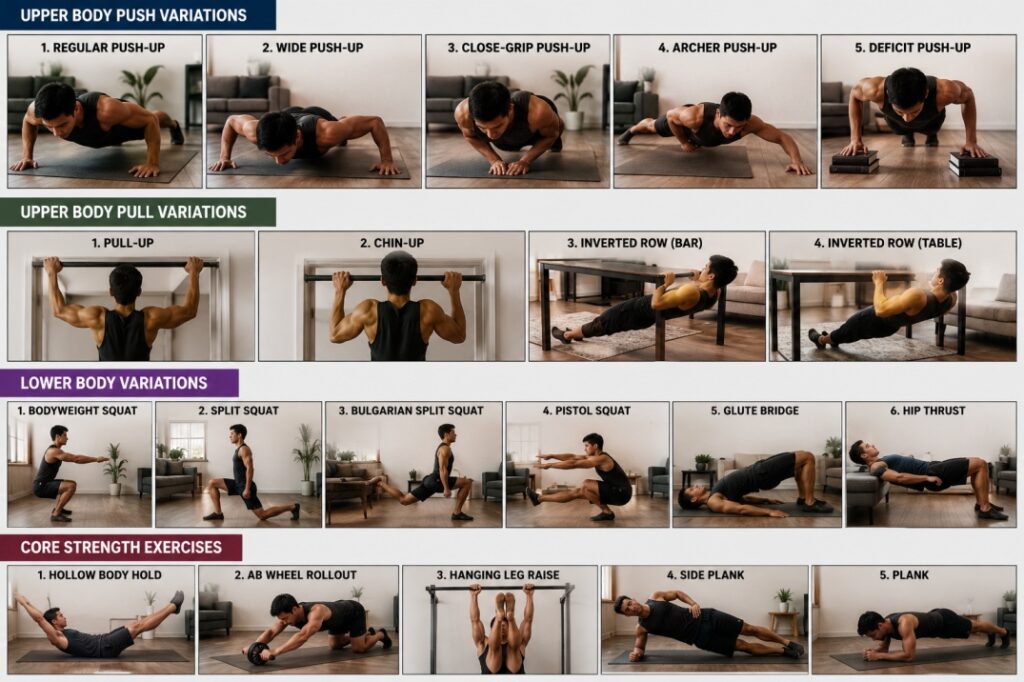
For your upper body, push-up variations are the foundation. Regular push-ups, wide push-ups, close-grip push-ups, and eventually archer and deficit push-ups all target the chest, shoulders, and triceps with increasing intensity. Pull-ups and inverted rows cover the back and biceps, assuming you have a bar or a sturdy table to work with.
For your lower body, squats and their progressions are the cornerstone. Bodyweight squats, split squats, Bulgarian split squats, and single-leg squats load the quads, glutes, and hamstrings. Glute bridges and hip thrusts done with a slow, controlled tempo are excellent for posterior chain development.
For your core, exercises like hollow body holds, ab wheel rollouts, and hanging leg raises build far more genuine strength than crunches ever will.
Our breakdown of how many sets and reps are best for building muscle gives you the exact rep ranges to target for hypertrophy with any of these exercises.
Building muscle at home without weights is entirely possible. But muscle growth does not happen from training alone. Nutrition does a significant amount of the heavy lifting.
Your body needs enough protein to repair and rebuild the muscle fibers that get stressed during training. The current research consensus recommends consuming between 1.6 and 2.2 grams of protein per kilogram of bodyweight per day for people actively trying to build muscle (Morton et al., 2018, British Journal of Sports Medicine).
Beyond protein, you need to eat enough total calories to support the repair process. Trying to build muscle in a significant calorie deficit is possible in very specific circumstances, but for most beginners, eating at or slightly above maintenance makes growth much more consistent and noticeable.
A lot of beginners underestimate how important rest is. You do not build muscle during a workout. You build it during the recovery period after a workout, when your body repairs and reinforces the damaged muscle fibers.
This means that training a muscle group every single day without rest is counterproductive. For most beginners doing full-body home workouts, training 3 to 4 days per week with at least one rest day between sessions allows for proper recovery without losing training frequency.
Sleep is part of this equation too. The majority of muscle protein synthesis occurs during deep sleep, making 7 to 9 hours of consistent sleep a legitimate performance and growth factor, not just a lifestyle preference.
Being honest about this matters. Bodyweight training at home can build a solid, functional, and visibly muscular body, particularly for the upper body and lower body foundational movements. However, there are limits.
For advanced trainees who already have a solid base of muscle, bodyweight training alone becomes harder to progressively overload without getting into highly technical skill movements. Certain muscle groups, like the upper back and direct arm work, are also harder to train effectively without any equipment at all.
For pure beginners and early intermediate trainees, though, these limitations are not a real concern. You have months of productive progress available to you before you ever need to worry about outgrowing bodyweight training.
If you do want to explore what a structured home routine looks like in practice, our best home workouts for beginners article walks you through a complete weekly plan.
Can beginners really build visible muscle without weights?
Yes. Beginners are in the most responsive phase of training. With consistent effort, proper exercise selection, adequate protein, and progressive challenge, visible muscle growth is very achievable with bodyweight training alone.
How long does it take to see results from home workouts?
Most beginners notice strength improvements within 2 to 4 weeks and visible muscle changes within 6 to 12 weeks, provided training is consistent and nutrition supports recovery.
Do I need a pull-up bar to build muscle at home?
A pull-up bar is highly recommended for balanced upper body development. Without one, you can use a sturdy table edge for bodyweight rows, but direct pulling movements are hard to replace entirely.
Is bodyweight training as effective as lifting weights for muscle growth?
For beginners and intermediate trainees, research shows comparable results when training volume and progressive overload are applied correctly. Advanced trainees may eventually need external load to continue progressing.
What is the most important thing for building muscle at home?
Consistency and progressive overload. Training regularly and gradually increasing the difficulty of your workouts over time is the single most important factor regardless of whether you use weights or not.
The gym is not a requirement for building muscle. It is one option among several. Your muscles respond to challenge and recovery, not to the location where the challenge happens. With the right exercises, a commitment to progressive overload, enough protein, and consistent rest, you can build a genuinely strong and muscular body at home, with no weights required.
Start where you are, track your progress, and focus on getting a little better each week. That is the actual science of muscle growth, and it works just as well in your living room as it does in any gym.