Compound vs Isolation Exercises: Which Should Beginners Focus On First?
June 15, 2026
1
Pick up almost any beginner workout plan and you will find squats, push-ups, and rows sitting alongside bicep curls and leg extensions. They are lumped together as if
Pick up almost any beginner workout plan and you will find squats, push-ups, and rows sitting alongside bicep curls and leg extensions. They are lumped together as if they do the same job. They do not. The difference between a compound movement and an isolation exercise is not a matter of difficulty or preference. It is a fundamental difference in how much of your body each exercise recruits, and that difference has a major effect on how fast you build strength and muscle as a beginner.
Understanding this distinction early on is one of the best decisions a new lifter can make. It removes the guesswork from programming and explains why certain exercises appear in virtually every evidence-based beginner plan, while others are optional tools that add value only once the basics are in place.
What Is a Compound Exercise?
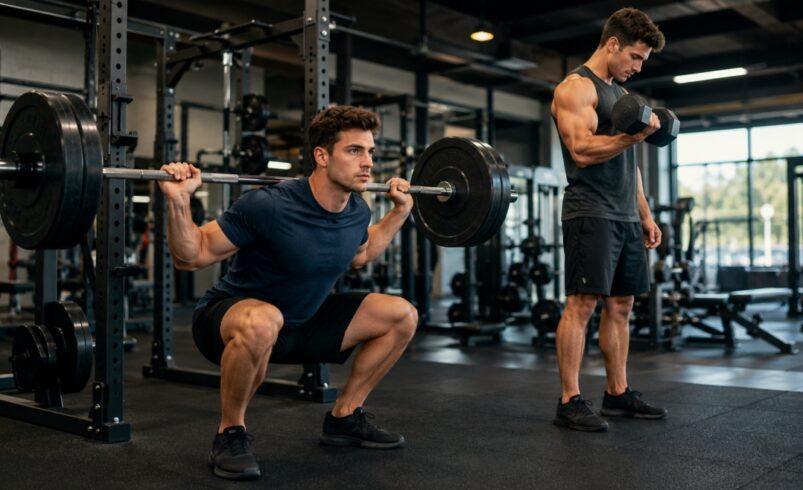
A compound exercise is any movement that recruits multiple joints and multiple muscle groups at the same time. When you perform a squat, for example, your hips and knees both flex and extend, which means your quadriceps, hamstrings, glutes, and lower back are all working simultaneously to complete the movement. No single muscle is doing the job alone.
This multi-joint nature makes compound movements uniquely efficient. In a single set of squats, you are training your entire lower body plus your core and spine stabilizers. That is a significant amount of work accomplished in a short time, which is one reason compound exercises form the backbone of virtually every research-supported strength training program for beginners.
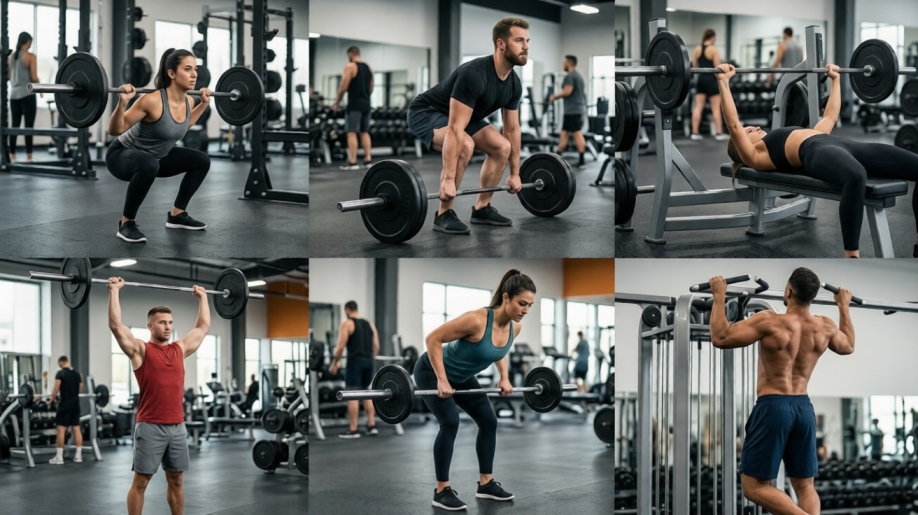
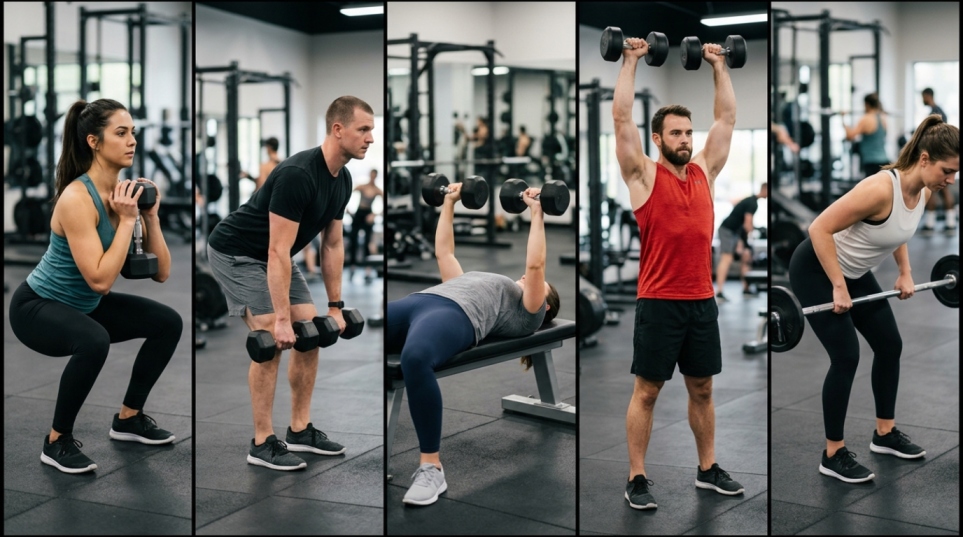
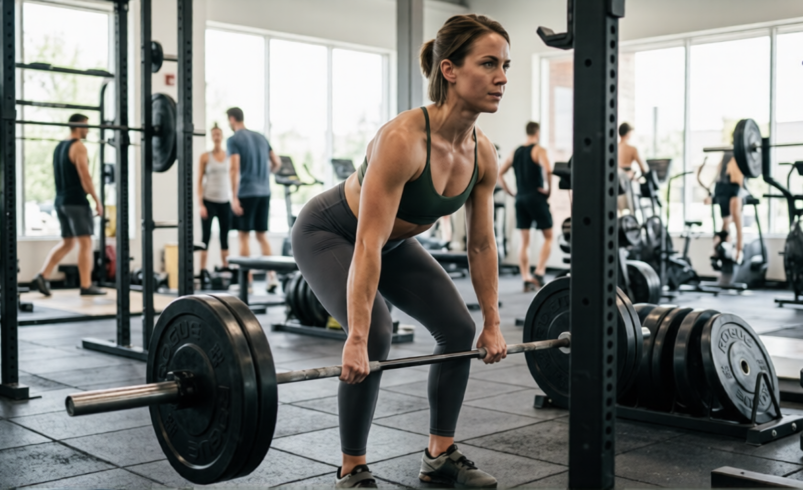
Common compound exercises include the squat, deadlift, bench press, overhead press, barbell row, pull-up, dip, and lunge. Each of these recruits at least two major joints and several muscle groups simultaneously.
What Is an Isolation Exercise?
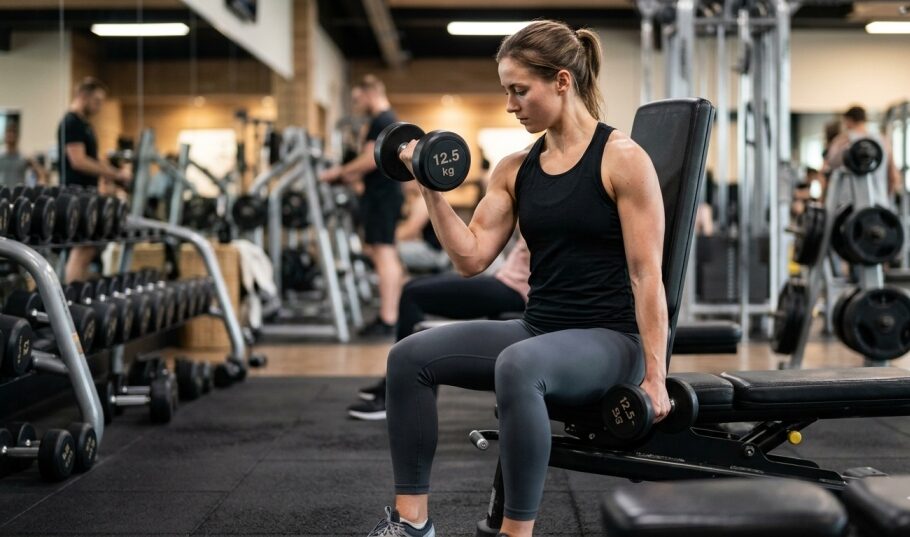
An isolation exercise restricts movement to a single joint and targets one primary muscle group with minimal involvement from others. A bicep curl is the classic example. Your elbow flexes, your bicep does the work, and almost nothing else is meaningfully recruited. This allows you to focus training stress precisely on one muscle, which has specific uses, but it also limits the overall stimulus and volume you can generate per unit of time.
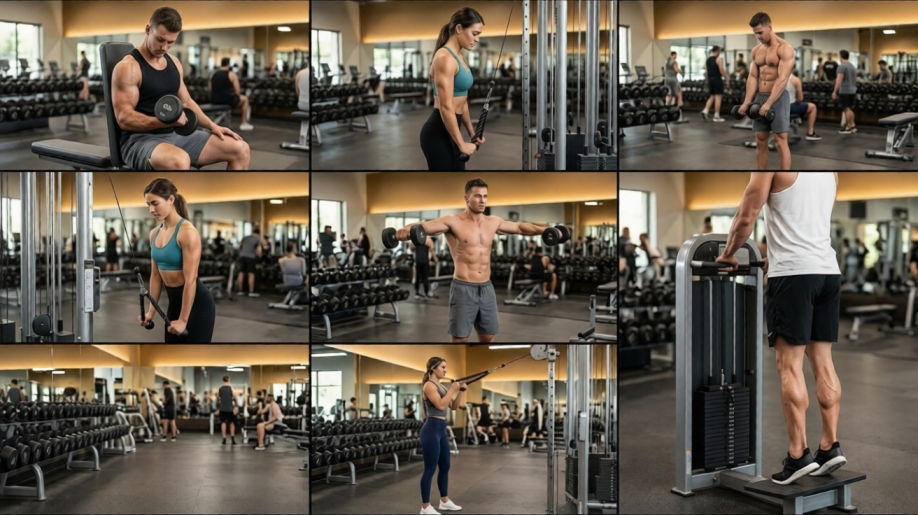
Other common isolation exercises include the tricep pushdown, leg extension, leg curl, lateral raise, calf raise, and chest fly. Each targets a specific muscle without demanding coordination from the surrounding muscle groups.
Isolation exercises are not inherently inferior. They serve a real purpose, particularly for addressing weak points, improving muscular symmetry, or targeting smaller muscles that compound movements do not fully train. The question is not whether to use them but when, and how much of your training time they should consume.
How Compound Exercises Drive Faster Muscle Growth for Beginners
Research in exercise science consistently shows that multi-joint compound movements produce greater hormonal and neuromuscular responses than isolation exercises performed for the same duration. A 2017 review published in the Journal of Strength and Conditioning Research found that compound exercises elicit significantly higher levels of testosterone and growth hormone release compared to single-joint movements, both of which support muscle protein synthesis and strength development.
For beginners specifically, this matters enormously. Muscle growth in the early stages of training is driven primarily by the nervous system learning to recruit motor units efficiently. Compound movements challenge more motor units across more muscles, which accelerates this neuromuscular adaptation. This is closely connected to the principle of progressive overload, which depends on your ability to gradually increase the demand placed on your muscles over time. Compound movements give you the most room to progress because they recruit the most total muscle and allow you to move meaningfully heavier loads as you get stronger.
Isolation exercises simply cannot replicate this stimulus. A leg extension increases the load on your quadriceps in one narrow plane. A squat challenges your quadriceps, hamstrings, glutes, adductors, core, and lower back across a full range of motion under real-world conditions. Both are quad exercises. Only one produces systemic adaptation.
The Role of Isolation Exercises in a Beginner Program
Isolation exercises are not without value, even for beginners. There are two situations where they earn their place in an early-stage program.
Addressing Lagging Muscle Groups
Some muscles receive limited stimulation from standard compound movements. The biceps, for instance, are recruited as a secondary mover during rows and pull-ups but are never fully isolated. Adding direct bicep work gives the muscle a targeted stimulus it does not get elsewhere. The same applies to the triceps through pressing movements, and the rear deltoids through rowing patterns.
Building the Mind-Muscle Connection
Beginners frequently struggle to feel which muscles are working during compound exercises. A new lifter doing a bench press may feel the movement in their shoulders or triceps more than their chest because the motor recruitment patterns are undeveloped. Adding targeted isolation work, like a dumbbell chest fly or cable crossover, helps develop the mind-muscle connection with the target muscle, which can improve compound exercise performance over time.
Understanding which muscles to target, and how to structure a program that develops them, becomes clearer once you understand how many sets and reps are appropriate for beginners. Isolation exercises generally require fewer total sets than compound movements to produce adequate stimulus, and overloading them is easy to do accidentally.
Compound vs Isolation: Training Volume and Efficiency
Beginners have a limited weekly training volume capacity. Your tendons, ligaments, and connective tissues take longer to adapt to training stress than your muscles do, which means loading too many exercises into each session raises your injury risk faster than you might expect. Every exercise you include in your program takes a slice of your recovery capacity.
This is where the efficiency argument for compound exercises becomes practical rather than theoretical. If you spend 30 minutes performing squats, deadlifts, and rows, you have trained your quadriceps, hamstrings, glutes, lower back, lats, biceps, and core all at once. If you spend the same 30 minutes on leg extensions, leg curls, hip adductions, and lat pulldowns, you have achieved a similar list of targets but with far less total stimulus per muscle and far less carryover to real-world strength.
For most beginners, a program built on four to six compound movements performed for three sets each produces better results than a program containing ten to fifteen isolation exercises performed across the same number of sets.
A Practical Exercise Selection Framework for Beginners
The following framework reflects the approach used in most evidence-based beginner programs and aligns with the guidance provided by the American College of Sports Medicine for those new to resistance training.
Priority Tier: Compound Movements (Build Your Program Around These)
Lower body push: Squat variations (goblet squat, front squat, back squat)
Lower body pull: Deadlift variations (Romanian deadlift, conventional deadlift, trap bar deadlift)
Upper body push: Bench press, dumbbell press, push-up progressions
Upper body press: Overhead press, dumbbell shoulder press
Upper body pull: Barbell row, dumbbell row, cable row, pull-up or lat pulldown
Secondary Tier: Isolation Movements (Add These to Fill Gaps)
Bicep curls for direct arm development
Tricep pushdowns or overhead extensions
Lateral raises for shoulder width
Face pulls for rear deltoid and rotator cuff health
Calf raises if calves are a specific priority
This structure ensures that the majority of your weekly volume goes toward exercises that produce the most systemic adaptation. Isolation work fills the gaps without dominating the program. This approach also pairs naturally with a structured beginner plan like the 8-week beginner strength training program, which is built around compound movement progressions.
What the Research Says: Compound vs Isolation for Hypertrophy
A 2020 study published in the Journal of Human Kinetics compared compound and isolation training protocols across matched volumes and found that compound training produced greater improvements in both strength and muscle cross-sectional area in untrained participants over an eight-week period. This supports the longstanding position of strength and conditioning researchers that compound exercises are the superior primary training stimulus for beginners, with isolation exercises serving as supplementary tools.
The National Strength and Conditioning Association (NSCA) similarly recommends that resistance training programs for beginners emphasize multi-joint exercises. Their position statement, available through the NSCA Journal of Strength and Conditioning Research, notes that multi-joint exercises are more metabolically demanding, produce greater acute hormonal responses, and develop functional strength patterns that transfer to daily activity and sport.
Common Beginner Mistakes Around Exercise Selection
Spending Too Much Time on Isolation Exercises
This is the most common programming error among new gym-goers. Bicep curls and leg extensions are easy to perform, feel comfortable, and produce a satisfying muscle pump that creates the impression of effective training. However, they produce far less systemic training stress than compound movements and do not build the neuromuscular foundation that beginners need most. Spending 40 minutes per session on isolation work while neglecting squats and rows is a common reason beginners plateau within the first few months.
Skipping Compound Exercises Because They Feel Hard
Compound movements like the deadlift or squat are technically demanding. They require coordination, balance, and sufficient mobility to perform correctly. Many beginners avoid them precisely because they feel unfamiliar and challenging. This avoidance has real costs. The technical difficulty of these exercises is precisely what makes them valuable; they demand whole-body coordination, recruit the most motor units, and produce the greatest adaptation over time. Starting with beginner-appropriate variations, goblet squats instead of back squats, Romanian deadlifts before conventional, allows you to build the pattern before adding heavy load.
Not Progressing Either Type of Exercise
Progressive overload applies equally to compound and isolation exercises. Adding weight, reps, or sets over time is what signals the body to keep adapting. Beginners who perform the same movements at the same weight for months stop progressing not because compound exercises stop working, but because the stimulus stops increasing.
Frequently Asked Questions
What is the difference between compound and isolation exercises?
Compound exercises involve multiple joints and recruit several muscle groups simultaneously. Isolation exercises restrict movement to a single joint and target one primary muscle. Squats, deadlifts, and rows are compound exercises. Bicep curls and leg extensions are isolation exercises.
Should beginners do compound or isolation exercises?
Beginners should build their programs primarily around compound exercises. These movements produce greater hormonal responses, recruit more muscle, and develop the neuromuscular foundation needed for long-term progress. Isolation exercises can be added to supplement, but they should not be the focus.
How many compound exercises should a beginner do per session?
Most beginner programs include three to four compound exercises per session. A typical full-body session might include a squat variation, a hinge variation, a push variation, and a pull variation. This covers all major muscle groups without exceeding recovery capacity.
Can you build muscle with isolation exercises alone?
Muscle growth is possible with isolation exercises, but it is far less efficient than a program built on compound movements. Isolation-only training also neglects the neuromuscular coordination developed through multi-joint patterns, which limits real-world strength development and increases the risk of muscular imbalances.
When should beginners add isolation exercises?
Isolation exercises can be added once a beginner has established consistency with their compound movements, typically after four to eight weeks of structured training. They are most useful for addressing specific weak points, improving muscle symmetry, or developing the mind-muscle connection with muscles that compound movements do not fully target.
Wrap Up
Compound and isolation exercises are not competing categories. They are different tools with different functions, and a well-designed beginner program uses both in the right proportions. Compound movements are the foundation because they recruit the most muscle, produce the greatest systemic stimulus, and build the coordination and strength that transfers to every other area of training. Isolation exercises are useful additions that address gaps and refine specific muscles once the basics are in place.
If you are a beginner building your first program, prioritize squats, deadlifts, presses, and rows. Perform them consistently, apply progressive overload session by session, and add isolation work selectively. That structure will produce more muscle and strength in your first year than any program built primarily around curls and cable flys.
[…] If you are still deciding which movements deserve the bulk of your early training time,comparing compound and isolation exercises covers the related question of which movement patterns to prioritize first, and bilateral compound […]





1 Comment
[…] If you are still deciding which movements deserve the bulk of your early training time,comparing compound and isolation exercises covers the related question of which movement patterns to prioritize first, and bilateral compound […]