What Is Progressive Overload? The One Principle Every Beginner Must Understand
May 1, 2026
2
There is one reason most beginners stop making progress after four to six weeks of training. Their workouts stopped being a real challenge. The body adapted. And since
There is one reason most beginners stop making progress after four to six weeks of training. Their workouts stopped being a real challenge. The body adapted. And since nothing changed in the training, there was no reason for it to keep adapting.
This is where progressive overload comes in. It is not a specific workout program or a fancy technique. It is a foundational principle that explains why the body gets stronger in the first place, and why it stops getting stronger when training stays the same. Understanding it clearly changes how you approach every session.
The Definition: What Progressive Overload Actually Means
Progressive overload means systematically increasing the demand placed on your body during training over time. The keyword is ‘progressive.’ Changes happen gradually and consistently, not all at once.
The concept was formally described by Dr. Thomas DeLorme, an American physician working in the 1940s. He used structured increases in resistance to help World War II veterans rebuild strength after injury. His observation was direct: a muscle that is not challenged beyond its current capacity has no biological reason to grow stronger. The challenge must exceed the current level to trigger adaptation.
That observation has been confirmed by decades of exercise science research and forms the basis of virtually every evidence-based strength training program in use today.
Why the Body Stops Responding Without Progressive Overload
Your body is continuously trying to maintain equilibrium. When you apply a new stress through training, that equilibrium is disrupted. The body responds by adapting to handle that stress more efficiently. This is good. It is the entire goal of training.
But here is the problem. Once the body has adapted to a given level of stress, that stress no longer disrupts equilibrium. It becomes the new normal. The training that once produced results now only maintains what you already have.
This process was described scientifically by physiologist Hans Selye as the General Adaptation Syndrome. He identified three phases. The alarm phase is when the new stress is first encountered and the body is temporarily disrupted. The resistance phase is when the body adapts and builds capacity to handle the stress. The exhaustion phase occurs if the same stress is applied indefinitely with no new challenge, and progress stops.
Progressive overload keeps the cycle moving. By slightly increasing the training demand before full adaptation occurs, you continuously move through the alarm and resistance phases. This is what produces long-term improvement.
What Happens at the Cellular Level When You Overload Correctly
When you train with a load that genuinely challenges your muscles, several biological responses occur simultaneously.
Muscle fibers experience microscopic structural damage along their proteins. Satellite cells migrate to the damaged tissue and fuse with the fibers, contributing new nuclei. More nuclei mean a greater capacity to produce the proteins needed for growth. Anabolic hormones, including testosterone and growth hormone, rise in response to the training stress. These hormones accelerate muscle protein synthesis, the process through which new muscle tissue is built from dietary amino acids. To understand this process in more detail, you can read our guide on how muscle growth actually works.
At the same time, your nervous system adapts. Motor units, each consisting of a motor neuron and the muscle fibers it controls, are recruited more efficiently. Your brain learns to activate more fibers at once, producing more force with less effort. This neural adaptation is why beginners gain strength rapidly in the first several weeks, often before any visible muscle growth occurs.
All of these adaptations are triggered by the stress of overload. Without the overload, the signal is absent. The adaptations slow and eventually stop.
The Difference Between Overload and Overtraining
A common mistake is to interpret progressive overload as doing as much as possible, as fast as possible. This misses the point and often leads to the opposite of progress.
Overload is a controlled, incremental increase in training demand. It is adding one or two repetitions to a set, or a small increase in weight, or reducing rest time by fifteen seconds. The body can handle this change, adapt to it, and come back ready for the next small challenge.
Overtraining is repeated excessive stress without sufficient recovery. The nervous system becomes chronically fatigued. Anabolic hormone levels drop. Performance decreases. Injury risk increases. Motivation often crashes. What looks like effort is actually stalling or reversing progress.
The word ‘progressive’ in progressive overload is doing a lot of work. It implies patience. The increases must be small enough for the body to adapt to between sessions. Larger and faster is not better. Consistent and gradual is what produces results over months and years.
The Many Ways to Apply Progressive Overload
Most people only associate progressive overload with adding weight to a barbell. That is one valid method, but the principle applies to any form of increase in training demand. Here are the primary ways to apply it.
Increase the weight used for an exercise while keeping reps and sets consistent.
Increase the number of repetitions performed at the same weight.
Add an additional set to an exercise, increasing total training volume.
Reduce rest time between sets, which increases cardiovascular demand and intensity.
Slow the tempo of repetitions to increase time under tension, which amplifies mechanical stress on the fiber.
Improve technique and range of motion, which increases the quality of the stimulus even without changing the load.
For most beginners, starting with repetition-based progression is the most practical approach. Once a given weight feels manageable for a higher rep range than when you started, add a small increment of weight and work back up. This is called a double progression model and is one of the most beginner-friendly structures available. It is also the core foundation used in our 8-week beginner strength training plan, which takes you from bodyweight movements to lifting weights.
Signs You Are Not Applying Progressive Overload
Many beginners train consistently without realizing their sessions contain no real progression. If any of the following are familiar, your training may lack overload.
You are lifting the same weights you were lifting eight weeks ago.
Workouts feel just as easy as they did when you started.
Your strength numbers have not changed.
Your physique has not changed despite consistent attendance.
You feel no challenge or meaningful effort at the end of your sets.
These are all signs that training has become maintenance rather than progression. The fix is to begin tracking your sessions precisely and to commit to small, consistent increases at each workout or each week.
Why Tracking Is the Practical Foundation of Overload
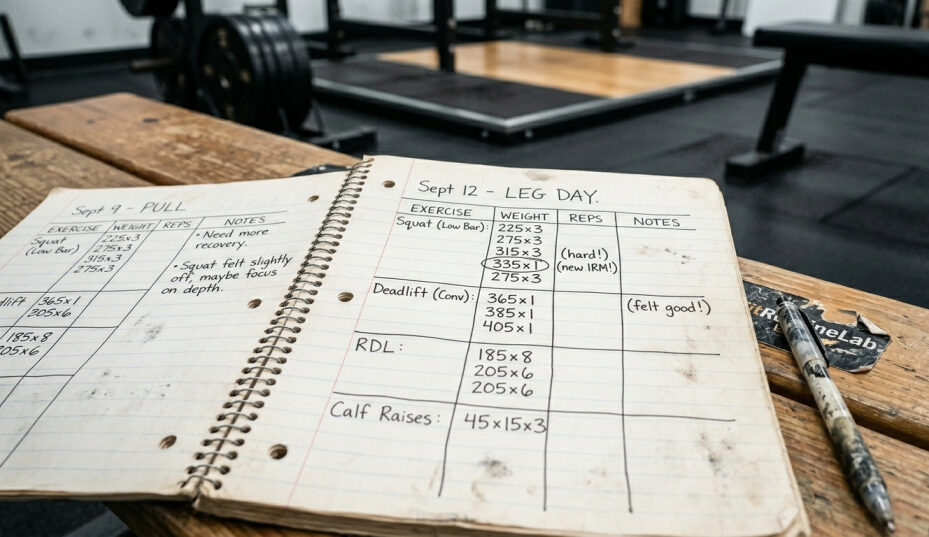
You cannot apply progressive overload from memory. Without knowing exactly what you did last session, you have no baseline to improve upon. A simple training log, whether a notebook or a free app on your phone, records the weight, repetitions, and sets for each exercise.
With that data, each session has a clear target: match or beat last time by a small margin. This turns training into a measurable, evidence-based activity rather than a feeling-based one. Over weeks and months, those small improvements accumulate into substantial progress.
The Bigger Picture: Why This Principle Matters
Progressive overload is not just a gym concept. It is a description of how the human body responds to any consistent physical challenge. Runners who gradually increase their mileage improve their cardiovascular capacity. Swimmers who train progressively increase their efficiency and speed. The principle is universal.
For beginners, the value of understanding progressive overload goes beyond any specific program or routine. It gives you the ability to evaluate any training approach critically. Does this program include a mechanism for increasing demand over time? If yes, it is built on sound principles. If not, it will produce early results followed by a plateau.
Keep increasing the challenge. Do it gradually and consistently. Track your progress so you know exactly where you are. Give your body a clear signal that its current capacity is no longer enough. That signal is what drives adaptation. That adaptation is what builds strength, muscle, and fitness over the long term.
[…] week looks flat. If you want a deeper explanation of how this stepwise increase in demand works, progressive overload is the underlying principle that keeps a program moving forward instead of stalling […]









2 Comments
[…] week looks flat. If you want a deeper explanation of how this stepwise increase in demand works, progressive overload is the underlying principle that keeps a program moving forward instead of stalling […]
[…] recover, and you’re still progressing, keep it. If progress stalls, check your exercises and progressive overload before blaming the […]