Full-Body Workout vs. Split Training for Beginners
- October 26, 2026
- 0
In the full body workout vs split training debate, the research shows no clear winner when weekly work is equal. So pick by schedule: if you can train
In the full body workout vs split training debate, the research shows no clear winner when weekly work is equal. So pick by schedule: if you can train
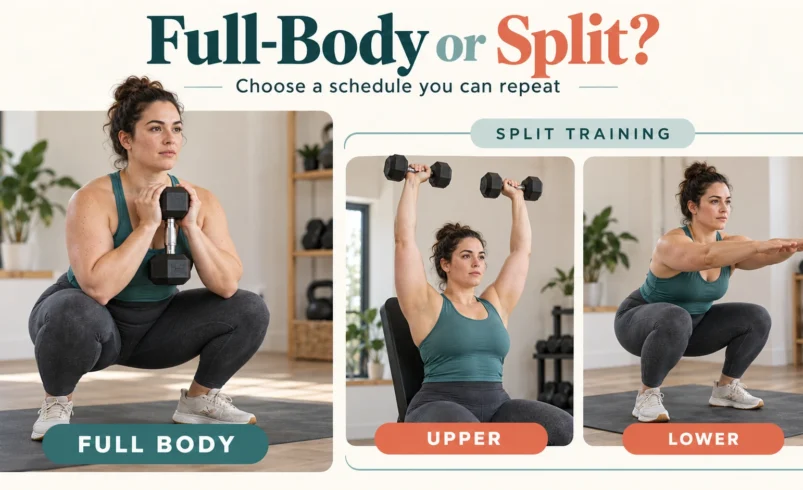
In the full body workout vs split training debate, the research shows no clear winner when weekly work is equal. So pick by schedule: if you can train two or three days a week, do full-body sessions. If four days fit your week, an upper/lower split works just as well.
The real question is how to spread the work across your week and still recover. Your routine has to survive an ordinary week, including the days work, family, or travel get in the way. If you’re still deciding how many days to train, start with our guide on how many days a week a beginner should work out.
A full-body workout trains all major muscle groups in one session. A split divides them across sessions, such as upper body on Monday and lower body on Tuesday. Neither label tells you how hard the program is; exercises, sets, load, and effort still decide that.
|
What to Compare |
Full-Body Training |
Upper/Lower Split |
|
Typical beginner schedule |
2–3 sessions a week |
4 sessions a week |
|
Times each muscle is trained |
2–3 times a week |
Twice a week |
|
Work in each session |
Upper and lower body |
Upper or lower body |
|
Main advantage |
Fewer sessions to fit in |
Shorter, more focused sessions |
|
Main trade-off |
More exercises per session |
More days to plan and attend |
This guide uses the upper/lower split because it’s the simplest. Other splits work differently. A push/pull/legs routine done once a week trains each muscle only once, while three full-body workouts train it three times.
Full-body doesn’t mean one exercise per muscle. Compound exercises move more than one joint, so a squat trains your legs and hips, and a press trains your chest or shoulders plus your arms.
When weekly work is matched, the split doesn’t matter much. A 2024 meta-analysis of 14 studies and 392 healthy adults found no significant difference in strength or muscle growth between split and full-body routines.
A 12-week trial in 44 untrained women reached the same result. One group trained full body twice a week, the other did four upper/lower sessions, with the same exercises, sets, and reps. Neither group gained more strength, muscle, or jump power.
How often you train each muscle does matter. A 2016 meta-analysis found that training a muscle twice a week built more muscle than once a week when total work was equal. Both schedules in this guide hit that mark.
Weekly volume means the total work you do in a week. The easiest way to track it is to count working sets: sets that challenge you, not light warm-ups. For muscle growth, ACSM’s 2026 resistance training guidelines point to about 10 sets per muscle group each week and say programs should fit your goals, enjoyment, and safety. As a beginner, you can start well below that and build up; our guide to beginner sets and reps shows where to begin.
The CDC recommends muscle-strengthening work for all major muscle groups on 2 or more days a week. Only 31% of U.S. adults met that guideline in 2020, so pick a schedule you’ll actually keep.
Two full-body sessions, such as Monday and Thursday, train every major muscle twice with recovery time between. Splitting those two days into one upper and one lower session trains each area only once a week, which the research above shows is less effective for muscle growth.
A three-day workout routine can run Monday, Wednesday, and Friday, with upper and lower body work in every session. You can repeat the same exercises or rotate a few variations.
A third day doesn’t mean adding a full extra workout of hard sets right away. Spread a manageable workload across the week and adjust it as you see how you recover. If you miss a day, pick up where you left off instead of cramming the missed sets into the next session.
An upper/lower routine is a good beginner workout split if four sessions fit your life. Each session has fewer exercises, though its length still depends on sets, rest, and equipment.
Count the whole time cost, including travel and changing. Four short gym trips can take longer overall than two longer home sessions. Our guide on how long a beginner workout should be helps you size each session.
A simple full body training schedule puts a rest day between strength sessions: Monday, Wednesday, and Friday, with easy walking on other days. If you’re starting with two sessions, use Monday and Thursday.
Each session can include a squat, a hip hinge, a push, a pull, and some core work. A hip hinge means bending mainly at the hips, as in a dumbbell Romanian deadlift. A row covers pulling work for your back and arms. Pick versions that match your equipment and skill.
No equipment? Our beginner bodyweight workout is a ready-made starting routine. Training at a gym? Use the simple 3-day full-body gym plan.
Keep early sessions easy to control. End each set when you could still do a couple more clean reps, and track your workouts so your next step is clear.
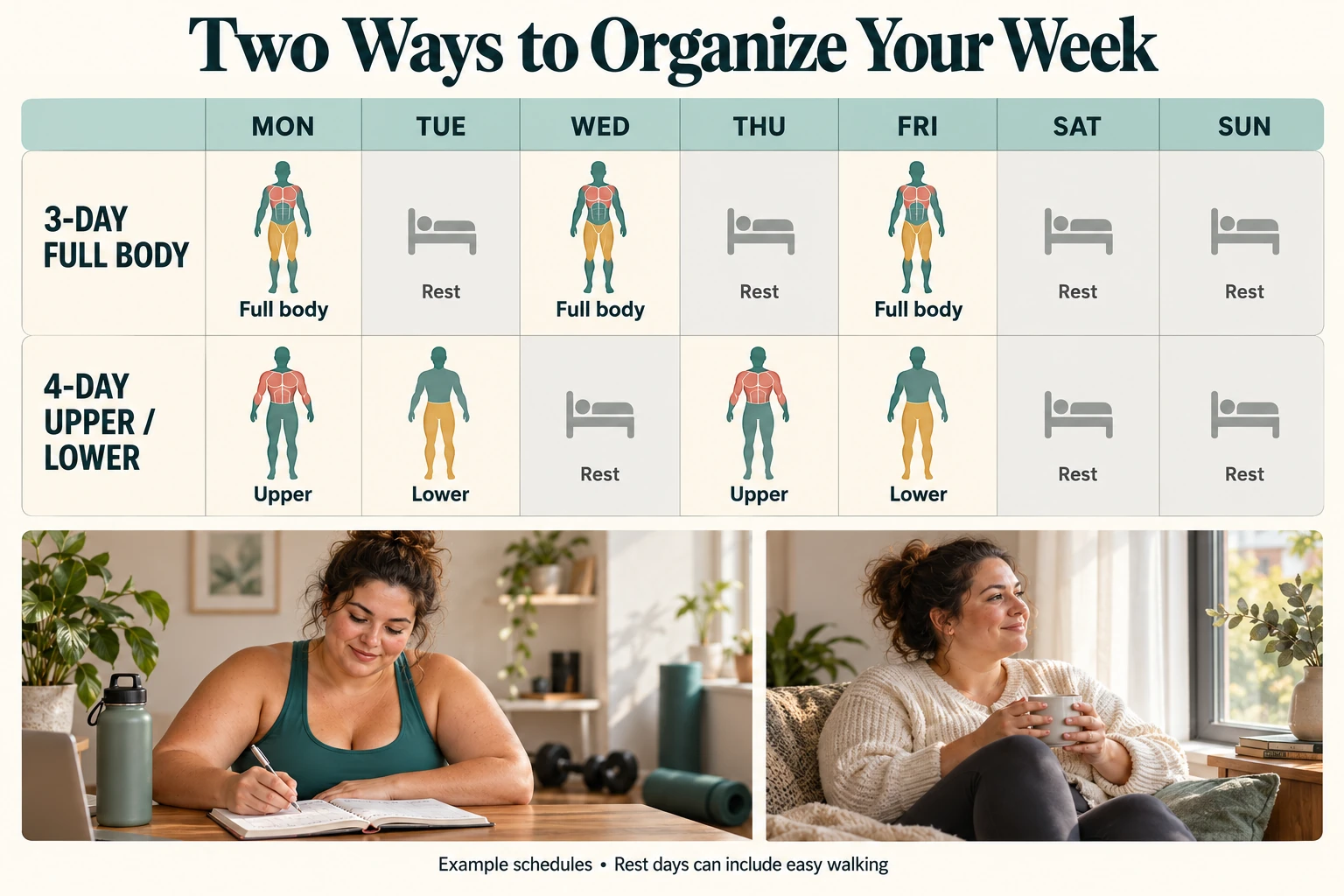
An upper/lower week can put upper-body sessions on Monday and Thursday and lower-body sessions on Tuesday and Friday. Wednesday and the weekend are off from strength work, and each area still gets two sessions.
Upper days might include a press and a row. Lower days might include a squat and a hip hinge, with core work where it fits. Back-to-back days still need attention, since some exercises use overlapping muscles.
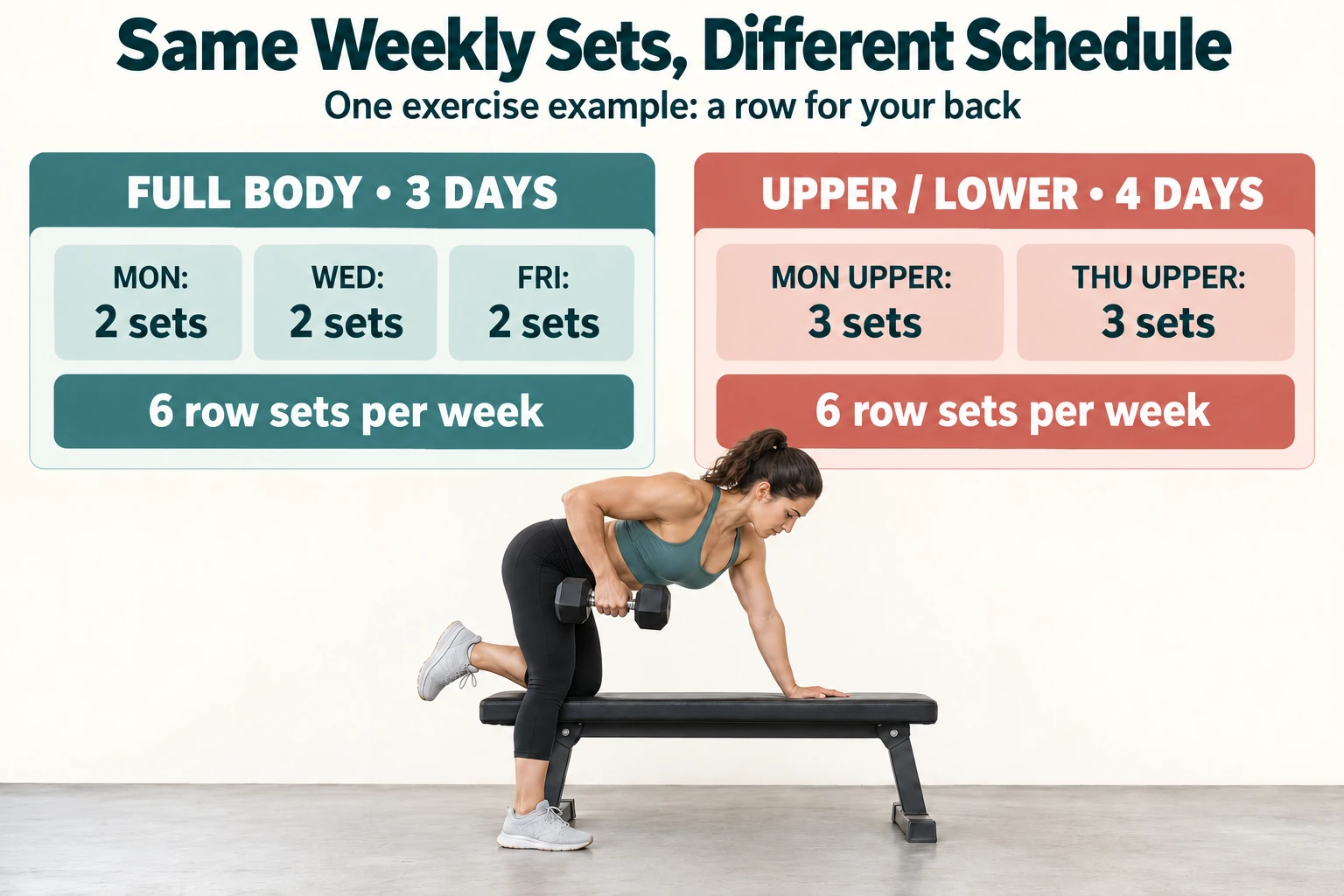
Say your plan includes six working sets of rows each week. On a three-day full-body plan, that’s two sets on Monday, Wednesday, and Friday. On a four-day upper/lower plan, it’s three sets on Monday and three on Thursday. For a one-arm row, the count applies to each side.
Both weeks contain six row sets. The split changes how the work is spread out; it doesn’t add more. This is an illustration, not a full workout or a set count for everyone, but it shows why counting training days alone gives a misleading comparison.
Change your schedule only when it fixes a real problem. Switch to upper/lower if full-body sessions have grown too long and you have four reliable training slots. Switch back to full body if missed days keep breaking your split.
You don’t need to switch after a set number of weeks. If your routine fits your calendar, lets you recover, and you’re still progressing, keep it. If progress stalls, check your exercises and progressive overload before blaming the split.
Watch your recovery. Ongoing fatigue, falling performance, or soreness that keeps disrupting the next session means you should cut or rearrange the work; our guide to rest days for beginners can help. Stop any exercise that causes sharp or worsening pain and get it checked.
Neither builds more strength or muscle when weekly work is equal. Full body is easier to fit into two or three days; upper/lower suits four days.
A bro split trains each muscle group once a week. Research favors training each muscle at least twice a week, so full body or upper/lower is a better start.
Yes. Keep the same exercises and weekly sets, and spread them across four days instead of three.
The best answer to full body workout vs split training is the schedule you’ll keep. Start by booking two strength slots. If three days fit, run a full-body routine with rest days between. If four shorter sessions suit you better, use upper/lower and track whether you complete it.
For home exercises you can scale up over time, follow our beginner home fitness progression guide. Put your sessions on the calendar now and log what you finish.