How Stress Actually Affects Muscle Building (The Mind-Body Link Beginners Miss)
July 8, 2026
0
Two beginners can follow the same programme, hit the same protein numbers, and sleep the same seven hours a night, and still end up with completely different results.
Two beginners can follow the same programme, hit the same protein numbers, and sleep the same seven hours a night, and still end up with completely different results. One builds muscle steadily. The other barely moves the needle. Ask either of them what’s different, and you’ll usually hear about training intensity, food, or sleep. Almost nobody mentions stress, even though chronic psychological stress is one of the most underrated barriers to muscle growth, especially for beginners who are already doing everything else right.
The link between mental stress and physical adaptation isn’t vague. It runs through specific, measurable hormones, and it produces outcomes that are predictable once you understand the mechanism. That’s what this article covers: the mechanism itself, why fitness content rarely mentions it, and what you can actually do about it.
If your recovery routine is already dialled in, it’s worth seeing how the body repairs itself more broadly in the full-body muscle-building routine at home for beginners, because everything below explains exactly why that recovery phase is so easy to quietly sabotage without realizing it.
Quick answer:Chronically elevated cortisol suppresses testosterone and IGF-1, breaks down muscle protein faster than it’s built, disrupts deep sleep, and shifts appetite in ways that make consistent training and eating harder. A single hard workout raising cortisol temporarily is normal and useful. Weeks of unrelieved background stress on top of training is not.
Key Takeaways
Cortisol, the body’s primary stress hormone, directly interferes with muscle protein synthesis when it stays chronically elevated.
Psychological stress and physical training stress trigger the same hormonal cascade, and the two compound when they occur together.
Chronic stress disrupts sleep quality, appetite, and recovery capacity at the same time, not one at a time.
Beginners are especially exposed, because a new training schedule usually gets layered on top of an already full life.
Acute stress from a single hard session is normal and helpful. It’s unrelieved, chronic stress that damages progress.
What Stress Actually Does to the Body
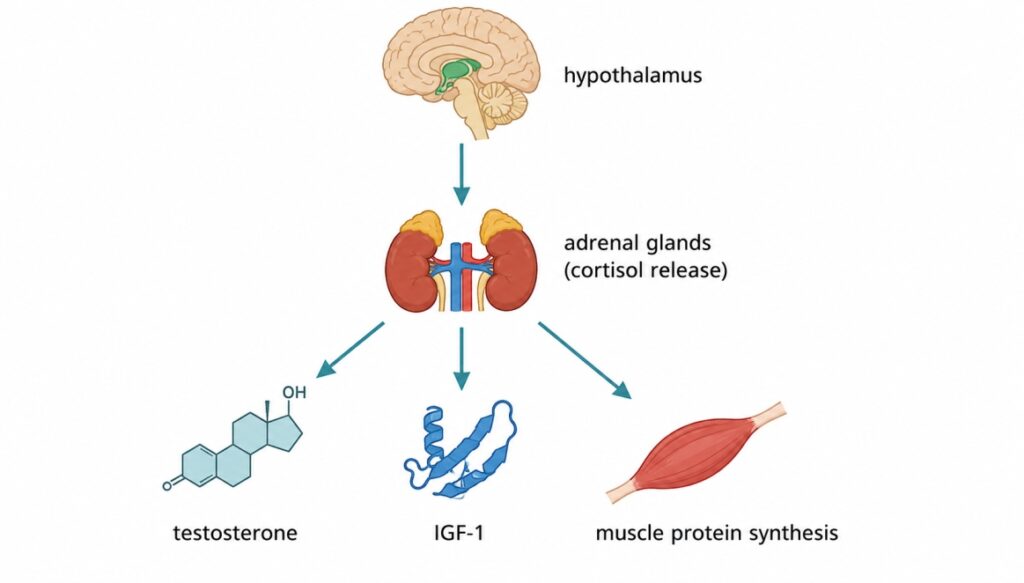
Stress isn’t a feeling. It’s a physiological cascade. When the brain perceives a threat, whether that’s a genuinely dangerous situation, a work deadline, or a strained relationship, the hypothalamus signals the adrenal glands to release cortisol. Cortisol’s job is to mobilise energy fast so the body can deal with whatever it’s just decided is a problem.
In short, controlled doses, that response works exactly as intended. It raises blood glucose, sharpens focus, deprioritises anything non-essential, and gets the body ready to act. Trouble starts when the response doesn’t switch off. Cortisol that stays elevated for days or weeks stops being adaptive and starts being destructive.
Research examining glucocorticoids and exercise adaptation, published in PMC, confirms that chronically elevated cortisol suppresses anabolic hormones, including testosterone and insulin-like growth factor 1, or IGF-1, both of which muscle protein synthesis depends on.
The Cortisol-Muscle Conflict: How It Works
Cortisol Is Catabolic
Catabolic simply means breaking complex molecules down into simpler ones. Applied to muscle, cortisol speeds up the breakdown of muscle protein into amino acids, which then get converted into glucose through a process called gluconeogenesis. In a genuine survival situation, that’s useful. For someone trying to build muscle, it’s close to the opposite of useful.
When cortisol stays chronically high, muscle breakdown can outpace muscle repair. That means someone training hard and hitting their protein targets can still end up at a net-neutral or even negative muscle balance, building and breaking down at the same time, with stress quietly tipping the scale the wrong way.
Cortisol Suppresses Testosterone and IGF-1
Testosterone and IGF-1 both matter enormously for muscle growth. Testosterone drives protein synthesis and plays an outsized role in strength development. IGF-1, produced mainly in the liver, is central to muscle cell growth and repair.
A PubMed study on cortisol and muscle strength found a link between elevated cortisol and reduced muscle mass and strength. Separately, the Longitudinal Ageing Study Amsterdam found that high cortisol was associated with a meaningfully higher risk of grip-strength loss over time. That research focused on older adults, but the underlying hormonal mechanism holds across age groups.
Under chronic stress, the body prioritises cortisol production, and the raw materials for that, particularly a precursor called pregnenolone, get partially diverted away from the pathway that would otherwise produce testosterone. Some people call this the “pregnenolone steal.” The real biology is more nuanced than that shorthand implies, but the bottom line holds up in the research: chronic stress lowers anabolic hormone output.
How Stress Disrupts the Three Pillars of Muscle Growth
Sleep quality deteriorates
Most muscle protein synthesis and growth hormone release happens during deep, slow-wave sleep. Chronic stress is one of the most consistent disruptors of that stage. Cortisol that stays elevated in the evening, right when it should be dropping, delays how fast you fall asleep and cuts into time spent in deep sleep. That means a beginner logging a full eight hours in bed can still be getting far less of the sleep that actually drives repair. It typically takes acute stress under a week to start showing up in the sleep cycle. Sustained stress over several weeks is what produces a measurable drop in anabolic hormone output.
Appetite and nutrition shift
Chronic stress pushes appetite in two directions. For some people it suppresses appetite almost entirely, making it hard to eat enough calories and protein to support growth, which works directly against the consistency covered in FitRoutineLab’s daily fitness routine guidance. For others, stress increases appetite, particularly cravings for high-sugar and high-fat foods, through cortisol’s effect on the brain’s reward circuitry. Either direction erodes the consistency muscle growth depends on.
Recovery between sessions is impaired
Recovery is an active process, built on protein synthesis, hormone signalling, and cellular repair, and chronically elevated cortisol suppresses all three. That means training again after a stressful few days can happen on muscle that hasn’t actually finished repairing, even if the time between sessions looks fine on paper. Training on under-recovered muscle is both less productive and riskier. Over weeks, that compounds into declining training quality and dropping motivation, which often gets misread as the programme not working, when the programme was never the problem.
Why Beginners Are Especially Exposed
In coaching beginners through exactly this pattern, one thing shows up again and again: the ones who plateau unexpectedly around week six almost always have a stress story attached to it, not just a training one. A new job. A move. A change in sleep schedule. It’s rarely the programme.
Experienced lifters tend to develop better stress-management habits over years of training, often because they’ve already run into this exact wall once. Beginners, by contrast, are usually starting a brand-new training schedule while everything else in life keeps running at full speed: work, relationships, sleep, eating habits, all being adjusted at once.
That total stress load is often at its highest at exactly the point recovery capacity matters most. It’s part of why some beginners see fast early progress and then hit a wall that seems to come from nowhere. The early gains happened during a lower-stress stretch, and the plateau lined up with rising life stress quietly undermining the recovery environment underneath it.
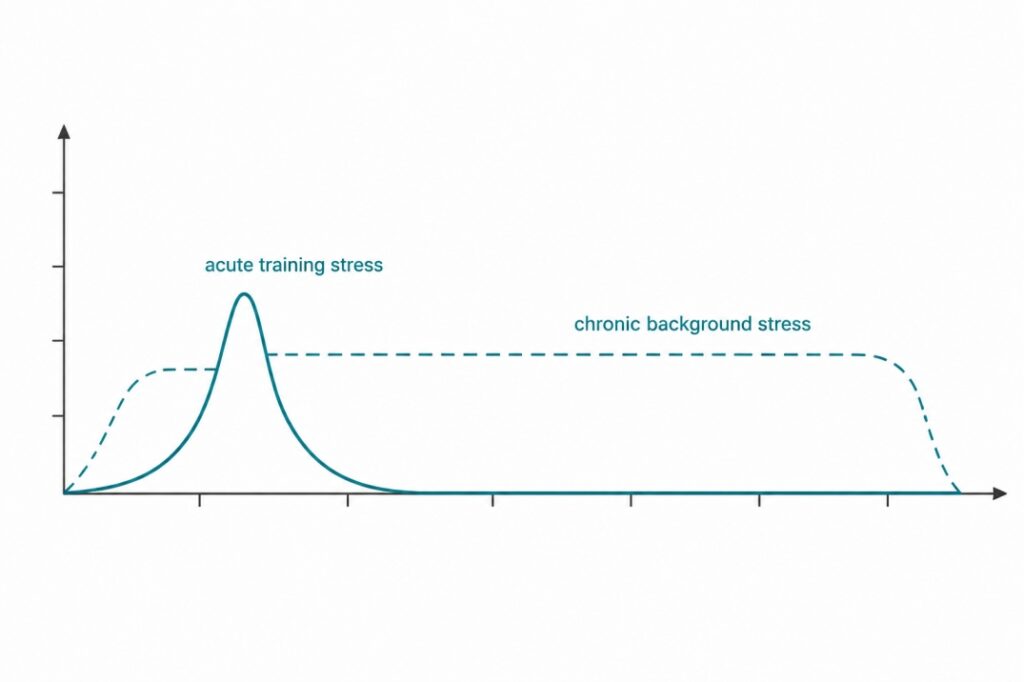
It’s worth being clear that training itself is a stressor, and that’s not a problem. Every session raises cortisol temporarily, which is a normal, useful part of adaptation. What matters is the distinction between that acute training stress, which is followed by planned recovery, and chronic background stress, which stays elevated and compounds with every session stacked on top of it. When both are present at once, the combined load can meaningfully suppress adaptation.
Stress Type
Duration
Cortisol Pattern
Effect on Muscle Growth
Acute training stress
Minutes to hours, tied to a session
Rises during training, falls once recovery begins
Neutral to positive; part of normal adaptation
Chronic background stress
Days to months, ongoing
Stays persistently elevated, including at rest
Negative; suppresses testosterone, IGF-1, and recovery
Training moderately through a genuinely stressful stretch is still usually worth doing. Mayo Clinic’s overview of exercise and stress management notes that regular physical activity helps regulate mood and build resilience against everyday stress, even though a single session produces its own short-term cortisol spike. The practical move during a high-stress period is to dial back volume and intensity, not to skip sessions entirely or push harder to compensate.
Practical Stress Management for Better Muscle Growth
Track stress load, not just training load
A log that only records sets, reps, and weight is missing half the picture. Adding a simple one-to-five daily rating for stress and recovery makes performance dips far easier to interpret. When those numbers run consistently high, that’s the cue to pull training volume back temporarily, not push through it.
Protect the sleep window without exception
Seven to nine hours remains the evidence-backed range for supporting protein synthesis and growth hormone release. Consistent bedtimes often matter more than total hours, because hormonal cycles run on circadian rhythm, and an irregular sleep schedule can suppress growth hormone output even when the tracker says total sleep time looks fine.
Use active recovery as a genuine stress buffer
Low-intensity movement, including walking, light stretching, and breathing exercises, has a measurable effect on the parasympathetic nervous system, lowering cortisol and improving recovery between sessions. Foam rolling belongs in this category too; if you’re not sure whether it earns its place beyond feeling good, FitRoutineLab’s look at foam rolling for beginners breaks down what the research actually supports. Treat these as recovery tools, not extra training, and don’t confuse them with higher-intensity work that adds to the stress load instead of reducing it.
Address psychological stressors directly
This is the part fitness content most often skips, because it extends beyond the gym. Work pressure, relationship strain, financial stress, and sleep deprivation all raise cortisol in ways that directly undercut muscle-building progress. Addressing these through practical changes, conversation, delegation, or better time management isn’t separate from your training goals. It’s part of them.
Adjust nutrition timing during high-stress stretches
Spreading protein evenly across the day becomes especially important when cortisol is elevated. The International Society of Sports Nutrition’s position stand on protein and exercise recommends roughly 0.4 grams of protein per kilogram of bodyweight per meal, spread across three to five meals, as a practical way to keep a positive protein-synthesis environment even when cortisol is working against it.
Supplements such as ashwagandha have some evidence suggesting a modest cortisol-lowering effect, but they belong in the category of minor adjunct, not primary solution. Sleep quality, adequate nutrition, sensible training load, and directly managing psychological stress all carry far more weight than anything sold in a bottle.
Why This Matters More If You’ve Hit a Plateau
If progress has already stalled and the usual culprits (sleep, food, programme design) all check out, stress is worth investigating before touching the training plan itself. FitRoutineLab’s breakdown of why beginners hit a plateau in weight training covers the other common causes side by side with this one, which makes it easier to rule things in or out systematically instead of guessing