How Long Should a Beginner Workout Be? (The Answer Is Simpler Than You Think)
- July 24, 2026
- 1
Two hours in the gym looks impressive on paper. It has almost nothing to do with why beginners actually make progress, or why so many quit inside their
Two hours in the gym looks impressive on paper. It has almost nothing to do with why beginners actually make progress, or why so many quit inside their
Two hours in the gym looks impressive on paper. It has almost nothing to do with why beginners actually make progress, or why so many quit inside their first month, either wrecked from sessions built for someone three years ahead of them, or quietly convinced that finishing in under an hour means they didn’t do enough.
Neither reaction is warranted. Session length isn’t something to guess at; it falls out naturally once you understand what a workout is actually built from, such as exercises, sets and reps, and the rest between them.
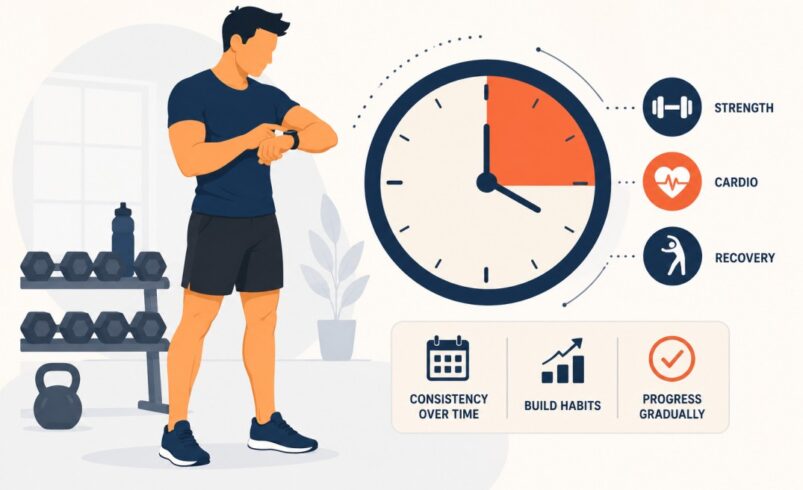
A full beginner workout, warm-up included, typically lands between 30 and 60 minutes. Full-body sessions run with moderate rest periods tend to sit closer to 45 minutes; shorter, focused bodyweight or home sessions can be effective in 25 to 30.
That range isn’t a rounded-off guess. The resistance training guidelines published by the American College of Sports Medicine in 2026 — built from 137 systematic reviews covering more than 30,000 adults, the majority beginners or novice trainees — reinforce a theme that keeps showing up across the research: the priority for a new trainee is consistent participation, not marathon sessions. A program built around a manageable time block you’ll actually repeat outperforms one that looks impressive on paper but collapses after two weeks.

There’s a persistent belief that more time in the gym equals more progress. It doesn’t hold up well against the data. Training volume and muscle growth follow a curve, not a straight line, according to training volume research — gains climb quickly at the start, then flatten out well before the two-hour mark many picture when they imagine a ‘serious’ workout.
Once a session drags past 60 to 90 minutes, fatigue accumulates faster than stimulus does. Form breaks down, rest periods stretch out without anyone noticing, and the final third of a workout often delivers less than the first two-thirds combined. For a beginner training within the beginner rep range that rep range research supports, the actual working time needed to hit an effective number of sets rarely exceeds 45 to 60 minutes once rest is factored in.
Extra time isn’t the same as extra effort. A tightly run 40-minute session with real intensity beats a loosely paced 90-minute one where half the clock disappears into phone breaks and wandering between machines.
Duration isn’t an input to choose first — it’s an output of four other decisions.
| Variable | Typical beginner range | Effect on total time |
| Exercises per session | 5–7 | More exercises add more time even at low sets |
| Sets per exercise | 2–4 | Multiplies total working time directly |
| Rest between sets | 60–90 sec (hypertrophy) | Often the single biggest time factor |
| Training split | Full-body vs. upper/lower | Full-body sessions run longer but happen less often per muscle group |
Run the math on a typical full-body day: six exercises, three sets each, 75 seconds of rest, roughly 40 seconds of actual work per set. That adds up to about 45 minutes before warm-up. Add five to ten minutes to prepare your joints and raise your heart rate, and the total lands squarely in the range the research supports.
This is also why the progressive overload principle matters more for session length than people expect. Add a set here or there over the coming weeks, and a workout stretches by a few minutes at a time. There’s no need to plan for a longer session on day one.
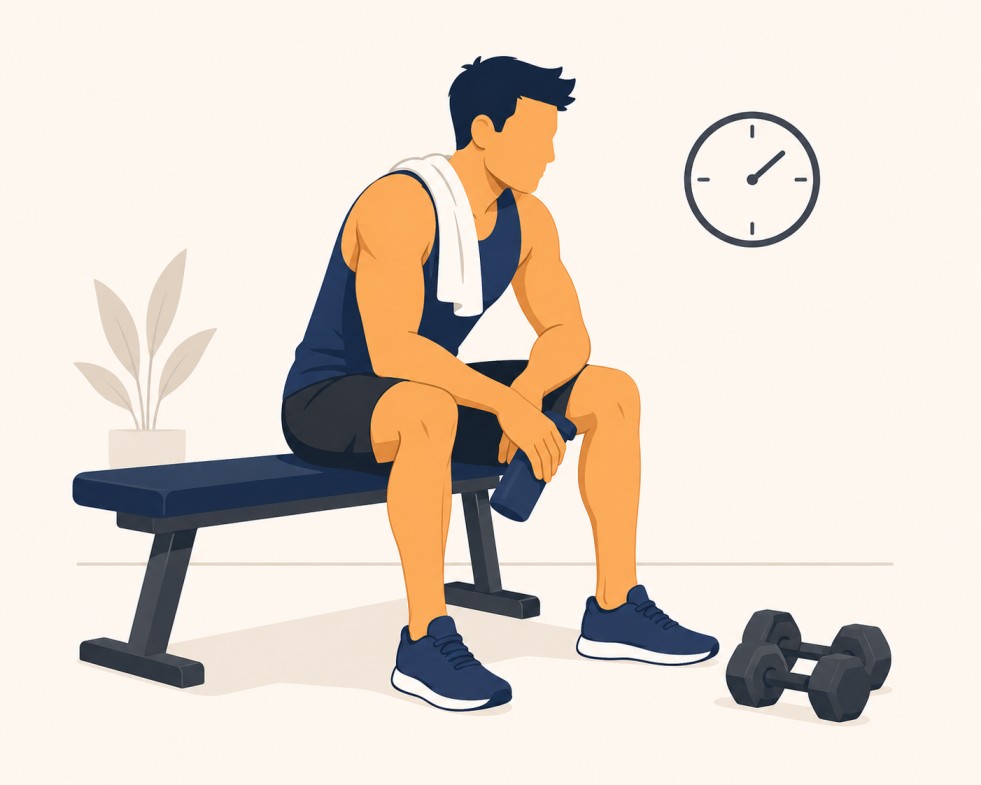
Duration shifts slightly depending on what you’re training for, mainly because rest periods and exercise count change.
Muscle building: 45–60 minutes. Moderate rest (60–90 seconds) between sets, six to eight exercises, working close to but not always at failure.
Strength: 50–75 minutes. Heavier loads need longer rest — two to three minutes per set — even though total sets per exercise stay similar.
General fitness or fat loss: 30–45 minutes. Shorter rest periods and simpler programming keep the session brisk without sacrificing quality, and pairing this with sensible eating matters more for results than extending the session — something the calorie deficit guide covers in more depth.
Home or bodyweight training: often 20–35 minutes, since equipment changes and loading time disappear. A 8-week strength plan can deliver a full stimulus in well under 45 minutes, and a quiet home workout built around controlled holds and slow reps fits comfortably inside that window.
Forty-five minutes isn’t realistic for every schedule, and a shorter session isn’t a compromise when that’s the case — it’s often the better decision. Research on training adherence consistently favors people who show up regularly over people who plan long sessions they skip half the time. A focused 25-minute full-body workout, done three times a week without fail, will out-produce an ambitious 90-minute plan that only happens once.
Supersetting compound movements — pairing a push exercise with a pull exercise and moving between them with minimal rest — is the most reliable way to compress a session without cutting the work that matters. A couple of well-chosen compound vs isolation movements cover more ground per minute than a longer list of single-joint exercises ever will.
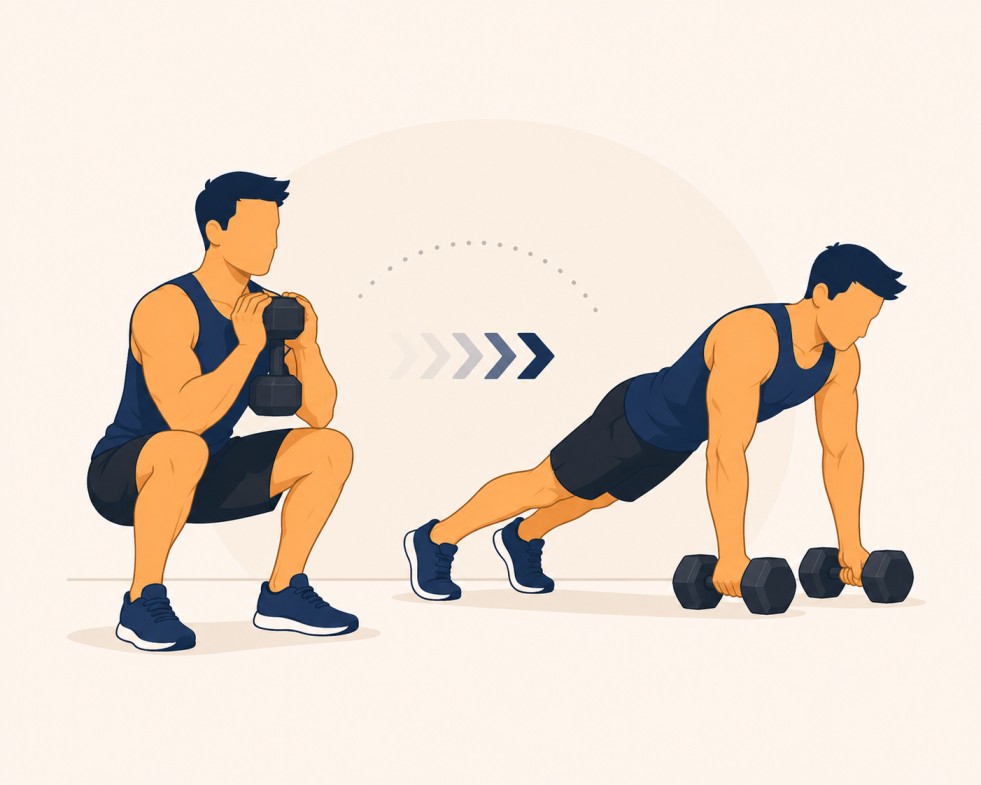
Extra time isn’t automatically wasted time. The first few weeks, spent learning form on new movements, often run long simply because you’re moving slower and resting to think through technique — that’s normal, not inefficient. Leg day, which usually involves the largest muscle groups and needs longer recovery between heavy sets, also tends to run past the average session without that being a problem.
The distinction that matters is whether the extra time produces anything. Practicing a squat pattern for an extra ten minutes is productive. Scrolling a phone for ten minutes between sets is not.
A few signals are worth watching for partway through a workout. If form on the final exercises looks noticeably worse than it did at the start, fatigue has outpaced the ability to train safely. If rest periods keep creeping past what was planned without a deliberate decision to extend them, focus has slipped rather than recovery need actually increasing. And when next-day soreness interferes with the next planned session — worth checking against workout soreness signals — total weekly load, not just single-session length, may need trimming.
None of this means the program has gone wrong. These are simply cues to tighten rest periods, trim an exercise, or call the session complete a few minutes earlier than planned.
Once a session length fits realistically into the week, the more useful question becomes how consistently it can be repeated. Three 45-minute full-body sessions a week, spaced with an active recovery day in between, will move a beginner forward faster than an inconsistent mix of long and skipped workouts ever could.
Timing the first two or three sessions honestly — warm-up to final set — gives a real baseline to work from, rather than a figure borrowed from someone else’s routine. From there, duration can grow the same way training does: gradually, in step with the extra sets and exercises progress actually calls for.
External References:
resistance training guidelines → https://pmc.ncbi.nlm.nih.gov/articles/PMC12965823/ (ACSM 2026 Position Stand)
rep range research → https://pubmed.ncbi.nlm.nih.gov/25932981/ Schoenfeld et al., JSCR)
training volume research → https://www.strongerbyscience.com/research-spotlight-volume-returns/ (Stronger By Science)





1 Comment
[…] changing. Four short gym trips can take longer overall than two longer home sessions. Our guide on how long a beginner workout should be helps you size each […]